
Batch filtration processes a fixed quantity of material at one time, while continuous filtration receives and separates material without regularly stopping the process. The difference may sound simple, but it can significantly affect production capacity, labor requirements, cake moisture, cleaning, automation, and equipment investment.
What Is Batch Filtration?
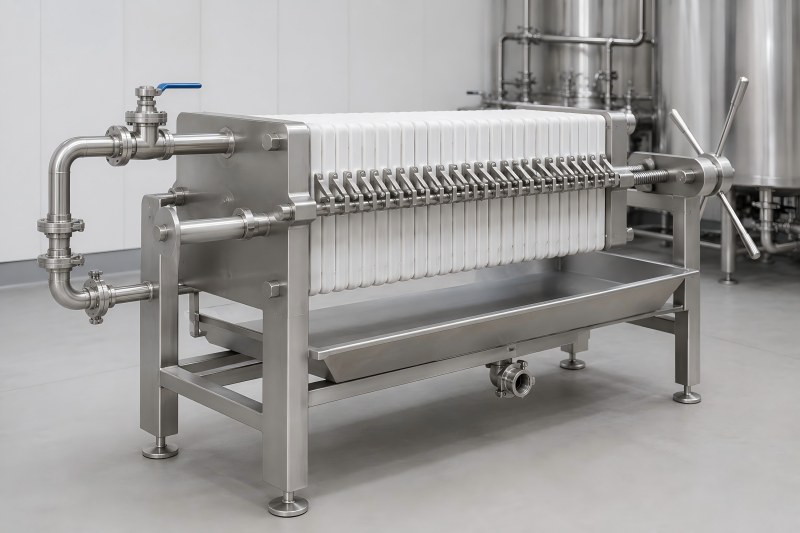
Batch filtration separates a predetermined amount of slurry during each operating cycle.
The filtration equipment is charged with slurry, pressure or vacuum is applied, liquid passes through the filter medium, and solids accumulate as filter cake. Once filtration ends, the filter cake is removed from the machine.
A typical batch filtration process may follow this sequence:
Slurry Feeding → Filtration → Cake Formation → Optional Washing → Dewatering → Cake Discharge → Cleaning → Next Batch
Common batch filtration equipment includes:
- Filter presses
- Plate and frame filters
- Nutsche filters
- Batch pressure filters
- Some vacuum filtration systems
Batch filtration is especially useful when the process requires controlled handling of individual production lots.
What Is Continuous Filtration?
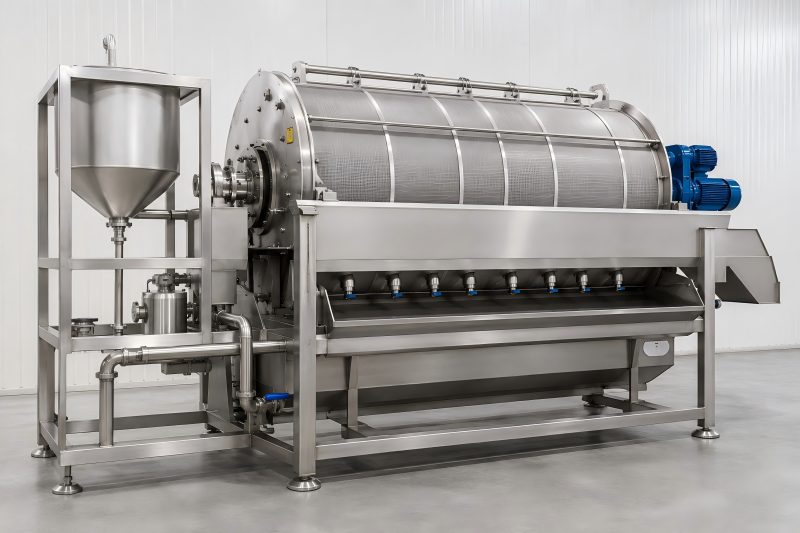
Continuous filtration is designed to receive slurry and discharge separated solids and liquid with minimal interruption.
Instead of processing one fixed volume and stopping after each cycle, material continuously enters the filtration zone while filtrate and filter cake are removed during operation.
A typical continuous filtration process may look like:
Continuous Slurry Feeding → Cake Formation → Washing / Dewatering → Continuous Cake Removal
Common continuous filtration equipment includes:
- Rotary vacuum drum filters
- Belt filters
- Disc filters
- Continuous pressure filters
- Certain centrifuge-based separation systems
Continuous filtration is generally selected for larger production volumes where stable material flow and high throughput are important.
Batch Filtration vs Continuous Filtration at a Glance
| Factor | Batch Filtration | Continuous Filtration |
| Operation | Processes material in separate cycles | Operates with continuous material flow |
| Production Scale | Small to medium | Medium to very large |
| Flexibility | High | Moderate |
| Product Changeover | Relatively easy | More complicated |
| Automation | Can be manual or automatic | Usually highly automated |
| Cake Discharge | At the end of each cycle | During operation |
| Cleaning | Easier between batches | Requires planned cleaning procedures |
| Process Control | Strong batch-by-batch control | Stable continuous control |
| Labor Requirement | Usually higher | Usually lower per unit of output |
| Initial Investment | Often lower | Often higher |
| Best For | Multiple products or variable production | High-volume repetitive production |
The exact performance depends on slurry characteristics, filtration area, pressure, cake resistance, filter media, and equipment configuration.
1. Process Operation Differences
The difference mainly depends on the material flow pattern.
In a batch filter, the machine works according to a repeating cycle. For example, a filter press may first be filled with slurry, then pressurized until the filter cake reaches the required thickness. The cake is discharged before another cycle begins.
Continuous equipment avoids this repeated stop-start sequence.
A rotary vacuum filter, for example, can continuously rotate through filtration, washing, drying, and discharge zones. The system operates continuously with consistent slurry input and utilities.
For factories requiring uninterrupted material handling, continuous filtration can provide a smoother production flow.
2. Production Capacity
Production capacity is often one of the main selection factors.
Batch filtration works well when production is divided into separate lots or when throughput requirements are relatively moderate. Capacity can often be increased by selecting larger filtration areas or installing multiple units.
However, each filtration cycle includes non-productive time such as:
- Filling
- Cake discharge
- Filter opening
- Cleaning
- Closing and restarting
These stages can reduce overall hourly throughput.
Continuous filtration generally provides higher throughput because filtration and cake discharge occur simultaneously.
For example, if a production line generates slurry 24 hours per day, continuous equipment may prevent slurry accumulation between filtration cycles.
3. Process Flexibility
Batch filtration usually provides greater operating flexibility.
The operator can adjust filtration time, pressure, cake washing, drying time, or feed quantity for each batch. This is useful when different products are processed on the same production line.
Batch filtration is therefore common when:
- Formulations change frequently
- Production quantities vary
- Different materials require different filtration conditions
- Product traceability is important
Continuous filtration is more suitable when the raw material remains relatively consistent over long operating periods.
Frequent product changes can make continuous systems less efficient because the equipment may require more extensive cleaning and process stabilization.
4. Filtration Quality and Cake Moisture
Both systems can produce good filtration results, but their performance characteristics are different.
Batch pressure filtration can often achieve high pressure across the filter cake. This can help reduce residual liquid and produce a relatively dry cake.
Some filter presses can also include membrane squeezing, compressed-air blowing, or additional cake drying steps.
Continuous filters usually operate under stable but sometimes lower pressure differences. Cake moisture therefore depends heavily on:
- Slurry particle size
- Cake permeability
- Vacuum or pressure level
- Cake thickness
- Filtration speed
- Dewatering time
The optimal choice depends on specific conditions. If very low cake moisture is required, the filtration technology must be selected according to the material rather than simply choosing batch or continuous operation.
5. Automation and Labor
Batch filtration traditionally requires more operator involvement.
Manual or semi-automatic equipment may require workers to:
- Open the filter
- Remove filter cake
- Clean filter cloth
- Close the equipment
- Restart filtration
Modern automatic filter presses can reduce much of this labor through automatic plate shifting, cloth washing, cake discharge, and control systems.
Continuous filters are normally designed for higher automation from the beginning.
Feed pumps, filter rotation, cake discharge, washing, and process controls can operate continuously with limited operator intervention.
For large-scale production, this can reduce labor per ton of processed material.
6. Cleaning and Product Changeover
Hygiene standards and cleaning needs affect equipment choices.Batch systems have a natural cleaning opportunity between production cycles.
This makes them suitable for processes where:
- Cross-contamination must be minimized
- Several products use the same equipment
- Operators must inspect product-contact surfaces
- Production requires validated cleaning procedures
Continuous equipment can also be cleaned effectively, but the process is usually more complex because larger areas, moving components, belts, drums, or continuous discharge systems may need cleaning.
For single-product high-volume production, this may not be a major disadvantage.
7. Equipment Footprint
Equipment footprint does not depend only on whether filtration is batch or continuous.
A batch filter press may provide a large filtration area within a relatively compact machine structure. However, additional space is required for plate opening, cake discharge, pumps, conveyors, and maintenance.
Continuous filters such as belt filters can require considerably more floor space because the filtration area is arranged horizontally.
Rotary drum and disc filters may offer a more compact alternative for certain large-volume applications.
When planning a filtration system, manufacturers should consider the entire installation rather than only the filter machine dimensions.
8. Initial Investment and Operating Cost
Batch filtration equipment often has a lower initial investment for small or medium production capacities.
It can also be easier to expand gradually by adding additional filtration units.
Continuous filtration systems may require higher investment because they often include:
- Continuous feeding systems
- Variable-speed drives
- Cake discharge mechanisms
- Washing systems
- Automated controls
- Larger supporting systems
However, a continuous filter may achieve lower labor cost and higher production efficiency at large scale.
Therefore, equipment price alone should not determine the selection.
The more useful comparison is usually cost per ton of processed material.
Typical Applications
Different industries may use either filtration method depending on process conditions.
| Application | Batch Filtration May Be Preferred When | Continuous Filtration May Be Preferred When |
| Chemicals | Multiple formulations are produced | One product runs continuously |
| Pharmaceuticals | Batch traceability is required | Large-volume intermediate processing is needed |
| Food Processing | Frequent product changes occur | Large quantities of consistent slurry are processed |
| Pigments | High cake pressure is required | Production volumes are very high |
| Minerals | Production is intermittent | Slurry generation is continuous |
| Wastewater | Sludge volume changes significantly | Sludge production remains relatively stable |
Selection varies according to application needs. Pilot filtration testing is often necessary before final equipment selection.
When Should You Choose Batch Filtration?
Batch filtration is generally suitable when your process requires:
- High production flexibility
- Frequent material changes
- Clear separation between production lots
- High filtration pressure
- Controlled cake washing
- Easy inspection and cleaning
- Small or medium production capacity
It can also be a practical choice for a new plant when future production volume is still uncertain.
When Should You Choose Continuous Filtration?
Continuous filtration is often more suitable when:
- Slurry is generated continuously
- Production operates for long periods
- Throughput is high
- Material properties remain relatively stable
- Automatic cake discharge is important
- Labor reduction is a priority
- Downstream equipment requires continuous feeding
In these conditions, continuous filtration can improve overall production stability.
How to Choose the Right Filter Machine
Choosing between batch and continuous filtration should start with the material rather than the equipment.
Before specifying a filtration system, evaluate:
Slurry concentration
A slurry containing 5% solids behaves very differently from one containing 50% solids.
Particle size
Fine particles may form dense filter cakes with high resistance, while coarse particles are usually easier to separate.
Liquid viscosity
High-viscosity liquids can significantly reduce filtration speed.
Required cake moisture
Some processes only require solid recovery, while others need the driest possible filter cake.
Filtrate clarity
The required liquid quality determines the filter media and filtration method.
Production capacity
Consider required output per hour or per day rather than only batch volume.
Cleaning requirements
Applications in food and pharma demand hygienic construction, corrosion resistance, and efficient cleaning.
Material characteristics
Corrosive, toxic, flammable, or temperature-sensitive materials may require specialized equipment configurations.
A Practical Example
Consider a chemical plant producing 20 different specialty products during a month.
Each product has different slurry characteristics, and production batches range from 500 kg to several tons.
A batch filter press may be the better choice because operators can adjust filtration conditions for each product and clean the system between batches.
Now consider a mineral processing plant producing the same slurry continuously at several tons per hour.
Stopping filtration after every cycle could create upstream material accumulation. A continuous belt or rotary filtration system may therefore provide more stable plant operation.
This confirms that filtration success depends on both equipment and process.
Can Batch and Continuous Filtration Be Used Together?
Yes.
Large processing plants sometimes use both systems.
A continuous filter may perform the main high-volume solid-liquid separation stage, while a batch filter is used for:
- Final polishing
- Product recovery
- Smaller production streams
- Specialty formulations
- Waste treatment
- Process testing
Using different filtration technologies at different stages can sometimes provide better overall process efficiency than relying on a single filtration method.
With accurate process information, the filtration system can be configured around the actual production conditions rather than simply selecting a machine based on capacity alone.