
A liquid bag filter system may need more filtration area when the required flow produces excessive clean resistance, useful runs become too short under stable feed conditions, or maintenance repeatedly prevents the line from meeting its production schedule. None of those observations proves that area is the only problem. A blocked basket, unsuitable medium, colder liquid, or changing contamination load can produce similar symptoms.
The useful distinction is between a system that has too little effective area for its duty and a system whose existing area is not being used properly. Before expanding a housing or adding another branch, collect a matched record of flow, temperature, differential pressure, feed condition, filtrate quality, and processed quantity. The seven signs below become much more informative when read together.
1. Clean bags start with too much differential pressure
A fresh bag should establish a repeatable baseline after correct installation, filling, venting, and stabilization. If the baseline is high at the required flow, the system may be asking too much of the available area. There is then limited pressure allowance left for the solids that accumulate during production.
Compare the reading with data for the actual medium and liquid conditions. A water curve does not automatically represent an oil, concentrated product, or cold formulation. Record actual flow; a pump speed setting is not a substitute for a flow measurement.
Check what the pressure measurement includes. Valves, narrow connections, and piping between the pressure taps contribute to the result. If those components dominate the loss, adding bag area will not remove the main restriction. Establish whether the high reading belongs to the element or to the installation as a whole.
Inspect the basket and bag seating during a properly isolated shutdown. A folded bag or obstructed support can make the effective area smaller than the nominal area. Restoring the intended arrangement may be enough to recover the expected baseline without increasing equipment size.
2. Runs shorten even though feed quality and operating conditions are stable
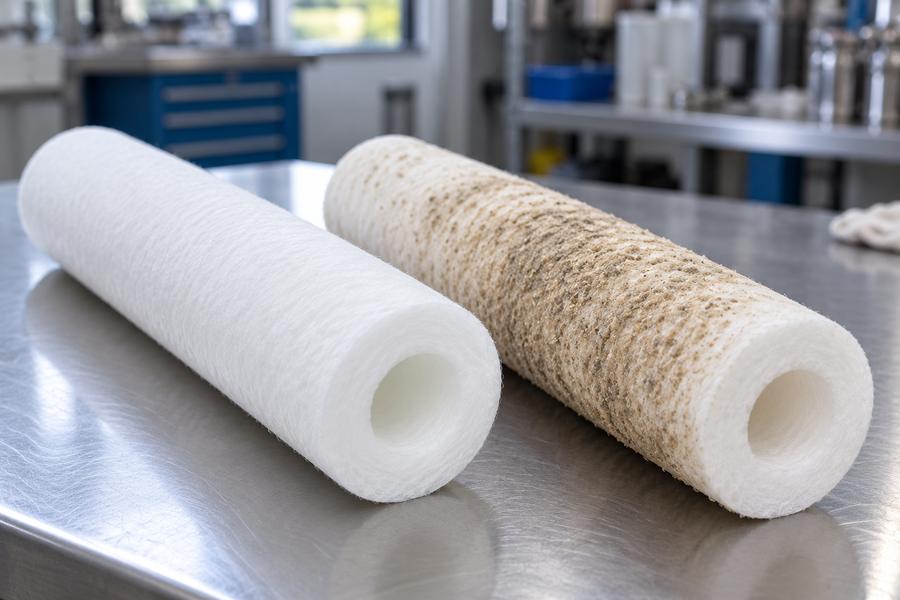
If the liquid, contamination, flow, and temperature remain comparable, a consistently short interval to the approved replacement point can indicate insufficient capacity in the available area. Record processed volume or mass as well as elapsed time so that the comparison reflects the amount of work performed.
Verify that feed quality is genuinely stable. A tank may appear unchanged while settled material is being drawn into the line, or a raw material change may introduce more fines. Use representative samples and production records to test that assumption.
Inspect spent bags for the character and distribution of the deposit. Uniform loading can support a capacity investigation. A deposit concentrated in one region may instead point to distribution, installation, or a local obstruction. Soft gels can blind a medium differently from rigid particles, so total solids alone may not explain the behavior.
More area may extend the practical run, but the improvement should be demonstrated with the relevant feed. Do not assume that doubling nominal area always doubles service life. Deposit formation, flow distribution, and the way the process controls flow can alter the relationship.
3. The filter cannot complete the intended batch
A bag filter may reach the required flow at startup yet require a change before the batch is finished. If this happens repeatedly under representative conditions, the installed duty and the batch requirement are poorly matched. More effective area is one possible correction.
Record why the batch stops. A differential pressure limit, a quality limit, and an arbitrary shift boundary are different events. If the element fails a quality requirement before it reaches a loading limit, investigate retention and sealing rather than treating the problem only as lack of area.
Compare the remaining batch quantity when replacement becomes necessary. A small but recurring shortfall may justify a focused capacity adjustment, while a large shortfall may call for a different media or pretreatment strategy. Evaluate several batches covering the normal variation in feed and operating conditions before deciding how much additional area is needed.
Include the loss associated with the extra changeout: retained product, startup diversion, and the interruption to the rest of the line. Those operating effects help define the practical target. The goal may be reliable completion of one batch, not the longest theoretically possible element life.
4. Cold starts restrict output despite correct operation
When a liquid becomes more viscous at lower temperature, a system that works comfortably during warm operation may struggle at startup. If the cold condition is part of normal production, the filter needs to be assessed for that condition rather than judged only after the line warms up.
Record temperature, flow, and differential pressure through the startup period. If flow is being reduced by the control system, note that as well. A falling differential can result from lower flow and does not by itself show that the liquid has become easier to filter.
More area may reduce the duty per unit area at the cold condition, but first check whether the fluid behavior and equipment data support that conclusion. Non-Newtonian formulations and temperature-dependent deposits may require a specific trial.
Heating is not a universal alternative. Product quality, process requirements, seals, and equipment limits may restrict temperature changes. Any revised operating method needs to be approved for the actual liquid. Size the filtration arrangement around the conditions the plant intends to use, not an assumed warmer condition that production cannot maintain.
5. Existing bags load unevenly and the system has little usable margin
In a multi-bag or parallel installation, nominal area can be misleading if flow is poorly distributed. Some bags may carry a disproportionate share of the duty while others remain lightly used. The heavily loaded portion then determines the operating interval.
Compare spent elements from different positions and record where each was installed. Check that they are the same approved specification and correctly seated. Differences in media, support condition, or installation can create an apparent distribution problem.
Where practical, assess branch flow and differential pressure. A common header does not guarantee equal flow through branches with different resistance. A fresh branch can take more flow than a loaded one, and the distribution may change as the run progresses.
This sign calls for restoring effective use of the existing area before buying more. Review manifolds, connections, valves, and internal distribution with the supplier. If the distribution is satisfactory but all available elements still reach the operating limit too soon, expansion becomes a stronger candidate.
Review the actual single-bag or multi-bag housing arrangement rather than counting bags alone. The useful capacity depends on how liquid reaches and leaves those elements and on which parts remain available during maintenance.
6. Changeouts consume too much of the production window
Frequent bag changes can become a production constraint even when each change is performed correctly. Measure the complete interruption from stopping the affected duty to releasing acceptable production again. Include drainage, inspection, filling, venting, and quality checks.
If short runs are caused by ordinary loading at the required duty, more area may reduce the number of interruptions. Compare the resulting improvement per batch or operating period. A slightly longer run can be valuable if it moves a changeout into a planned pause.
Check whether the existing procedure adds avoidable delay. Missing parts, poor access, an awkward drain route, or an unclear restart sequence can extend downtime independently of area. Fixing those issues may improve output without changing the filtration equipment.
For continuous processes, additional area and redundancy are separate decisions. Two branches sharing the duty may provide more area while both are operating, but one remaining branch may still be unable to carry the full requirement during maintenance. Define the one-path duty if uninterrupted production is part of the objective.
7. Planned throughput exceeds the duty that was actually demonstrated
A production increase is a reason to reassess filtration before problems appear. Review the conditions under which the present system was selected and tested. A larger batch or higher flow may increase both the instantaneous hydraulic duty and the total contaminant presented during a run.
Distinguish increased daily output from increased instantaneous flow. More operating hours at the same rate may primarily change replacement frequency and staffing. A higher rate through the same area can change clean resistance and loading behavior as well.
Use a controlled trial at the proposed conditions when possible. Record quality and pressure through a representative processed quantity, and keep stopping criteria within the approved limits. A short test that reaches the new flow does not establish full-batch capacity.
Check the rest of the line. Pumps, connections, valves, downstream equipment, recovery vessels, and maintenance access may also limit the expansion. More bag area should be part of a coordinated process assessment rather than the only change made in response to a new output target.
Confirm the diagnosis before choosing an expansion
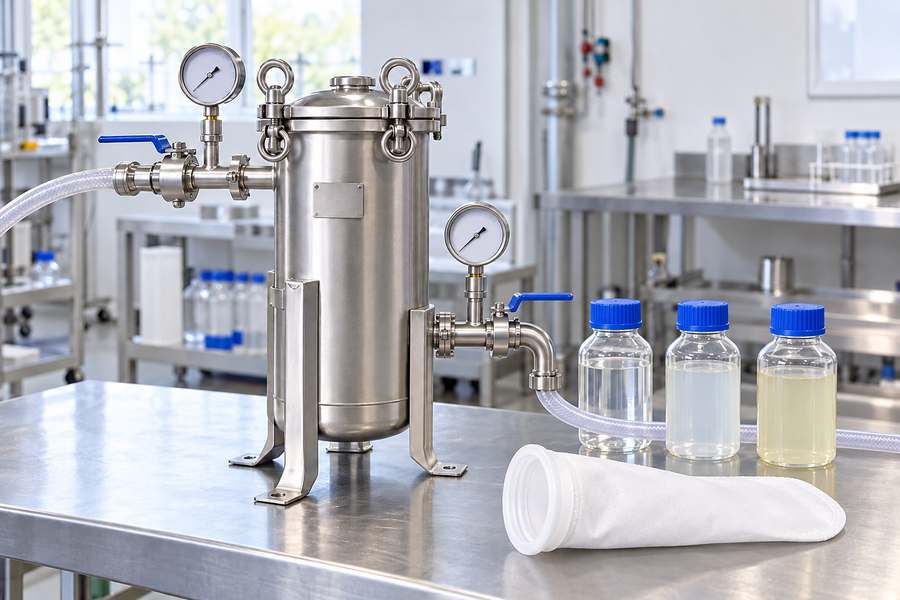
Build a comparison using the same liquid, temperature range, retention requirement, and representative feed. First verify instruments and inspect the installed components. Then test the candidate change under controlled conditions. Preserve the old baseline so that an improvement can be measured rather than recalled from memory.
A change in filter bag media or construction may improve loading behavior without changing the vessel. It may also increase clean resistance or alter the retained liquid. Evaluate the whole run and the quality result, not only the initial pressure reading.
A larger housing, a multi-bag arrangement, a parallel branch, or a compatible higher-area element can each change the available area. They also differ in hold-up, connections, maintenance, and fit. Confirm compatibility and performance for the proposed assembly rather than assuming the options are interchangeable.
A prefilter is another possibility when a distinct coarse fraction is consuming capacity. That is a staging decision, not simply an area increase. It adds its own resistance and maintenance task, so specify what it will remove and how its benefit will be verified.
Use a short diagnostic comparison
| Observation | Check before expanding area |
| High clean differential | Actual flow, viscosity, media specification, basket cleanliness, and connection losses |
| Rapid pressure rise after a normal start | Feed contamination, gels, process changes, and useful processed quantity |
| Poor quality at low differential | Seal fit, media damage, bypass, and retention suitability |
| Unequal loading | Element consistency, installation, and flow distribution |
| Too much production downtime | Run length, maintenance access, spare parts, and complete restart duration |
Document what the proposed expansion is expected to achieve. Suitable targets include completing a defined batch, maintaining flow during a cold start, or reducing changes over a representative production period. Keep the target tied to accepted output and a specific operating envelope.
As a simple illustration, if a verified effective area of one square meter handles ten cubic meters per hour, the flow per area is ten cubic meters per hour per square meter. Adding an equally effective parallel area while keeping total flow unchanged would halve that calculated loading only if the flow divides as intended. This arithmetic describes the planned duty; it does not predict service life or prove retention performance. Use the supplier’s definition of effective area and confirm the installed distribution. The distinction is especially important when comparing flat bags with other constructions whose quoted media area may not be used in the same way.
Verify the new arrangement after installation
Establish a new clean baseline and compare it at matched flow and temperature. Monitor the pressure trend, downstream quality, processed quantity, and the reason each run ends. If the system has multiple paths, confirm how the duty is distributed and what happens during maintenance.
Measure product retention and recovery too. A larger assembly can reduce replacement frequency while increasing the liquid held at each stop. The net result depends on both quantities, so keep them in the acceptance record.
Update the replacement specification, operating limits, and maintenance procedure. Operators need to know what normal behavior looks like in the revised system. Retaining old settings without reviewing the new arrangement can hide the improvement or create new uncertainty.
More area is justified when it solves a demonstrated limitation under the conditions production actually needs. The strongest evidence is a combination of high duty per effective area, repeatable short runs, and an improvement in a controlled comparison. Treat the seven signs as prompts for that investigation, not as an automatic instruction to buy a larger vessel.