
A changing particle distribution does not produce a universal winner between melt blown and string wound filter cartridges. Both are depth filtration formats, and both can be suitable for a feed containing coarse and fine particles. The better choice is the specific cartridge that maintains the required outlet quality through the expected loading, flow, temperature, and startup conditions.
That distinction matters when purchasing replacements. Two cartridges marked with the same micron number can differ in retention efficiency, usable capacity, construction, and resistance. Treat a replacement as equivalent only after its documented filtration performance and mechanical fit have been checked against the approved element. Start with what changes in the liquid, then compare evidence for the proposed elements.
Define what “variable particle sizes” means in your process
A feed can vary in several ways. It may contain a broad distribution at all times, with large fragments and much finer solids arriving together. Alternatively, most batches may be clean until a tank is disturbed and a short burst of sediment enters the line. A third case is a raw material change that shifts the fine fraction while leaving the liquid visually similar.
These situations place different demands on the cartridge. A broad distribution tests how effectively the media uses its depth. A sudden solids surge tests available capacity and the response of the operating procedure. A change toward smaller particles tests the relevant part of the retention curve, which may not be obvious from differential pressure.
Record whether particle shape and behaviour change as well. Rigid mineral particles, soft agglomerates, fibres, and deformable gels do not necessarily respond alike to the same filter. A test using a convenient standard dust can help compare products, but it cannot settle every question about a real process liquid.
The objective also needs definition. Protecting a pump from coarse sediment differs from controlling visible defects in a coating or protecting a downstream membrane. Identify the particle sizes and concentrations that matter to the next operation, rather than asking the cartridge to remove everything indiscriminately.
Understand the construction without treating it as a performance guarantee
Melt blown cartridges are formed from fine polymer fibres collected into a porous structure. Many industrial products use polypropylene, although other polymers exist. String wound cartridges use yarn wound around a core; the yarn, core, winding pattern, and manufacturing control all contribute to the finished element.
Graded structures are available in both categories. The general aim is to let some larger material accumulate in more open regions while finer material is retained further into the media. Whether a particular cartridge achieves useful depth loading depends on its design and the incoming contaminants.
Manufacturers also offer bonded constructions and other features intended to control media stability. Those features belong to the specified product, not automatically to every cartridge described by the same manufacturing term. Ask for the exact construction and qualification data rather than assuming all melt blown elements have a fixed structure or all wound elements behave identically.
For an initial product review, compare the options in the liquid filter cartridge range. Then narrow the discussion to the actual media material, rating definition, dimensions, and operating limits needed for the application.
Read the micron rating together with its efficiency
A micron number without a retention efficiency and test method leaves an important part of the specification unanswered. Nominal ratings can use different conventions. An absolute claim also needs its stated basis, including the particle size, efficiency, test conditions, and whether the result applies throughout the intended service conditions.
For example, imagine two candidate cartridges carrying a nominal five-micron label. One could allow substantially more particles near that size to pass than the other. This is a hypothetical comparison, not a statement about any named product. It explains why matching labels alone can produce disappointing results after a supplier change.
Request a retention curve or suitable efficiency data around the particle sizes relevant to the process. If a supplier provides a beta ratio, confirm the size to which it applies and the counting method. A ratio is useful only when the underlying challenge and measurement conditions are understood.
Also ask whether the data represent a clean element, a loading test, or another defined condition. Real cartridges change as retained solids accumulate. Some develop a more effective deposit layer; others may experience unwanted passage under particular operating conditions. Outlet measurements during the trial establish what actually happens in your duty.
Compare usable capacity, not the amount of dirt a cartridge can hold
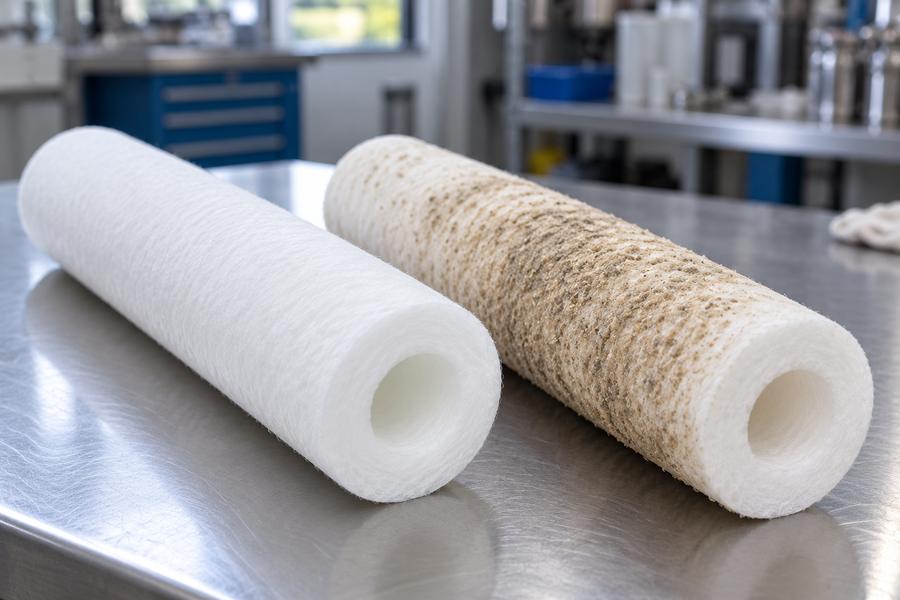
The useful endpoint is the volume of acceptable liquid produced before replacement is required. A cartridge can contain a large mass of retained solids and still be unsuitable if the outlet fails its quality limit early. Conversely, a relatively light element may serve well when the feed is clean and the purpose is final protection.
Define the trial endpoint before testing. It may be a differential pressure limit, an outlet particle limit, a batch completion requirement, or a scheduled hygiene interval. The earliest applicable limit determines service life. Comparing elements against different endpoints makes the result difficult to interpret.
Use representative feed conditions and record the accepted volume. If a wound cartridge is tested on a clean day and a melt blown cartridge receives a tank-bottom surge, elapsed service hours alone are a poor comparison. Repeat the trial across the meaningful range of feed conditions where practical.
Inspect used elements after safe removal. A deposit concentrated on the outside may indicate that the incoming load is dominated by particles stopped near the surface. Uneven loading can suggest distribution or installation problems. Visual inspection helps generate explanations, but it does not replace measured filtrate quality.
Check pressure behaviour at the real viscosity and flow
A clean pressure-drop curve is only useful when its test conditions are known. Water at one temperature may behave very differently from a viscous process liquid or colder water at the same volumetric flow. Ask the supplier to relate the published curve to the intended operating envelope.
Both candidate cartridges must fit within the pressure allowance for the complete line. Account for the housing and piping as well as the media. A very restrictive element can reduce production before it accumulates much contamination, making its theoretical dirt capacity irrelevant to the batch.
Do not increase pump pressure merely to extend a run without checking the cartridge, core, seals, housing, and process limits. The permitted differential pressure can depend on temperature and construction. The lowest applicable limit governs the installation.
Where the process cycles frequently, include starts and flow changes in the trial. An element that performs well under steady laboratory conditions may need additional evaluation when the plant repeatedly stops, restarts, or changes flow. Measure outlet quality during those transitions rather than assuming the steady-state result covers them.
Choose materials for the whole service sequence
Cartridge compatibility includes more than the normal product. List the cleaning liquid, rinse water, sanitizing conditions, and any abnormal exposure that the element is expected to experience. The media, core, end components, adhesive if present, and seals must all suit the intended service.
For string wound products, distinguish the yarn from the core material. A familiar outer fibre does not establish that the internal support is suitable for the same chemistry or temperature. For melt blown products, obtain the polymer and construction details rather than assuming the visible white material proves a particular composition.
Where purity matters, ask about extractables, fibre release, and any required pre-rinse. These are product-specific questions. Neither manufacturing category should be declared universally free of shedding or extractables without evidence for the selected grade and application.
Food, pharmaceutical, and other regulated applications may require supporting documentation beyond general compatibility information. Identify the relevant documentation with the site’s quality team. A broad claim that a cartridge material is commonly used in an industry is not a substitute for qualification of the supplied product.
Do not overlook the cartridge-to-housing seal
Particles can pass around an incorrectly fitted cartridge even when the media itself is appropriate. Check overall length, end configuration, bore dimensions, sealing surfaces, and the required compression or engagement. Similar-looking elements are not always mechanically interchangeable.
Inspect the housing internals during the trial. A missing adapter, damaged knife edge, displaced gasket, or incorrectly seated element can produce poor filtrate with little warning from differential pressure. Before rejecting a media type, establish that the installation actually forces the liquid through it.
A multi-cartridge vessel adds distribution and consistency questions. Use the approved element configuration throughout the vessel unless a mixed arrangement has been intentionally designed and validated. One incorrectly fitted element can compromise the combined outlet even if the rest perform well.
When specifying a stainless steel cartridge filter housing, check how each element is seated, supported, and sealed within the vessel. The cartridge and vessel should be specified as a working assembly, with clear replacement instructions for operators.
A practical comparison trial
Prepare two qualified candidates with documented specifications. Use the same housing where compatible, or equivalent validated test assemblies. Keep the liquid source, sampling method, flow target, and endpoint consistent. Record unavoidable differences so they do not disappear into an overall average.
- Baseline: Record feed condition, temperature, flow, and clean differential pressure after the approved flushing procedure.
- Normal loading: Track accepted volume, pressure change, and outlet quality at defined intervals.
- Feed variation: Include representative changes in the coarse and fine fractions without exceeding the approved process envelope.
- Transitions: Examine startup and routine flow changes for any outlet-quality disturbance.
- Endpoint: Stop at the first applicable replacement criterion and record its cause.
- Inspection: Check the removed cartridge, seals, and housing for evidence that explains the measurements.
Sample handling deserves attention. Use clean containers and a consistent collection procedure. A contaminated bottle can make a good filter look poor, while a settled sample can underrepresent the incoming solids. Agree with the laboratory on mixing, transport, and analysis before the first run.
Keep the comparison tied to production. Record rejected startup liquid, flushing requirements, operator time, and changeout losses alongside element consumption. A longer run is useful only if it produces the required quality and fits the operating schedule.
Use the failure pattern to choose the next change
| Trial observation | Likely question to investigate | Useful next step |
| High resistance immediately after startup | Is the grade or available area unsuitable for the viscosity and flow? | Review clean-flow data and assembly sizing |
| Rapid loading after coarse solids enter | Would upstream removal protect the final cartridge? | Test a suitable preliminary separation step |
| Fine particles pass with modest pressure loss | Is retention adequate, and is the element sealed correctly? | Inspect fit and compare efficiency data |
| Quality changes during restart | Are transitions affecting retention or installation integrity? | Evaluate the complete startup procedure |
| Large differences between nominally identical runs | Is feed variation or product consistency driving the result? | Trace batches, elements, and sampling conditions |
Keep a retained sample and a clear replacement record
Before standardizing the selection, retain an unused sample from the evaluated supply and keep its batch identification with the trial record. Record the packaging description and the supplier specification revision. These details make later investigations more useful if a replacement shipment looks different or service life changes unexpectedly.
Ask operators to note the reason for each routine changeout rather than recording only the date. A pressure-limited run, a quality-limited run, and a scheduled batch-end replacement are different outcomes. Grouping them together can conceal whether a cartridge is handling particle variation well or simply being replaced before its useful capacity is tested.
When a different arrangement matters more than a different cartridge
If both candidates fail quickly after the same solids surge, switching manufacturing type may not solve the underlying load. More effective area, an upstream separation step, or better control of tank sediment may be more useful. Investigate the source of the problem before tightening the final grade.
If both meet quality but one gives more consistent accepted volume across representative batches, that consistency may be the deciding benefit. Set a purchasing specification that preserves the demonstrated construction, rating basis, and fit. A generic substitution based only on length and micron number could lose the result established in the trial.
The final recommendation should name a qualified cartridge and its operating conditions, not simply “melt blown” or “string wound.” Record the evidence, replacement trigger, and conditions that would require reassessment. That gives production and purchasing a common basis for handling the next change in the feed.