
A filter bag is suitable for food contact when all wetted components meet applicable food-contact requirements and supporting evidence covers the intended operating conditions. A polymer name alone cannot establish compliance.
Buyers must evaluate material formulations, manufacturing controls, food composition, contact duration, temperature, and cleaning procedures. The evidence must cover the assembled bag under the plant’s actual exposure conditions.
What Does Food-Contact Suitability Mean for a Filter Bag?
During filtration, liquid food contacts the media, seams, collar, and other wetted surfaces. Certain substances from the material may migrate into the product, depending on its formulation and exposure conditions.
Filtration performance addresses a different requirement. Particle retention, permeability, flow rate, and mechanical strength describe how a bag performs during operation, but they do not establish chemical safety.
Food-contact regulations vary by destination market and material category. In the United States, applicable FDA requirements govern substances used in food-contact applications, including permitted conditions of use.
FDA public guidance distinguishes between authorized substances and their permitted uses. An authorization for a particular substance does not automatically cover every formulation, finished product, or processing condition.
Some food-contact notifications are also specific to particular suppliers, substances, and intended uses. Buyers should not interpret a general FDA reference as proof that an entire filter bag is approved.
Compliance depends on the applicable rules, actual formulation, and foreseeable conditions of use. A supplier’s declaration should identify the relevant market and explain the scope of its supporting evidence.
Which Filter Bag Materials Are Suitable for Food Contact?
Material selection is the first step. Buyers can review available liquid filter bag materials and assess their suitability alongside the filtration system, including compatible filter housings.
However, neither polymer is automatically suitable for food contact in every formulation. Resin grades, additives, pigments, processing aids, and manufacturing residues can influence the finished material’s compliance status.
For example, resistance to a particular liquid does not necessarily establish acceptable migration behavior. Material compatibility and food-contact compliance must be assessed independently.
The chemical composition of the food influences material selection. Water-based products, acidic beverages, fatty liquids, and alcoholic products can create different compatibility and migration considerations.
How Do Filter Bag Construction and Manufacturing Affect Food Safety?
The finished bag contains more than its main filter fabric. Seams, thread, welded joints, support components, and other wetted parts can introduce additional materials into the food-contact system.
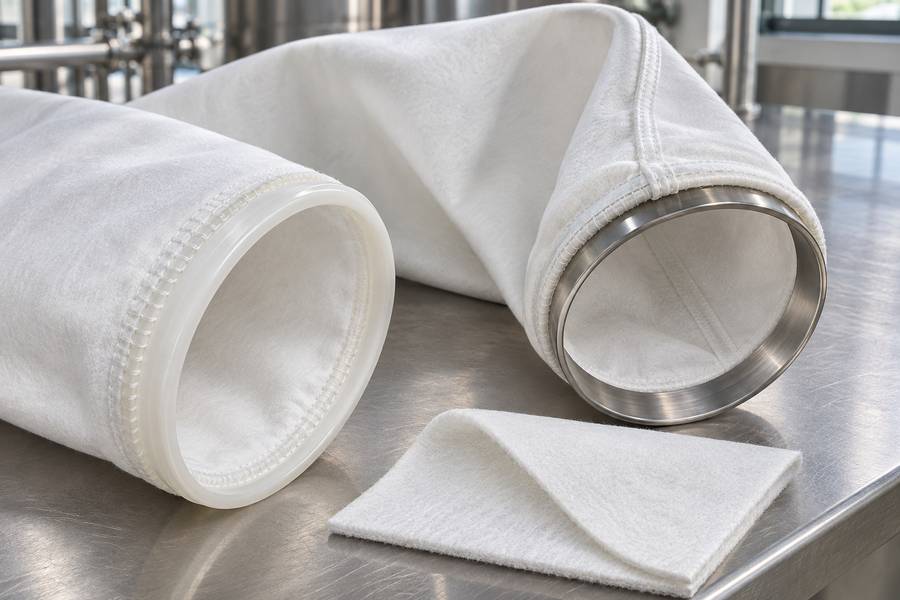
Sewn bags use thread to join fabric sections. Buyers should examine thread composition, seam integrity, exposed edges, and the possibility of loose fibers entering the filtered liquid.
Welded bags join compatible thermoplastic materials through heat or another suitable bonding process. This construction can avoid sewing thread, but the welding process must produce consistent, secure joints.
Documentation for the main filter fabric does not necessarily cover the thread or welded areas. Buyers should verify that all components exposed to the food are included in the compliance assessment.
Fiber release can occur when filter media are damaged, poorly finished, or subjected to unsuitable operating conditions. Loose fibers may then enter the filtered liquid and create downstream quality problems.
Surface condition deserves attention during sample inspection. Buyers should examine fabric edges, cut sections, seams, and the inside of the finished bag for visible loose material or manufacturing debris.
However, a visually clean filter bag is not automatically free from particulate contamination. Where fiber release is critical, buyers should establish appropriate inspection or testing methods for the application.
Packaging should protect the finished filter bag from dust, moisture, handling residues, and other environmental contaminants during transportation and storage.
Connecting Food-Contact Evidence to the Bag Being Purchased
A food-contact declaration should identify the applicable regulatory framework and explain which product or material it covers. Buyers need to establish whether the declaration applies to the finished bag or only its filter fabric.
Buyers should also check the intended food categories, temperature range, contact duration, and other restrictions. A declaration covering one application should not automatically be extended to another.
Migration testing evaluates whether substances transfer from food-contact materials into food or appropriate food simulants under defined conditions. Testing requirements depend on the applicable regulatory framework and material category.
Read the laboratory method beside the production specification. Check which sample was tested, how it was prepared, which food simulant was used, and the exposure time and temperature.
These details determine whether the evidence represents the intended application.
A test report for raw fabric may not represent the complete finished bag. Sewing thread, welding materials, coatings, and other wetted components may require separate supporting evidence.
Change-control procedures are equally important. Changes to polymer grades, additives, thread, manufacturing processes, or suppliers may affect the original compliance assessment and should be communicated.
| Purchase detail | Evidence to request |
| Exact bag code | A declaration identifying the finished construction and covered components |
| Food and exposure | Defined food categories, contact duration, and temperature conditions |
| Ring, thread, and additives | Coverage of their formulations, rather than fabric-only documentation |
| Repeated use | Supported cleaning conditions and an agreed replacement schedule |
| Supply consistency | Lot identification and notification before material or process changes |
Give each approved bag a purchasing code tied to its complete construction. A change from a metal ring to a plastic collar should trigger document review, even if the fabric stays unchanged.
Keep the declaration, relevant test summary, drawing, and approved sample together. Receiving staff need a practical way to compare each delivery with the version that technical and quality teams accepted.
A supplier may protect detailed formulations as confidential information. Ask for sufficient compliance confirmation and restricted-substance information through the appropriate review process, rather than assuming a public datasheet contains everything.
Which Operating Conditions Affect Filter Bag Suitability?
Temperature and contact duration influence both material performance and migration behavior. A material suitable for short exposure at moderate temperatures may require additional assessment under prolonged or elevated-temperature conditions.
A polymer’s general temperature resistance should not be confused with its verified food-contact suitability. Both requirements must be satisfied independently.
Pressure differential affects the mechanical loading applied to a filter bag. Excessive loading can deform the media, stress seams, or damage the bag during operation.
Single-use and reusable filter bags have different service requirements. A bag intended for repeated use must maintain acceptable material properties and structural integrity throughout its specified cleaning cycle.
Cleaning agents, hot water, and sanitation procedures can affect polymer compatibility and seam durability. Buyers should verify that these exposures fall within the documented conditions of use.
Repeated cleaning may also leave residues if procedures are unsuitable. The cleaning process should therefore address both material compatibility and the prevention of unwanted substances entering subsequent production batches.
Include idle periods in the exposure description. A bag left filled overnight may contact the food much longer than the recorded pumping time suggests, especially during interrupted batch production.
List the cleaning and sanitation steps separately from normal filtration. The highest temperature or strongest chemical exposure may occur between batches rather than while product is flowing.
Do not assume that a mesh bag can be reused because it looks washable. Confirm the intended service life and an effective cleaning procedure for that exact construction.
Set rejection rules for torn seams, distorted collars, persistent residue, or unidentified bags. Removing an uncertain item from service is more useful than relying on appearance alone.
How Should Buyers Verify a Food-Contact Filter Bag Before Production?
Sample evaluation should begin with document verification. Confirm that the material identification, construction details, and compliance evidence correspond to the exact sample and proposed production specification.
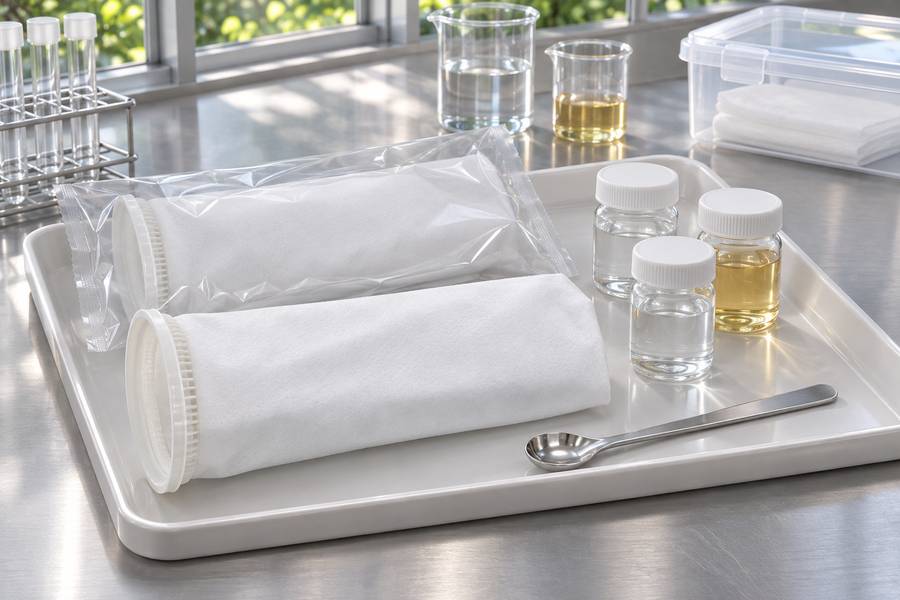
Next, inspect the bag’s surface, seams, edges, dimensions, and packaging. Look for visible loose fibers, damaged areas, inconsistent welding, or other manufacturing defects that could affect service performance.
An application-specific trial can then assess filtration behavior under representative process conditions. Relevant observations include flow rate, pressure differential, particle retention, bag deformation, and structural integrity.
Keep the results of filtration trials separate from food-contact compliance evidence. A bag that performs well during a production trial still requires appropriate regulatory documentation for its intended use.
Unusual odor or discoloration may indicate material incompatibility, processing residues, cleaning-agent carryover, or changes in the process liquid. Review the relevant material and cleaning documentation before changing filter specifications.
Check trial samples after the planned operating exposure, not only before installation. Record their lot codes and retain the inspection findings so the approved trial can be traced to subsequent deliveries.
Keep an agreed reference sample where storage conditions preserve its condition. It can help identify a changed seam, collar, or surface finish when a later shipment differs.
For a new purchasing project, provide Zonel Filtech with the process liquid description, destination market, operating temperature, contact duration, cleaning method, and filtration requirements.
Request a sample and product-specific compliance documentation for review before approving bulk production. Confirm that the proposed bag’s complete wetted construction matches the documented specification, then define acceptance criteria for the production trial.