
In pharmaceutical manufacturing, purity, sterility, and product consistency are not just regulatory objectives — they are imperatives for patient safety. Filtration plays a critical role across multiple unit operations, from raw material preparation to final product clarification. Among the wide range of filtration technologies used in pharmaceutical processes, candle filter housings are often selected for applications requiring high throughput, effective solids removal, and robust validation capability.
Introduction to Candle Filters
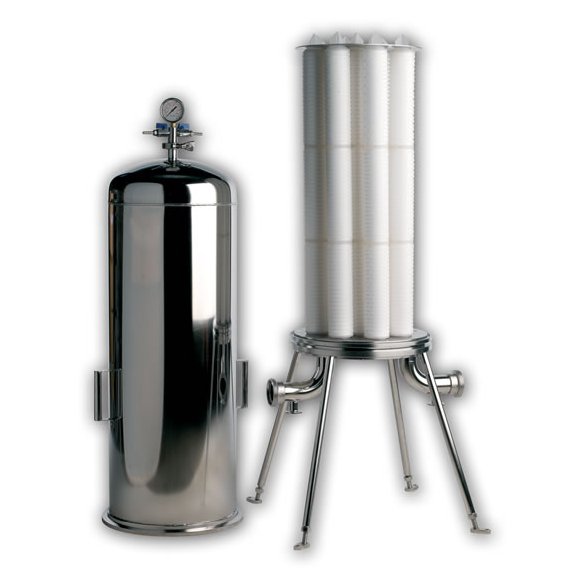
Candle filters are a type of pressure-driven filtration system that uses multiple vertical, tubular filter elements (“candles”) installed inside a pressure vessel (the housing). The filamentous or pleated filter elements provide large surface area within a compact footprint.
What Is a Candle Filter Housing?
A candle filter housing is the structural vessel that holds one or more candle elements. During operation, slurry or liquid streams are passed through the filter element surfaces, trapping suspended solids while allowing clarified liquid (filtrate) to pass through.
How Candle Filtration Works
There are two primary modes of candle filter operation: inside-out filtration and outside-in filtration:
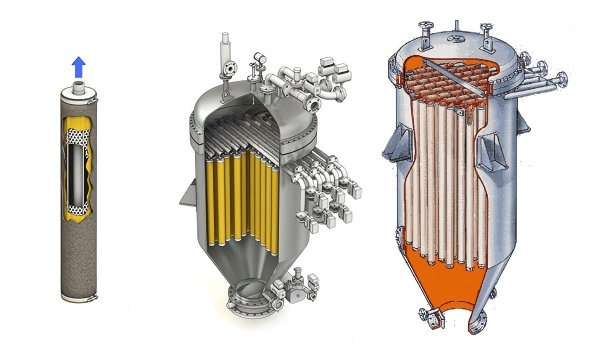
- Inside-Out: Liquid flows from the inner core of the candle outward through the filter media. Solids accumulate on the exterior.
- Outside-In: Liquid flows from the outside of the candle inward. Solids collect on the outside surface.
The method chosen depends on feed characteristics such as solids concentration, particle size distribution, and viscosity.
Key Components of a Pharmaceutical Candle Filter Housing
A pharmaceutical-grade candle filter system typically includes:
| Component | Function |
| Filter Housing Vessel | Contains pressure liquid/solid mix and supports internal filter elements |
| Filter Candles | Replaceable filter elements made of PTFE, stainless steel mesh, or cartridges |
| Inlet/Outlet Ports | Feed entry (inlet) and filtrate exit (outlet) |
| Differential Pressure Gauges | Monitor pressure drop to determine cake formation and filter performance |
| Vent/Drain Ports | Support CIP/SIP, drainage, and safety venting |
| Sealing System | Ensures no leakage; hygienic gasket materials required |
| Support Frames/Saddles | Provide structural support to candles |
Pharmaceutical Applications of Candle Filtration
Pharmaceutical candle filters are used extensively where efficient separation and sterility are essential. Typical applications include:
- Clarification of fermentation broths
- Antibiotic suspension filtration
- Active pharmaceutical ingredient (API) purification
- Sterile buffer and excipient filtration
- Intermediates clarification in downstream processing
- Biopharmaceutical fluid processing before chromatography
Materials of Construction and Surface Finish
Materials must be compatible with pharmaceutical chemistry and cleaning protocols. Common choices include:
- 316L Stainless Steel: Standard for pharmaceutical equipment
- Hastelloy: Used for aggressive chemistries
- Polytetrafluoroethylene (PTFE) or Polypropylene: For gaskets and filter media components
Surface finish is critical for cleanability and reducing contamination risk:
| Surface Requirement | Typical Specification |
| Wetted Surface Finish | ≤ 0.8 μm Ra (roughness average) |
| Crevice-Free Design | Mandatory for GMP cleanability |
| Electropolishing | Applied where required |
| Seam/Weld Quality | Full penetration, smooth with passes |
GMP (Good Manufacturing Practice) Considerations
GMP compliance for equipment like candle filter housings is not optional; it is essential to ensure product quality and regulatory acceptability. The key compliance areas include design, validation, cleaning, documentation, and maintenance.
Design and Construction Controls
- Hygienic Design: There should be no dead legs or stagnant zones where residues can accumulate.
- Material Traceability: Certificates of compliance for all wetted parts must be maintained.
- Sealing Integrity: Seals and gaskets must be compatible with process fluids and CIP/SIP regimes.
- Cleanability: Access must allow full Clean-In-Place (CIP) coverage, and surface finishes must support washing and sanitization.
- Pressure Ratings: Must be engineered to withstand intended operating pressures and validated accordingly.
IQ/OQ/PQ Equipment Qualification Process
GMP requires formal qualification to verify that the system meets intended design and performance criteria.
Qualification Activities
- IQ: Verifies installation against design drawings and specifications.
- OQ: Checks systems operate under normal and worst-case conditions (pressure, temperature, flow).
- PQ: Demonstrates performance under real production conditions using simulated or actual product.
Validation and Process Control
Validation ensures that candle filtration performs as intended consistently. Key aspects include:
- Filter Integrity Testing: Bubble point testing or pressure hold tests for membrane candles.
- Performance Monitoring: Documentation of filtration rate, differential pressure trends, and solids loadings.
- Sampling and Analytical Testing: Routine monitoring of filtrate quality (turbidity, residual solids).
- Filter Media Certification: Supplier certificates showing media pore size distribution and retention ratings.
Validation Checklist Example
| Validation Activity | Status/Notes |
| Structural and Weld Quality Verification | Completed; records archived |
| Surface Finish Compliance | Verified ≤ 0.8 μm Ra |
| Pressure and Temperature Tests | Completed; met design tolerances |
| Filter Media Certificate of Analysis | Received and filed |
| Cleanability Testing | Demonstrated via swab and rinse analysis |
| Integrity Testing Pre/Post Operation | Consistent results within acceptance |
| SOPs for Operation, Cleaning, and Maintenance | Approved and trained |
Cleaning, CIP/SIP, and Maintenance
GMP demands effective cleaning and sterilization procedures to prevent cross-contamination.
Clean-In-Place (CIP) Requirements
Circulate detergent solutions, rinsing agents, and sanitizers through the housing and filter elements.
Validate CIP effectiveness by residue testing.
Maintain logbooks of CIP cycles and results.
Sterilize-In-Place (SIP) Requirements
Utilization of steam or chemical sterilants compatible with materials.
Process must be validated with biological indicators when sterilization is required.
Control temperature and time per approved cycles.
Maintenance Best Practices
Scheduled inspection of gaskets, seals, and filter media.
Record all component replacements and any unexpected incidents.
Implement preventive maintenance to reduce downtime.
Documentation and Change Control
Candle filter housings are subject to rigorous documentation to demonstrate control and traceability.
Required GMP Documents
- IQ/OQ/PQ protocols and reports
- Material certificates (wetted parts)
- SOPs for operation, cleaning, and maintenance
- Cleaning validation reports
- Change control records
- Calibration certificates for instruments
Change Control Process
Any change to the system, such as swapping filter media or modifying process parameters, must be:
- Evaluated for impact on product quality.
- Reviewed by Quality Assurance.
Approved and documented with justification and updated validation as required.
Operational Best Practices
To ensure candle filter housings perform optimally:
- Use filter media validated for the specific application.
- Monitor differential pressure; replace elements before breakthrough occurs.
- Track slurry characteristics regularly — changes may indicate upstream process deviations.
- Define clear criteria for filter element change-out.
Common Challenges and Mitigation Strategies
| Challenge | Root Cause | Mitigation Approach |
| Filter clogging too quickly | High solids load; inappropriate media size | Pre-filtration; adjust media; intermediate clarification |
| Poor cleanability | Surface roughness; dead legs | Improve design; increase CIP dwell time |
| Differential pressure spikes | Inconsistent feed quality | Better upstream control; staged filtration |
| Sterility assurance failures | Inadequate SIP coverage | Re-validate sterilization; review warm-up/cool-down patterns |
Candle filter housings are indispensable in pharmaceutical manufacturing for effective clarification and solids handling. However, their use must be grounded in stringent GMP compliance, from design and qualification all the way through validation, cleaning, and maintenance.
A systematic approach that includes appropriate materials, controlled fabrication, validated cleaning and sterilization, well-written SOPs, and comprehensive documentation not only ensures regulatory compliance but also upholds the safety, quality, and consistency that pharmaceutical products demand.