
Candle filters enable solid–liquid separation across pharmaceutical, chemical, food, water, and biotech industries. Their high filtration efficiency, compact structure, and closed-system operation make them ideal for applications requiring clarity, sterility, and contamination control.
However, like all filtration systems, candle filters require regular cleaning to maintain performance, prevent pressure drop escalation, and ensure consistent product quality. Two primary cleaning methods are commonly used: backwash cleaning and manual cleaning.
Understanding Candle Filters and Fouling Mechanisms
Before comparing cleaning methods, it is important to understand how candle filters operate and why cleaning is necessary.
What Is a Filter?
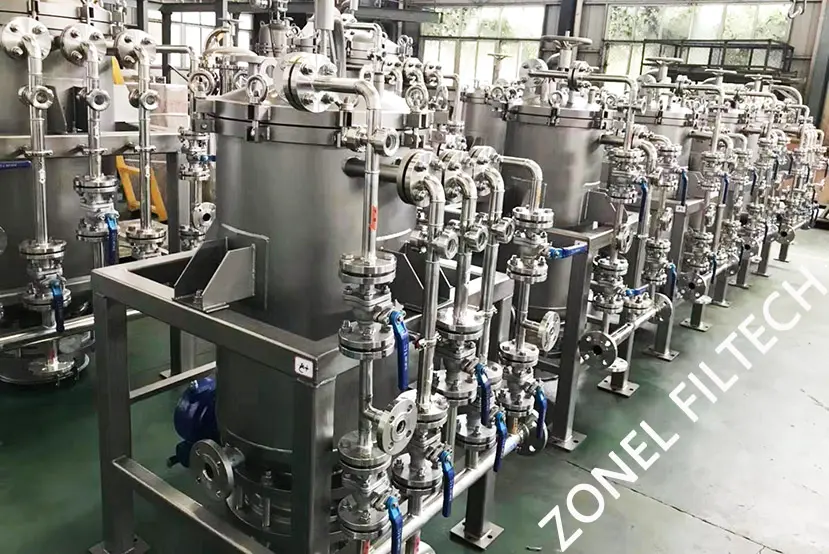
A candle filter typically consists of multiple vertically mounted filter elements (candles) inside a pressure vessel. The filtration medium may be:
- Sintered metal
- Wedge wire
- Textile filter media
- Ceramic
- Polymeric membranes
During operation, slurry enters the vessel and solids accumulate on the outer surface of the candles, forming a filter cake. Clarified liquid passes through the filter medium and exits as filtrate.
Why Cleaning Is Necessary
Over time, several fouling mechanisms occur:
- Cake buildup
- Pore blockage
- Gel layer formation
- Scaling
- Biofouling (in some applications)
These issues cause:
- Increased differential pressure
- Reduced flow rate
- Lower filtration efficiency
- Shortened filter life
- Potential contamination risks
Cleaning restores permeability and extends equipment lifespan.
Backwash Cleaning Method
Backwash cleaning is an automated cleaning process that reverses flow direction to dislodge accumulated solids from the filter surface.
How Backwash Works
The backwash process generally follows these steps:
- Filtration stops.
- Clean filtrate or cleaning fluid is pumped in reverse direction.
- Reverse flow removes cake from surface.
- Dislodged solids settle or are discharged.
- Filtration resumes.
In many systems, compressed air may assist the backwash cycle for improved cleaning efficiency.
Types of Backwash Systems
Backwash can be implemented as:
- Liquid backwash
- Gas-assisted backwash
- Pulse backwash
- Continuous automated backwash
- CIP-integrated backwash
Modern candle filter systems often integrate programmable backwash cycles into PLC-controlled automation platforms.
Manual Cleaning Method
Manual cleaning involves opening the filter vessel and physically removing accumulated solids.
How Manual Cleaning Works
The general procedure includes:
- Shutting down the filtration process.
- Depressurizing and draining the vessel.
- Opening the housing.
- Removing candle elements.
- Washing manually (water spray, brushing, chemical soaking).
- Reinstalling elements.
- Reassembling and restarting.
Manual cleaning may involve chemical cleaning solutions for stubborn fouling.
Backwash vs. Manual Cleaning: Technical Comparison
The choice between backwash and manual cleaning depends on multiple operational factors.
Technical Comparison of Backwash vs. Manual Cleaning
| Parameter | Backwash Cleaning | Manual Cleaning |
| Automation Level | Fully or semi-automatic | Fully manual |
| Downtime | Minimal | Significant |
| Labor Requirement | Low | High |
| Cleaning Frequency | High-frequency cycles possible | Periodic, scheduled |
| Suitability for Continuous Operation | Excellent | Limited |
| Risk of Contamination | Very low | Higher (open exposure) |
| Cleaning Effectiveness | Good for surface cake | Excellent for deep fouling |
| Initial Investment | Higher | Lower |
| Operating Cost | Lower long-term | Higher labor cost |
| GMP Compliance | Highly suitable | Requires strict procedures |
Advantages of Backwash Cleaning
Reduced Downtime
Backwash systems can complete cleaning cycles in minutes without disassembly. This significantly reduces production interruptions.
Improved Operational Efficiency
Automated backwash cycles can be triggered by:
- Differential pressure thresholds
- Timer-based scheduling
- Flow rate drop
This ensures optimal filter performance at all times.
Lower Labor Cost
Backwash reduces labor costs and minimizes human error by eliminating frequent manual cleaning.
Better GMP Compliance
In pharmaceutical and food industries, maintaining a closed system is critical. Backwash systems minimize contamination risk because the vessel remains sealed.
Longer Equipment Life
Frequent automated cleaning prevents excessive cake buildup, reducing mechanical stress on filter elements.
Limitations of Backwash Cleaning
Despite its advantages, backwash cleaning has certain limitations.
Higher Initial Investment
Backwash systems require:
- Pumps
- Control valves
- PLC systems
- Instrumentation
- Piping modifications
This increases capital expenditure.
Limited Effectiveness for Certain Fouling
If fouling penetrates deep into pores or forms hardened scale, backwash may not fully restore permeability.
Increased System Complexity
More automation means:
- More components
- More maintenance
- Higher technical requirements
Advantages of Manual Cleaning
Deep Cleaning Capability
Manual cleaning allows:
- Visual inspection
- Mechanical brushing
- Chemical soaking
- Ultrasonic cleaning (if needed)
This can remove stubborn deposits more effectively.
Lower Initial Cost
Systems without backwash hardware are simpler and cheaper to purchase.
Suitable for Low-Frequency Use
For small-scale operations or batch production, manual cleaning may be sufficient.
Limitations of Manual Cleaning
Production Downtime
Manual cleaning can take several hours, reducing production capacity.
Labor-Intensive Process
It requires trained operators and physical handling.
Contamination Risk
Opening the vessel exposes filter elements to the environment, which may not be acceptable in sterile applications.
Safety Concerns
Handling chemicals and pressurized equipment introduces safety risks.
Cost Analysis: Short-Term vs. Long-Term Perspective
When evaluating cleaning methods, both capital expenditure (CAPEX) and operational expenditure (OPEX) must be considered.
Cost Comparison Overview
| Cost Factor | Backwash System | Manual Cleaning |
| Initial Equipment Cost | High | Low |
| Installation Cost | Moderate to High | Low |
| Automation Cost | High | None |
| Labor Cost | Low | High |
| Downtime Cost | Low | High |
| Maintenance Cost | Moderate | Low to Moderate |
| Long-Term Total Cost | Often Lower | Often Higher |
When Backwash Is More Economical
Backwash becomes cost-effective when:
- Operation is continuous
- High production volume
- Strict contamination control required
- Labor cost is high
- Downtime is expensive
When Manual Cleaning Is More Economical
Manual cleaning may be preferable when:
- Production is small scale
- Budget constraints exist
- Fouling is infrequent
- Product changeovers are rare
Application-Based Recommendations
10.1 Pharmaceutical Industry
Backwash cleaning is strongly recommended due to:
- GMP requirements
- Closed-system operation
- Reduced contamination risk
- Validation compatibility
Manual cleaning may only be used for periodic deep cleaning during shutdown maintenance.
Chemical Processing
If handling aggressive chemicals, backwash reduces operator exposure. However, periodic manual inspection remains necessary.
Food & Beverage
Backwash supports hygienic design principles and faster turnaround between batches.
Water Treatment
Backwash is widely adopted in continuous filtration systems. Manual cleaning is used for major maintenance intervals.
Hybrid Approach: Best of Both Worlds
In many industrial setups, a combination strategy is used:
- Frequent automated backwash cycles
- Scheduled manual deep cleaning during maintenance shutdowns
This hybrid method ensures:
- Continuous operation
- Maximum filter lifespan
- Thorough fouling removal
Environmental and Sustainability Considerations
Backwash systems:
- May use more cleaning fluid
- Generate wastewater
- Require energy for pumps
Manual cleaning:
- Uses more labor
- May require more chemicals
- Involves potential waste handling issues
Optimized backwash cycles can reduce water consumption significantly through intelligent control algorithms.
Maintenance and Monitoring Strategy
Regardless of cleaning method, best practices include:
- Monitoring differential pressure
- Tracking flow rate trends
- Recording cleaning frequency
- Inspecting filter media regularly
- Performing periodic integrity tests
Smart filtration systems increasingly integrate sensors and data logging for predictive maintenance.
Decision-Making Framework
When selecting between backwash and manual cleaning, consider:
- Production scale
- Regulatory requirements
- Budget constraints
- Labor availability
- Product sensitivity
- Fouling characteristics
- Desired automation level
A lifecycle cost analysis is strongly recommended.
Both backwash and manual cleaning methods play essential roles in maintaining candle filter performance. Backwash systems provide automation, reduced downtime, lower long-term operational cost, and improved contamination control, making them ideal for high-volume and GMP-regulated industries.
Manual cleaning offers deeper fouling removal, lower initial investment, and flexibility for smaller operations but comes with higher labor demands and longer downtime.
In modern industrial environments, the optimal solution is often a hybrid approach — using automated backwash for routine cleaning and manual intervention for scheduled deep maintenance.