
When choosing between 304 and 316 stainless steel filter housings, buyers should compare corrosion resistance, fluid compatibility, operating conditions, fabrication quality, and long-term maintenance requirements.
Although both grades offer useful corrosion resistance, their alloy compositions differ. Understanding these differences helps engineers select a housing that matches the process environment without unnecessary material costs.
Alloy Composition: Where the Two Grades Differ
The two grades share an austenitic structure, but their chemistry does not provide identical service limits. Their surface protection comes from a thin chromium-rich oxide film.
Nickel contributes to the stable austenitic structure within the metal.
Molybdenum in the 316 formulation gives it an advantage against chloride-related pitting over 304, although the advantage has limits under aggressive service conditions.
That difference matters when assessing a housing exposed to saline residues or chloride-bearing cleaning solutions.
Zonel Filtech lists 304 and 316L housing options. The 316 comparison here describes the alloy family; specify 316L explicitly when that is the quoted construction.
Check the grade suffix on the quotation rather than treating every 316 specification as identical. The 304L and 316L grades have lower maximum carbon contents, which can help reduce sensitization risks during welding.
Grade 304 generally performs well in many indoor industrial environments, general water applications, and services with relatively mild chemical exposure. It is often a practical option when chloride exposure is limited.
Neither grade is immune to corrosion. Selecting 316 does not eliminate the need to assess chemical compatibility, temperature, surface condition, fabrication quality, and maintenance practices.
How Do 304 and 316 Compare in Different Corrosive Environments?
Chloride ions can damage the passive surface film and initiate localized corrosion. Pitting may develop at isolated surface locations, while crevice corrosion can occur in narrow gaps with restricted fluid circulation.
Temperature, pH, chloride concentration, exposure duration, stagnant conditions, and surface deposits must all be considered. There is no universal chloride threshold that guarantees either grade will remain corrosion-free.
For marine-related applications, buyers should be particularly careful. Continuous seawater exposure can exceed the practical capabilities of both grades, so the complete service environment requires evaluation before specifying a housing.
Acid compatibility cannot be determined simply by choosing 316 instead of 304. Different acids attack stainless steel differently, and their effects depend on concentration, temperature, impurities, and exposure time.
Cleaning agents deserve equal attention. Filtration systems may encounter detergents, sanitizers, acids, or alkaline solutions during routine cleaning, creating exposure conditions different from normal production operation.
Where cleaning-in-place procedures are used, the material specification should cover the complete cleaning cycle. Chemical compatibility during flushing, soaking, rinsing, and shutdown should be considered together.
Pitting and crevice corrosion are especially relevant to filter housings because their construction includes joints, covers, gasket interfaces, support structures, and other locations where liquid can remain trapped.
Deposits and accumulated particles may create localized conditions beneath the retained material. These areas can become more corrosive than exposed surfaces, particularly when chloride-containing liquids remain stagnant.
Welded areas also deserve attention. Poor weld finishing, heat tint, embedded contaminants, and inadequate post-weld cleaning can weaken corrosion performance regardless of whether the housing uses 304 or 316.
Which Operating Conditions Should Buyers Evaluate?
Temperature affects corrosion behavior and can change the suitability of a stainless steel grade. A material that performs adequately under cool conditions may face greater localized corrosion risks at elevated temperatures.
Pressure capacity must be evaluated separately from corrosion resistance. It depends on housing geometry, wall thickness, material properties, connections, fabrication quality, and the applicable design requirements.
Neither 304 nor 316 has one universal filter housing pressure rating. Request the manufacturer’s documented design pressure and temperature limits for the specific housing configuration rather than assuming that material grade establishes capacity.
The process liquid determines much of the material compatibility assessment. Buyers should document its chemical composition, dissolved salts, pH, suspended solids, and potential contaminants before requesting a housing specification.
When selecting liquid filtration bags, buyers should evaluate their compatibility with the same process fluid and cleaning conditions. The bag material and housing components must work together as a complete filtration system.
Operating conditions include more than continuous filtration. Startup, shutdown, intermittent operation, flushing, and cleaning can expose the housing to different chemical concentrations and temperature conditions.
Residual liquid is an important consideration during shutdown. Poor drainage can leave deposits and concentrated chemicals inside the housing, increasing the likelihood of localized corrosion in vulnerable areas.
The purchase drawing should show how the installed vessel empties, where liquid can collect, and how maintenance personnel reach those areas. Effective drainage also makes inspection and routine maintenance easier.
What Fabrication and Design Details Should Buyers Compare?
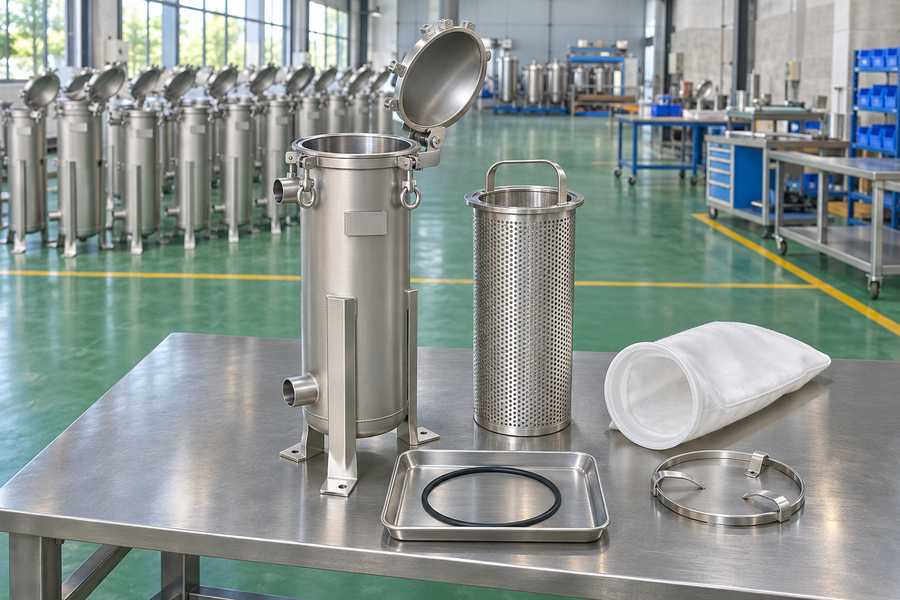
When evaluating stainless steel filter housing options, buyers should also consider the filtration assembly, including the housing body, connections, internal supports, and sealing components. Material selection should cover every wetted surface.
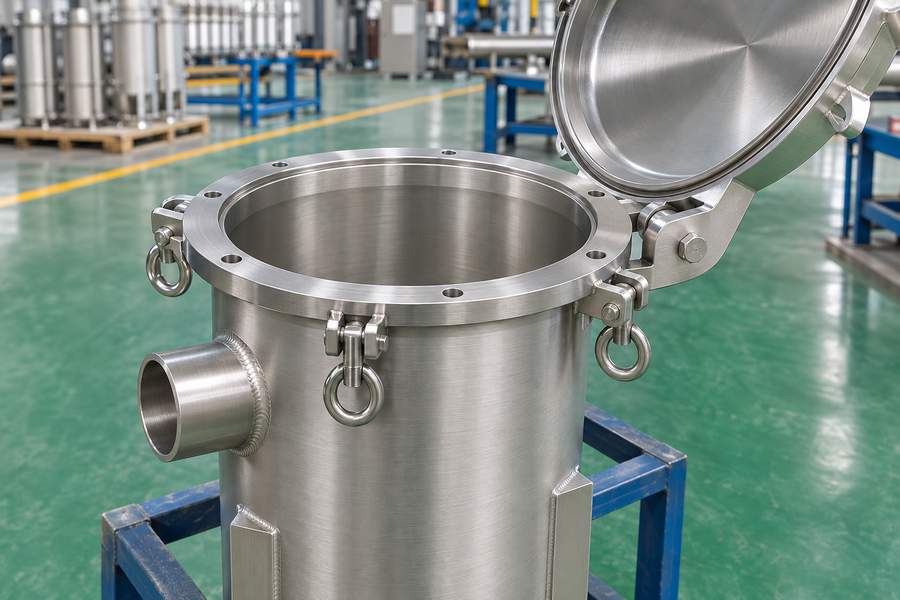
Welding can produce heat tint and alter the surface condition around the weld. Leaving weld discoloration and affected surface material untreated can undermine the resistance expected from the selected alloy.
Low-carbon variants such as 304L and 316L are often considered for welded constructions because their reduced carbon content helps limit sensitization during welding. The final specification should reflect the fabrication method.
Surface finish influences cleanability and the potential retention of process residues. A suitable finish can reduce particle attachment and make internal inspection and cleaning more manageable.
However, polishing cannot compensate for an unsuitable alloy. Even a smooth 304 surface may experience localized corrosion in conditions where 316 or another material is more appropriate.
The housing shell is only one part of the material specification. Covers, filter supports, flanges, bolts, fittings, fasteners, and other wetted components should also be reviewed.
Gaskets and seals require separate compatibility checks. Their chemical resistance, temperature limits, compression behavior, and expected service conditions may differ from those of the stainless steel housing.
Check metal combinations at wetted joints. Electrical contact between unlike metals, together with a conducting liquid, can create a galvanic couple that accelerates attack on the less noble member.
Component selection should consider the complete assembly rather than isolated materials.
How Do Material Selection and Lifecycle Costs Compare?
The alloying additions used in 316 commonly carry a material premium. Compare current quotations for equivalent vessels to establish the actual difference.
However, the final housing price also reflects dimensions, wall thickness, fabrication, and finishing requirements.
An unsuitable material can lead to corrosion inspections, component replacement, repairs, and unplanned production interruptions. These consequences may outweigh an initial purchase-price difference when the process environment is demanding.
However, choosing 316 does not automatically reduce maintenance costs. Poor drainage, incompatible seals, contaminated welds, and unsuitable cleaning practices can still cause equipment problems.
| Application condition | 304 stainless steel | 316 stainless steel |
| General water filtration | Often suitable after compatibility assessment | Consider when additional corrosion resistance is needed |
| Mildly corrosive liquids | Depends on chemical composition | May provide additional resistance |
| Chloride-containing fluids | Requires careful evaluation | Often preferred, subject to exposure conditions |
| Marine-related applications | More limited suitability | Better resistance than 304, but not universally suitable |
| Chemical cleaning | Depends on cleaning chemistry | Depends on cleaning chemistry |
| General industrial filtration | Often a practical option | Consider when operating conditions justify the cost |
Turning the Material Comparison Into a Purchase Specification
A purchase specification should identify the exact material grade instead of using a general description such as stainless steel. Specify 304, 304L, 316, or 316L according to the application.
Buyers should also identify the applicable material standard and documentation requirements. Link the material documentation to the delivered parts through their identification records; a certificate without a traceable connection to the vessel provides limited assurance.
Provide the supplier with the required flow conditions, design pressure, operating temperature, fluid composition, and connection details. These inputs allow the proposed configuration to be evaluated against actual service requirements.
Specify filtration requirements, housing dimensions, drainage arrangements, surface finish, and inspection access. If cleaning chemicals are used, include their identities, concentrations, temperatures, and exposure procedures.
Request confirmation of the specific housing’s pressure and temperature limits. These values must come from the actual design documentation, not from a general comparison between stainless steel grades.
Ask for relevant material certificates, traceability information, and inspection documentation according to the purchase requirements. Confirm that the records identify the supplied material grades and applicable components.
Welding procedures, surface treatment, and fabrication acceptance criteria should also be agreed upon where relevant. For demanding applications, define how weld areas and internal surfaces will be inspected before delivery.
Compare quotations using equivalent housing dimensions, material grades, design conditions, connections, and component specifications. A lower quotation may reflect differences in construction rather than a more economical material choice.
Before placing the order, prepare a written process-condition specification covering the normal and cleaning environments. Ask the supplier to confirm the proposed material grade and wetted-component compatibility against those conditions.
For an existing installation, use operating records, corrosion inspection findings, and maintenance history to identify whether the current material remains suitable. Resolve documented corrosion concerns before approving a replacement housing or repeating the original specification.