
Monofilament filter cloth generally releases filter cake more easily than multifilament cloth because its smooth, continuous yarn surfaces provide fewer spaces for particles to become trapped within the fabric.
However, actual cake release also depends on particle characteristics, fabric weave, permeability, and operating conditions. Understanding these differences helps engineers select suitable cloth constructions and troubleshoot difficult discharge.
What Are Monofilament and Multifilament Filter Cloths?
Both constructions are available in different polymers, weaves, and specifications. Comparing complete woven filter cloth characteristics is therefore more useful than choosing by yarn type alone.
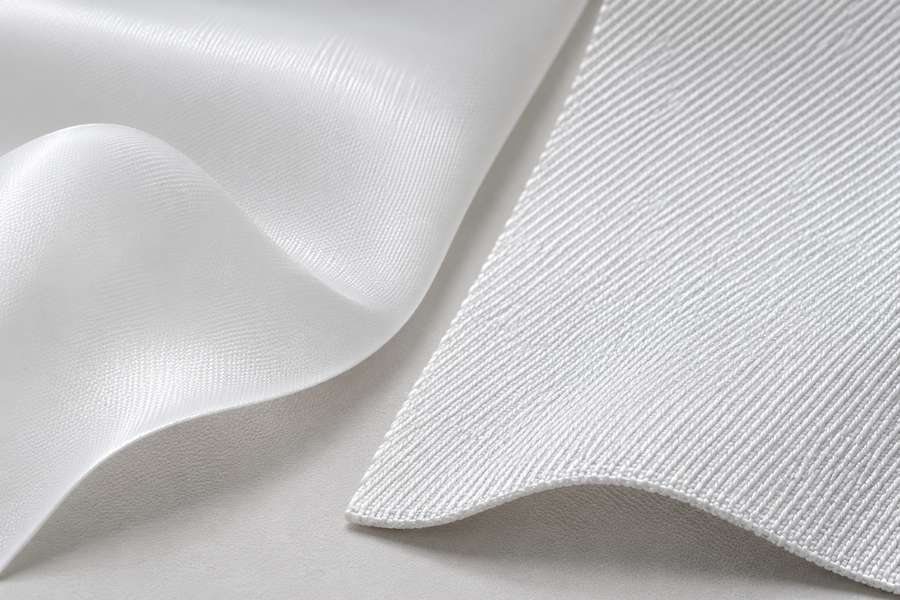
Monofilament Filter Cloth
Monofilament cloth uses individual continuous filaments woven directly into fabric. Each yarn consists of one filament, producing a relatively smooth surface and clearly defined openings between intersecting yarns.
However, its openings must still match the particle-retention requirements. An excessively open construction may allow unwanted solids into the filtrate, even when cake release is satisfactory.
How a Multifilament Yarn Is Built
Several slender, unbroken strands run together through each multifilament yarn in the woven cloth. The individual strands create a more complex surface with small spaces between filaments.
This structure can provide additional opportunities for fine-particle retention. However, particles entering the yarn may become difficult to remove, potentially contributing to deposits and reduced permeability.
Multifilament construction should not be confused with spun-staple yarn, which consists of shorter fibers assembled into yarn. These materials have different structural characteristics and filtration behavior.
Which Filter Cloth Releases Filter Cake More Easily?
Why Monofilament Usually Releases Cake More Easily
During filtration, suspended solids accumulate on the fabric or within its openings. With monofilament yarns, the relatively smooth surfaces provide fewer opportunities for particles to become mechanically trapped.
When the filtration cycle finishes, the cake can separate from the cloth with less interference from internal particle deposits. This is particularly useful when consistent cake discharge and straightforward cleaning are important.
Why Multifilament May Retain More Residual Solids
The spaces between individual filaments can capture fine particles during filtration. Some solids may penetrate the yarn instead of remaining entirely on the fabric surface.
These deposits can create additional mechanical attachment and make cleaning more demanding. Accumulation over repeated cycles may also obstruct filtration passages and contribute to fabric blinding.
Nevertheless, multifilament cloth does not always produce poor cake release. Suitable weave geometry, yarn density, and slurry characteristics can deliver satisfactory discharge performance.
The following comparison summarizes general tendencies rather than guaranteed results. A plant trial still needs to establish how that particular weave handles the slurry and releases the cake.
| Comparison factor | Monofilament | Multifilament |
| Yarn surface | Smooth and uniform | Multiple strands with internal spaces |
| Cake release | Generally easier | More application-dependent |
| Fine-particle retention | Depends on fabric openings | Often suitable for finer retention |
| Internal deposits | Generally less likely | Greater potential for accumulation |
| Permeability | Often relatively high | Depends on yarn density and weave |
| Cleaning | Often more straightforward | May require additional attention |
What Factors Affect Filter Cake Release Performance?
Particle Size and Surface Characteristics
Particle shape also influences retention. Irregular or elongated solids can become mechanically interlocked with fabric structures, while sticky particles may adhere strongly to otherwise smooth surfaces.
Slurry composition should therefore be evaluated before selecting a construction. A cloth suitable for coarse mineral solids may behave differently when processing fine, fibrous, or adhesive materials.
Cake Thickness and Cohesion
Successful discharge requires the cake to maintain sufficient internal strength while separating from the fabric. A poorly consolidated layer may break apart rather than detach as a complete cake.
Two interactions are important: cohesion between particles and adhesion between particles and cloth. Strong internal cohesion combined with relatively weak fabric adhesion generally supports cleaner discharge.
Excessively thin cakes can also create problems because they may lack sufficient strength for consistent removal. Changing yarn construction alone will not necessarily correct unsuitable cake formation.
Weave and Operating Conditions
Plain, twill, and satin weaves arrange yarn intersections differently. Their surface geometry, opening characteristics, and contact patterns can influence particle retention and cake separation.
For example, satin constructions can provide longer yarn floats and relatively smooth surfaces. However, weave selection must also account for dimensional stability and mechanical requirements.
Filtration pressure affects cake consolidation and moisture distribution. Excessive compression under unsuitable conditions can produce a dense cake that requires greater effort to remove.
Washing, drying, and discharge methods also influence the result. Engineers should evaluate the complete filtration cycle rather than attributing every release problem to the fabric surface.
How to Choose Between Monofilament and Multifilament Filter Cloth
When Monofilament Is More Suitable
Monofilament is often a suitable choice when cake removal and convenient maintenance are major priorities. Its construction can help reduce particle accumulation within yarns.
- Coarser solids: Applications where suitable fabric openings can retain the required particles.
- Difficult discharge: Processes experiencing persistent cake adhesion or excessive residual deposits.
- Frequent cleaning: Operations where reducing internal particle accumulation is beneficial.
- Permeability: Applications requiring relatively open fabric structures and suitable filtrate flow.
Before selecting monofilament, confirm that its openings provide adequate solids retention. Easier cake discharge should not compromise the required filtrate quality.
When Multifilament Is More Suitable
Multifilament may be preferable when fine-particle retention and filtrate clarity take priority over the easiest possible cake discharge.
- Fine solids: Applications requiring additional opportunities for particle capture.
- Filtrate quality: Processes with demanding suspended-solids requirements.
- Filtration structure: Applications requiring a suitably constructed fabric for finer separation.
Considering Blended Constructions
Blended woven fabrics can combine different yarn constructions to address competing filtration requirements. For example, monofilament and multifilament yarns may be arranged in different fabric directions.
The resulting performance depends on yarn placement, weave, and the intended filtration surface. Buyers should request detailed construction specifications instead of assuming blended fabrics automatically provide better results.
How to Troubleshoot Poor Filter Cake Release
When cake discharge becomes difficult, replacing the cloth immediately may overlook the actual cause. Start by examining residual deposits, filtrate behavior, cake formation, and equipment operation.
Filter Cake Sticks to the Fabric
Inspect the cloth after discharge and determine whether residual solids remain on the surface or appear trapped within the yarn structure.
- Particle penetration: Check whether fabric openings suit the actual particle-size distribution.
- Surface deposits: Look for accumulated solids, sticky residues, or incomplete cleaning.
- Cake properties: Review thickness, moisture, and cohesion before blaming fabric construction.
Blinding and Reduced Permeability
Blinding occurs when particles obstruct fabric openings or accumulate within the yarn structure. This increases filtration resistance and can extend operating cycles.
Compare current filtrate flow and filtration duration with previous operating records. Determine whether blockage occurs mainly at the surface or inside the fabric before choosing a cleaning or replacement strategy.
Uneven Cake Discharge
Broken or unevenly discharged cakes may indicate inconsistent formation rather than excessive cloth adhesion. Check feed distribution, filtration conditions, and moisture differences across the filtration area.
Also examine plate alignment and the discharge mechanism. Mechanical problems can prevent consistent cake removal even when the selected filter cloth is appropriate.
Problems Continue After Cloth Replacement
If replacement fabric does not improve discharge, compare its weave, yarn construction, permeability, and opening characteristics with the previous specification.
Review slurry consistency, cleaning procedures, and equipment settings as well. A different fabric cannot correct every problem caused by unsuitable operating conditions.
What Should Buyers Check Before Ordering Filter Cloth?
Purchasing decisions should be based on documented process requirements rather than general descriptions such as monofilament or multifilament. Zonel Filtech can evaluate construction options against the application information provided.
Confirm Application and Material Requirements
Start with the filter type, slurry composition, particle-size distribution, and required filtrate quality. These details establish the filtration requirements and help identify suitable fabric constructions.
Operating pressure, temperature, washing conditions, and cleaning chemicals should also be documented. Polymer compatibility requires application-specific assessment because resistance varies with chemical concentration and operating conditions.
Verify Fabric Specifications
Request complete technical information covering yarn construction, weave, fiber material, permeability, and physical dimensions. Yarn type alone cannot establish filtration precision or guarantee a particular cake-release result.
Confirm warp and weft arrangements, fabric thickness, weight, and mechanical requirements. Also check seams, installation dimensions, and compatibility with the existing equipment.
Do not treat yarn construction as a micron rating. Actual particle retention depends on fabric openings, yarn dimensions, weave geometry, and operating conditions.
Conduct a Representative Fabric Trial
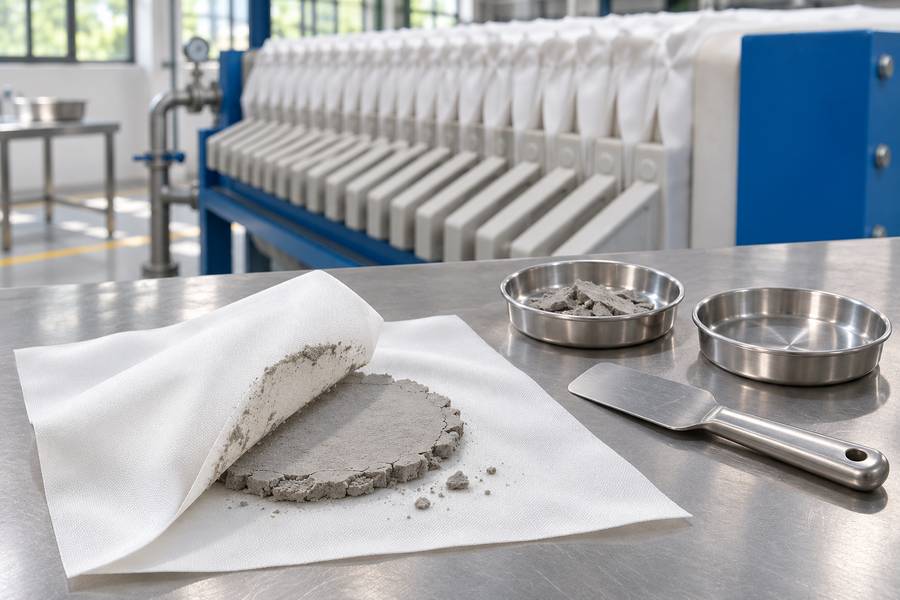
Before approving bulk production, compare suitable fabric samples using representative slurry and compatible equipment conditions. Keep operating conditions consistent so differences between candidate constructions can be evaluated meaningfully.
Record filtrate clarity, filtration duration, cake moisture, discharge behavior, and residual deposits across repeated cycles. These measurements provide a more useful comparison than judging one discharge in isolation.
When reviewing filter press configurations, also confirm plate dimensions, cloth installation requirements, and discharge arrangements.
A practical purchasing step is to provide Zonel Filtech with the existing cloth specification, equipment details, slurry characteristics, and photographs of discharged cakes. Use those details to choose trial fabrics with the supplier.
Authorize production quantities only after repeated runs satisfy the agreed filtrate and discharge requirements.