
A duplex bag filter can support uninterrupted production during a bag change because it provides another filtration path while one housing is isolated. A single bag housing normally requires the flow through that housing to stop for maintenance. The distinction is straightforward, but the production result depends on how the duplex system is sized, connected, controlled, and operated.
Two vessels standing next to each other do not prove that the process can keep running. The available path must carry the required flow, maintain acceptable filtrate quality, and allow the other path to be serviced safely. A plant should specify those conditions before describing a system as suitable for uninterrupted production.
Define what production cannot tolerate
Start with the downstream process. Does it require continuous flow, a minimum flow, a stable pressure, or a fixed quantity within a batch window? A short interruption that is harmless in a transfer operation may be unacceptable at a continuously fed production step. State the requirement in measurable terms.
Also define what counts as acceptable liquid during a changeover. If all material must pass through the qualified filter, opening an unfiltered bypass is not a solution to maintenance downtime. If startup liquid needs diversion until it meets a quality criterion, account for that period in the continuity assessment.
Consider whether a buffer tank can bridge the interruption. Its useful capacity, product residence limits, and downstream demand determine whether it is an appropriate alternative. A single filter with suitable storage may meet the production requirement, while a duplex installation without enough capacity in the active branch may not.
Include the actual maintenance duration. Isolation, drainage, inspection, refilling, venting, and quality release can take longer than exchanging the bag itself. Use the full interval when comparing production arrangements.
What a single bag filter does well
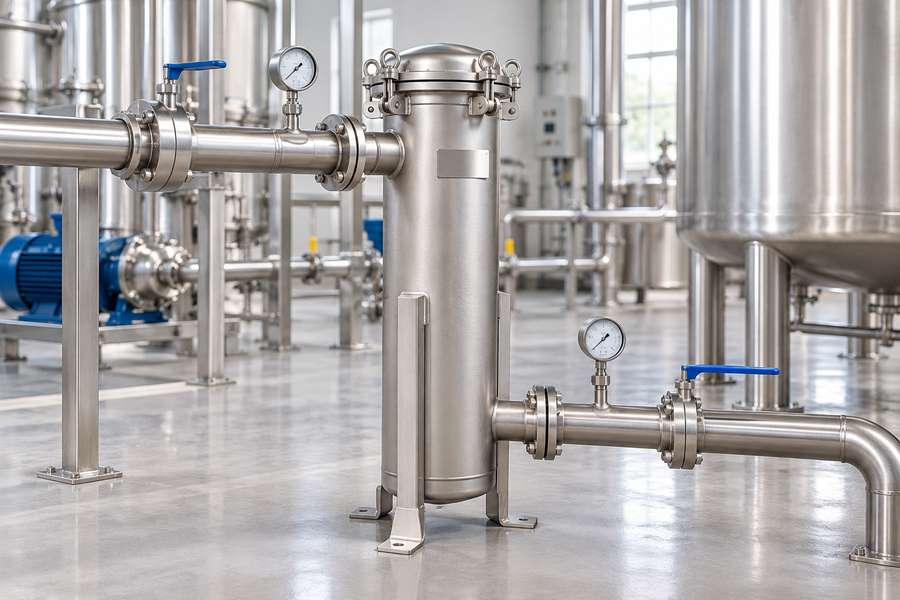
A single housing offers a direct flow path and relatively simple maintenance planning. It has fewer valves and connections than a more elaborate changeover arrangement, and the relationship between feed conditions, differential pressure, and bag life is easy to track.
It can be a practical choice for batch transfer, intermittent service, or a process with planned stops. If the bag completes the required batch with acceptable quality and pressure, replacing it between batches may fit naturally into the production schedule.
Single does not mean undersized. A correctly selected vessel and medium can meet a demanding duty within its validated operating envelope. Conversely, a duplex arrangement does not make an unsuitable medium appropriate. Retention, material compatibility, support, and sealing requirements apply to both designs.
The limitation appears during servicing. The housing must be isolated and depressurized according to its procedure before opening. If that housing is the only acceptable path and downstream demand continues, the process needs storage, an approved pause, or another qualified filtration path.
How a duplex arrangement supports maintenance
A duplex system provides two paths with a means of selecting or sharing flow between them. In a duty and standby arrangement, one path performs the normal duty while the other is prepared for use. The standby path is brought into service through the approved changeover sequence before the other is isolated for maintenance.
Another arrangement operates both paths together during normal production. This provides shared flow, but its maintenance capability depends on what happens when one path is unavailable. If both are needed to meet normal demand, the remaining path may not support full production.
Make the intended operating mode explicit. The same two vessels can be described casually as duplex, parallel, or duty and standby, yet those terms may conceal different capacity assumptions. The specification should state the required flow and quality with one path isolated.
The housing, valve arrangement, instruments, and operating procedure form one system. Review the proposed bag filter housing configuration with its actual connections and isolation provisions. Do not infer a complete changeover capability from a housing photograph or a single-vessel data sheet.
Size the available path for the maintenance condition
The critical question is whether the active path can handle the required duty by itself. Check actual flow, liquid viscosity at the relevant temperature, clean resistance, expected loading, and the pressure required downstream. Include the valves and common headers in the assessment.
A path that carries half the flow during normal shared operation will see a different duty if it must carry all the flow during maintenance. Its differential pressure can rise, and its useful operating interval may shorten. Evaluate that condition before relying on it for continuity.
Consider the loading state at changeover. The remaining path may already be partly loaded if both have been operating. Alternatively, a standby element may be fresh but require filling, venting, and quality checks. The maintenance scenario should match the intended operating sequence.
Allow enough service time to restore the offline path before it is needed again. If the active bag reaches its replacement point faster than operators can complete the other changeout, the system will eventually force a stop. Size the available filtration capacity and schedule the replacement work so that a serviced path is ready before the operating bag reaches its limit.
Use a simple operating example
Suppose a hypothetical process requires a continuous flow of 12 cubic meters per hour. Two branches normally share that flow equally. Demonstrating acceptable operation at 6 cubic meters per hour in each branch does not demonstrate that either branch can carry 12 during maintenance. That condition needs its own hydraulic and quality assessment.
The example does not prescribe a vessel size or imply a universal capacity. It illustrates the design condition that matters: the remaining qualified path must meet the required duty when the other is unavailable.
Keep filtration quality stable during changeover
A changeover is more than moving a valve. The standby housing must contain the correct element, have its seals and retainers properly installed, and be ready for the approved filling and venting procedure. Any startup liquid requiring diversion must have a defined destination.
Sample downstream during the transition when quality risk justifies it. Stable pressure is useful, but it does not prove that the element is correctly seated or that no contamination has entered from an idle branch. Include the relevant product acceptance test in commissioning.
Review what happens to the liquid left in the standby path. It may remain acceptable, or it may settle, change temperature, age, or become unsuitable for reintroduction. Assess that retained liquid against the product’s stability requirements and the length of the shutdown. Establish a procedure for returning the path to service after both short and long pauses.
Choose liquid filter bags with consistent specifications for the intended duty. If the two paths use different media or ratings, document why and how the resulting filtrate remains acceptable. A spare bag with a similar appearance is not automatically an equivalent replacement.
Provide isolation that permits real maintenance
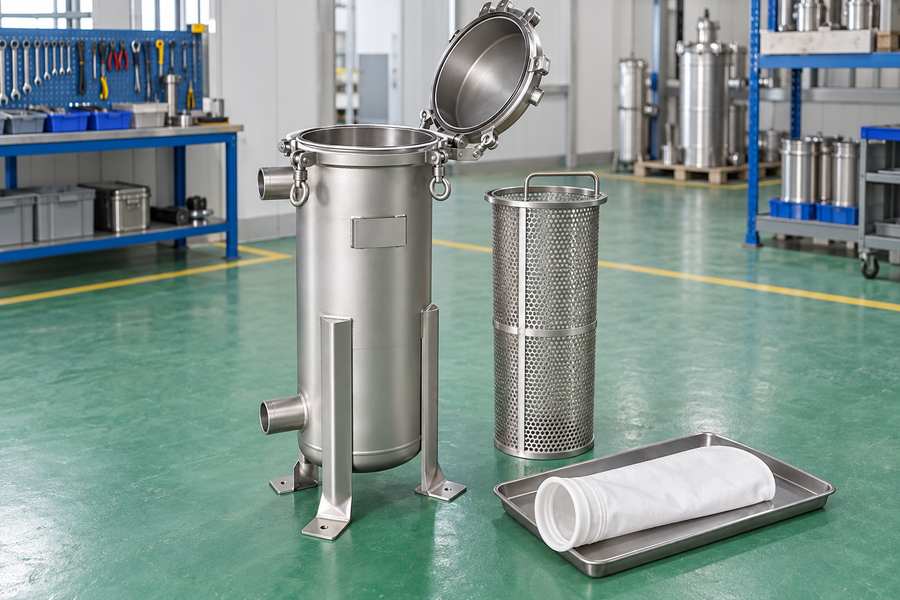
The offline housing needs an approved means of isolation, depressurization, drainage, and verification before opening. Account for possible pressure from both upstream and downstream. The presence of a closed valve does not remove the need to follow the plant’s isolation procedure.
Drain and vent routes should lead to suitable destinations and remain accessible when the other path is operating. Keep recovered product separate from waste where required. Shared drain arrangements need particular attention so that flow or pressure cannot be unintentionally introduced from the active side.
Lay out the equipment so that maintenance does not interfere with the operating path. Allow room to open the lid, withdraw the bag and basket, inspect seals, and move wet components. Access that looks sufficient on a plan may disappear once valves, instruments, and nearby pipework are installed.
Specify the intended valve arrangement and its operating sequence with the equipment supplier and plant team. Avoid presenting a generic valve sequence as suitable for every installation. Different changeover devices and process conditions require different procedures.
Instrumentation should show which path needs attention
Provide measurements that allow operators to understand the condition of each path. Differential pressure across the active housing is a common operating indicator, but it should be interpreted with actual flow and temperature. A shared reading across the whole arrangement may not identify an individual restriction.
In shared-flow operation, a cleaner branch can carry more flow than a loaded one. A normal total flow does not prove balanced loading. Where distribution affects performance, include a suitable means of assessing branch flow rather than assuming the branches divide it equally.
Make the active and isolated states clear at the operating position. Labels, position indication, and a documented sequence can reduce ambiguity. If automation is used, define its response to instrument faults, an unavailable standby path, or a failure to complete the changeover.
Keep alarm and replacement settings tied to the approved equipment and process limits. Housing design pressure and bag differential pressure are different limits. Neither should be copied from an unrelated installation merely because the vessel looks similar.
Compare the maintenance workload, not only downtime
A duplex system can move maintenance away from a production stop, but it does not eliminate the work. Operators still need to inspect, drain, clean where required, replace consumables, and prepare the offline path. Include that workload in staffing and spare-parts planning.
Track how often each path is used and serviced. Unequal duty can create different wear patterns or leave one branch idle for long periods. A deliberate rotation policy may be useful, but it should respect product residence and quality requirements rather than being adopted automatically.
Keep records of element identity, installed date, operating time or processed quantity, differential pressure, and the reason for replacement. That information helps distinguish a genuine capacity problem from a change in feed or an incorrect replacement bag.
Include retained product and cleaning requirements in the comparison. Two housings can hold more liquid than one, and a standby vessel may need additional cleaning before a grade change. The ability to maintain flow is only one part of the production decision.
Check the exceptions before accepting the system
Ask what happens when the standby path is not ready at the moment it is needed. A missing replacement bag, a damaged seal, or a housing awaiting cleaning can remove the redundancy that the production plan assumes. The operating procedure needs a defined response, including when to reduce throughput or stop through the approved process.
Review common components as well. Two housings may still depend on one pump, one common valve, or one restricted header. A duplex filter does not provide redundancy for every component in the process line. Identify which maintenance events it can bridge and which still require a planned shutdown.
Test the communication between production and maintenance. Operators should know which path is available, which is isolated, and who is responsible for returning it to service. A clear handover record is particularly useful when a changeout spans a shift boundary. The next team should not have to infer readiness from the position of a lid or the presence of a new bag.
Finally, retain a commissioning record of the actual one-path operating test. Include the liquid condition, measured flow, pressure readings, quality checks, and duration. That record provides a basis for evaluating later production increases. Without it, a future team may assume that the original continuity claim applies to a larger duty that was never tested.
Choose the arrangement around the production schedule
| Production condition | Single housing consideration | Duplex consideration |
| Planned pauses between batches | Changeout may fit within the normal pause | Additional continuity may offer little benefit |
| Continuous downstream demand | Needs adequate buffering or an approved interruption | Can support maintenance if the available path meets the full duty |
| Frequent product changes | Fewer wetted components to manage | More attention to retained liquid and branch cleaning |
| Variable contaminant loading | Run length may become difficult to schedule | Changeover flexibility helps only if standby capacity is ready |
| Limited maintenance access | Simpler footprint may be easier to accommodate | Both paths need practical servicing space |
Commission the selected arrangement using the conditions that justify it. For duplex service, demonstrate the required flow and quality with one path offline, complete a representative changeout, and verify the transition back to the intended operating mode. Retain the measured flow, pressure, and quality results from this maintenance test as evidence of the installed system’s capability.
If a single housing already completes the batch and maintenance fits the schedule, it may remain the more practical choice. If the process cannot tolerate a filter-related interruption, a correctly engineered duplex system can provide the necessary operating flexibility. The deciding evidence is sustained accepted production during maintenance, not simply the presence of a second vessel.