
For baghouse dust collectors, size is usually described by diameter × length, such as 130 mm × 3000 mm, 152 mm × 6000 mm, or 6 in × 120 in. For liquid filter bags, standard industry bag sizes often use numbers such as #1, #2, #3, and #4.
For example, one common liquid filter bag size is #2, which is approximately 7.06 in in diameter and 32 in in length. Critical Process lists #1 as 7.06 in × 16.5 in and #2 as 7.06 in × 32.0 in, while smaller #3 and #4 bags use a 4.12 in diameter with shorter lengths.
What Does Industrial Filter Bag Size Mean?
Industrial filter bag size usually refers to several key dimensions:
| Size Parameter | Meaning | Why It Matters |
| Diameter | The width of the round filter bag | Must match the cage, tube sheet, or bag housing |
| Length | The total working length of the bag | Affects filtration area and installation space |
| Flat width | Width of the bag when laid flat | Commonly used for sewn dust collector bags |
| Surface area | Actual filtration area of the bag | Determines airflow capacity or dirt-holding capacity |
| Ring/collar size | Top sealing structure size | Prevents leakage and bypass |
| Bottom type | Sewn, disc, reinforced, or special bottom | Affects durability and dust release |
| Micron rating | Particle retention size, mainly for liquid bags | Determines filtration precision |
Why Filter Bag Size Is So Important
A filter bag is a key component that influences filtration efficiency, pressure drop, and overall system reliability. In a dry dust collector, the total filter bag area determines the air-to-cloth ratio, also called filter velocity. It measures airflow per square foot of filter media and is calculated as total CFM divided by total filter area.
For example:
Air-to-cloth ratio = Airflow / Total filter area
If a dust collector handles 4,000 CFM and has 2,000 sq. ft. of filter area:
4,000 ÷ 2,000 = 2:1 air-to-cloth ratio
This means every square foot of filter media handles 2 cubic feet of air per minute. A higher ratio means the filter bag is working harder. A lower ratio usually gives longer bag life, better dust release, and more stable pressure drop.
In liquid filtration, bag size affects flow capacity, dirt-holding volume, change-out frequency, and pressure drop. Larger bags usually provide more surface area and higher holding capacity. Pentair’s industrial liquid filter bag data shows #2 bags with a 7.06 in diameter and 32 in length have about 4.4 sq. ft. of surface area, while smaller #3 bags have about 0.5 sq. ft. of surface area.
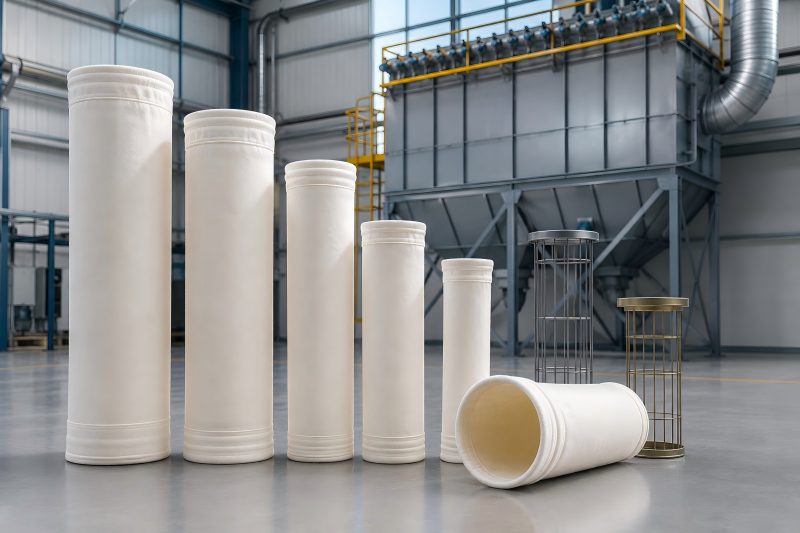
Common Industrial Dust Collector Filter Bag Sizes
Dust collector filter bags are used in baghouses, pulse-jet dust collectors, reverse-air dust collectors, and shaker-type systems. Common bag sizes vary by country, equipment brand, application, and cleaning method.
Common Round Baghouse Filter Bag Sizes
| Diameter | Approx. Metric Diameter | Common Length Range | Typical Applications |
| 4 in | 102 mm | 1.5–3 m | Small dust collectors, compact systems |
| 4.625 in | 117 mm | 2–4 m | General dust collection |
| 5 in | 127 mm | 2–5 m | Woodworking, powder processing |
| 5.25 in | 133 mm | 2–6 m | Cement, chemical, metal dust |
| 5.875 in | 149 mm | 3–8 m | Heavy-duty industrial baghouses |
| 6 in | 152 mm | 3–10 m | Large baghouses, cement, steel, power plants |
| 6.25 in | 159 mm | 4–10 m | High-airflow dust collectors |
IAC lists common U.S. market bag diameters such as 4.00 in, 4.625 in, 5.00 in, 5.25 in, 5.875 in, 6.00 in, 6.12 in, 6.25 in, 6.375 in, and 6.62 in. These sizes are often connected with specific flat-width dimensions used for fabric cutting and sewing.
In many industrial dust collectors, 120–160 mm diameter bags are common, especially for pulse-jet baghouses. Shorter bags are easier to install and clean, while longer bags provide more filtration area in the same floor space. However, very long bags require good cage support, proper airflow distribution, and reliable pulse-cleaning design.
Common Liquid Filter Bag Sizes
Liquid filter bags are used in water treatment, paint and coating filtration, chemical processing, oil filtration, food and beverage processing, coolant filtration, and wastewater treatment. Unlike dust collector bags, liquid filter bags are usually selected according to standard housing size.
Common Liquid Filter Bag Dimensions
| Bag Size | Diameter | Length | Approx. Surface Area | Typical Use |
| #1 | 7.06 in / 179 mm | 16.5 in / 419 mm | About 2.0 sq. ft. | Medium flow, compact housing |
| #2 | 7.06 in / 179 mm | 32 in / 813 mm | About 4.4 sq. ft. | High flow, most common industrial size |
| #3 | 4.12 in / 105 mm | 8–9 in / 203–229 mm | About 0.5 sq. ft. | Small batch filtration |
| #4 | 4.12 in / 105 mm | 14 in / 356 mm | About 1.0 sq. ft. | Low to medium flow |
| #9 | 5.62 in / 143 mm | 32 in / 813 mm | About 3.4 sq. ft. | Special housing designs |
| #12 | 8.25 in / 203 mm | 30 in / 762 mm | About 5.5 sq. ft. | Higher dirt-holding capacity |
Pentair’s data shows several standard liquid bag sizes, including #3, #4, #7, #8, #9, #1, #2, and #12, with different surface areas ranging from about 0.5 sq. ft. to 5.5 sq. ft.
For many industrial liquid filtration systems, #2 filter bags are the most widely used size because they offer a good balance of flow capacity, dirt-holding capacity, availability, and housing compatibility.
Air-to-Cloth Ratio Guide
The ideal air-to-cloth ratio varies by application and operating conditions. There is no single universal number, but the following data can be used as a practical starting point.
| Application | Typical Air-to-Cloth Ratio | Sizing Recommendation |
| Light nuisance dust | 3.5:1–5:1 | Higher ratio may be acceptable |
| Wood dust | 2.5:1–4:1 | Avoid excessive velocity and re-entrainment |
| Cement dust | 2:1–3.5:1 | Use durable media and enough filter area |
| Metal grinding dust | 2:1–3.5:1 | Consider spark resistance and dust hazard |
| Welding fumes | 1.5:1–3.5:1 | Fine particles need lower ratio |
| Pharmaceutical powder | 1:1–2.5:1 | High efficiency and low emission required |
| Carbon black / very fine dust | 0.8:1–2:1 | Use low ratio and high-efficiency media |
| High dust loading process | 1.5:1–3:1 | More filter area is recommended |
ACT Dust Collectors explains that applications with more particulate per cubic foot of air generally need a lower air-to-cloth ratio, and source-capture systems often require lower ratios because dust concentration is higher.
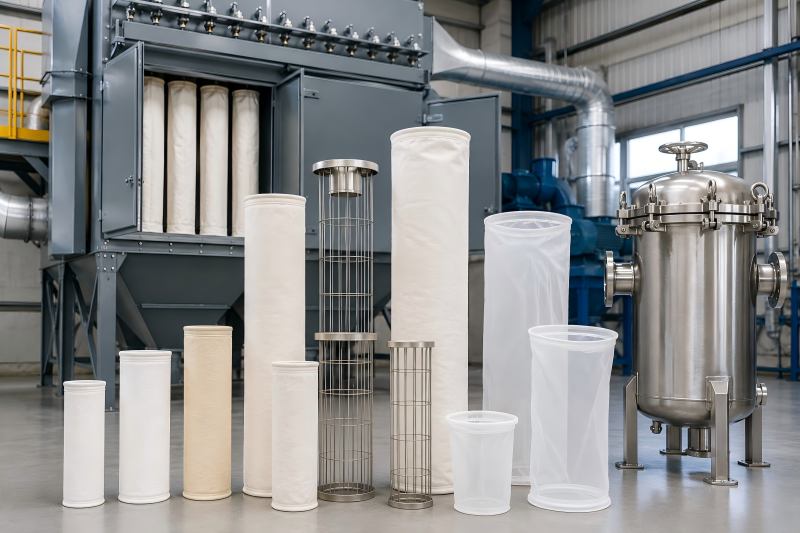
Choosing the Right Dust Collector Filter Bag Size
Step 1: Confirm the Dust Collector Type
The bag size should fit the dust collector structure. Common systems include:
| Dust Collector Type | Common Bag Style | Size Consideration |
| Pulse-jet baghouse | Cylindrical bag with cage | Must match cage diameter and tube sheet hole |
| Reverse-air baghouse | Large fabric bag with rings | Length, ring spacing, and tension are critical |
| Shaker baghouse | Fabric bag with hook or loop | Requires correct tension and top/bottom fittings |
| Plenum pulse system | Snap-band top bag | Top collar must seal tightly |
| Top-load pulse system | Snap-band or flange top | Easy replacement but exact fit is required |
A pulse-jet baghouse usually uses a cage inside the filter bag. If the bag is too narrow, installation becomes difficult and fabric stress increases. If the bag is too wide, the fabric may fold, rub against the cage, or clean poorly.
Step 2: Measure the Existing Bag Correctly
If you are replacing old bags, measuring the current bag is the safest method. Albarrie recommends measuring the bag length and diameter carefully, fully extending the bag, and noting features such as rings, rope, snap bands, cuffs, wear strips, and cage details.
Important measurement points include:
- Bag diameter or flat width
- Total length
- Top construction
- Bottom construction
- Snap band or collar size
- Cage diameter and length
- Tube sheet hole size
- Number and spacing of support rings
- Ground wire or anti-static requirements
- Wear protection area
Step 3: Calculate Required Filter Area
Before choosing bag length or number of bags, calculate the total filtration area required.
Required filter area = System airflow ÷ Target air-to-cloth ratio
Example:
| Parameter | Value |
| System airflow | 10,000 CFM |
| Target air-to-cloth ratio | 2.5:1 |
| Required filter area | 4,000 sq. ft. |
If each selected bag provides 20 sq. ft. of filter area:
Required number of bags = 4,000 ÷ 20 = 200 bags
This calculation helps decide whether you need longer bags, more bags, larger diameter bags, or a bigger dust collector.
Step 4: Check Installation Space
Longer filter bags increase surface area, but they also require more vertical space. Before increasing bag length, check:
- Baghouse internal height
- Cage installation clearance
- Maintenance access
- Hopper design
- Dust drop-out space
- Pulse pipe position
- Walkway or roof access
- Crane or lifting space
A longer bag is not always better. If airflow distribution is poor, the lower part of the bag may not clean well. In high dust loading systems, long bags may also suffer from uneven dust cake formation.
Choosing the Right Liquid Filter Bag Size
For liquid filtration, bag size selection is mainly based on housing size, flow rate, viscosity, dirt loading, micron rating, and change-out frequency.
Step 1: Match the Bag Housing
The first rule is simple: the bag must fit the housing. A #2 bag must be installed in a #2 housing, and a #1 bag must be installed in a #1 housing. Even if the diameter seems close, the sealing ring, basket support, and bag length must match correctly.
Step 2: Estimate Flow Capacity
A larger bag can usually handle a higher flow rate and hold more contaminants. However, the actual flow depends on liquid viscosity, particle loading, micron rating, and filter media.
| Bag Size | General Flow Capacity Trend | Best Use |
| #3 / #4 | Low flow | Lab, small batch, pilot systems |
| #1 | Medium flow | Compact industrial systems |
| #2 | High flow | Standard industrial filtration |
| #12 | Very high dirt-holding need | Heavy-duty filtration |
Step 3: Choose the Right Micron Rating
Micron rating controls particle retention. Pentair lists industrial liquid filter bag media with micron ratings from 1 to 1500 µm, while Critical Process offers standard liquid bag sizes in multiple materials and retention ratings.
| Micron Rating | Typical Filtration Purpose |
| 1–5 µm | Fine polishing, high clarity filtration |
| 10–25 µm | Paint, coating, fine process liquid filtration |
| 50–100 µm | General industrial liquid filtration |
| 150–300 µm | Coarse particle removal |
| 400–1500 µm | Pre-filtration or large particle capture |
Lower micron ratings improve filtration precision but may raise pressure drop and shorten service life. If the system clogs too quickly, a staged filtration design may be better. For example, use a 100 µm pre-filter before a 10 µm final filter.
Filter Bag Size and Pressure Drop
Pressure drop clearly indicates whether the bag size is suitable. In dust collection, a bag that is too small for the airflow will load quickly and create high differential pressure. In liquid filtration, a small bag or overly fine micron rating can cause high inlet pressure and frequent change-outs.
Common Pressure Drop Problems
| Problem | Possible Size-Related Cause | Solution |
| Pressure drop rises quickly | Bag area too small | Increase bag length, number, or diameter |
| Bags clog too often | Air-to-cloth ratio too high | Lower filtration velocity |
| Dust leaks after installation | Wrong top size or poor seal | Check snap band, collar, and tube sheet |
| Bag collapses or deforms | Wrong cage fit or excessive pressure | Match cage and bag dimensions |
| Liquid bypass | Wrong ring size or poor housing fit | Use correct bag size and sealing ring |
| Short bag life | Bag too tight, too long, or rubbing | Check cage, length, and installation clearance |
A filter bag should not be selected only by price. An undersized bag may look cheaper at first, but it can increase compressed air use, fan energy, downtime, labor cost, and replacement frequency.
Material Selection Also Affects Size Choice
Bag size and filter media must be selected together. A larger bag with the wrong media can still fail. A correctly sized bag with poor chemical or temperature resistance will also have a short life.
Common Dust Collector Filter Bag Materials
| Material | Typical Temperature Resistance | Common Applications |
| Polyester | Up to about 130°C | General dust collection |
| Polypropylene | Lower temperature, good chemical resistance | Moist or chemical dust |
| Acrylic | Medium temperature, hydrolysis resistance | Cement, coal, moist dust |
| PPS | Higher temperature and chemical resistance | Power plants, boilers |
| Aramid/Nomex | High temperature | Asphalt, cement, metal processing |
| Fiberglass | Very high temperature | Kilns, furnaces, power plants |
| PTFE membrane | Surface filtration layer | Fine dust, low emission requirements |
For high-temperature or corrosive gas, the bag may need special media, surface treatment, membrane coating, or anti-static design. These requirements may influence bag thickness, sewing method, cage clearance, and installation tolerance.
The right industrial filter bag size should be selected by combining equipment fit, filtration area, operating conditions, and maintenance goals. For dust collector systems, focus on diameter, length, cage fit, tube sheet sealing, total filter area, and air-to-cloth ratio. For liquid filtration systems, focus on housing size, bag number, diameter, length, surface area, micron rating, sealing ring, and dirt-holding capacity.
A good filter bag size should achieve four goals:
- Fit the equipment correctlywithout leakage or bypass.
- Provide enough filtration areafor stable airflow or liquid flow.
- Keep operating pressure drop under control.
- Ensure durability, easy installation, and quick replacement.
In many cases, choosing a slightly larger filtration area can reduce pressure drop, extend bag life, lower maintenance frequency, and improve system stability. However, the final choice should always match the actual filtration system design, process conditions, dust or liquid properties, and performance requirements.