
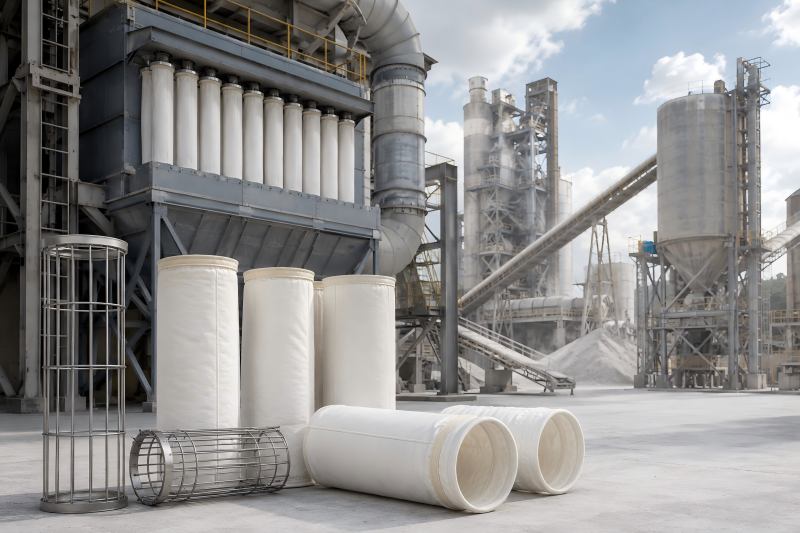
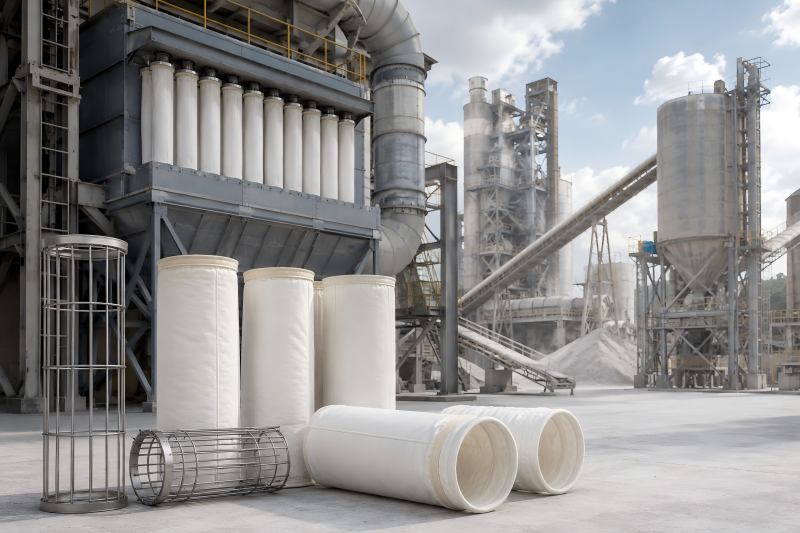
Industrial filter bags are essential dust control components in cement plants. From raw material crushing to clinker cooling, cement grinding, packing, and bulk loading, cement production generates large amounts of fine, abrasive dust. If this dust is not controlled properly, it can reduce equipment efficiency, increase maintenance costs, create workplace safety risks, and cause emission problems.
In cement manufacturing, baghouse dust collectors are widely used to capture particulate matter from kilns, raw mills, clinker coolers, finish mills, storage bins, conveyors, transfer points, bagging systems, and loading systems. Under U.S. federal cement plant standards, affected sources include kilns, clinker coolers, raw mills, finish mills, raw material dryers, storage bins, conveying transfer points, and bagging or bulk loading systems.
Why Filter Bags Matter in Cement Plants
Cement dust is very fine, dry, alkaline, and abrasive. In many parts of a cement plant, dust is also exposed to high temperature, moisture, acid gases, and changing airflow conditions. Because of this, ordinary dust filter bags may fail quickly if they are not designed for cement industry conditions.
The U.S. EPA states that emissions from portland cement plants come from fuel burning, heating feed materials, grinding, cooling, and material handling, and particulate matter is one of the pollutants regulated in cement manufacturing. In practice, this means filter bags are not only spare parts; they are part of the plant’s environmental protection system, production stability system, and maintenance cost control system.
A good cement plant filter bag should provide:
- High dust capture efficiency
- Stable airflow and low pressure drop
- Strong abrasion resistance
- Good temperature resistance
- Resistance to moisture and chemical attack
- Long service life
- Easy dust cake release during cleaning
Main Applications of Filter Bags in Cement Plants
Different production sections require different filter bag designs. The working conditions at a kiln, clinker cooler, coal mill, cement mill, and packing station are not the same.
| Cement Plant Area | Dust Condition | Main Requirement for Filter Bags |
| Kiln/preheater | High temperature, fine dust, chemical gas | Heat resistance, chemical resistance, stable emission control |
| Raw mill | Large dust volume, variable moisture | Anti-clogging, hydrolysis resistance, good dust release |
| Clinker cooler | Hot and abrasive clinker dust | High-temperature resistance, abrasion resistance |
| Cement mill | Fine cement powder | Efficient filtration, smooth airflow |
| Coal mill | Fine combustible dust | Anti-static, flame-retardant design |
| Silo venting | Dry fine powder | Good air permeability, compact design |
| Packing machine | High dust concentration near bagging | High efficiency, easy cleaning |
| Belt transfer points | Nuisance dust | Durable and economical media |
The Federal Register notes that control devices typically used in portland cement plants include fabric filters and electrostatic precipitators for kiln particulate matter control, and fabric filters for clinker coolers and raw material handling operations.
Filter Bag Materials for Cement Plants
Filter media choice determines system performance. The wrong material can cause early bag failure, high pressure drop, dust leakage, or poor cleaning performance.
| Filter Bag Material | Typical Use in Cement Plants | Key Advantages | Limitations |
| Polyester | Cement mill, packing, silo venting, low-temperature dust | Cost-effective, good strength | Not suitable for high temperature or strong hydrolysis |
| Acrylic | Raw mill, moist dust areas | Better hydrolysis resistance than polyester | Lower temperature resistance than aramid |
| Aramid / Nomex | Kiln, clinker cooler, high-temperature dust | Good heat resistance, strong mechanical performance | Sensitive to moisture and acid under some conditions |
| PPS | Areas with chemical gas and moderate heat | Good chemical resistance | Oxidation resistance must be considered |
| Fiberglass | Very high-temperature gas filtration | Excellent heat resistance | Requires careful handling, may need surface treatment |
| P84 | Fine dust and high-temperature filtration | High filtration efficiency, good dust capture | Higher cost, sensitive to certain conditions |
| PTFE membrane media | Low emission requirements, fine dust | Excellent surface filtration and dust release | Higher initial cost |
For many cement plants, polyester filter bags are used in lower-temperature areas such as cement grinding, silo venting, and packing. Aramid, fiberglass, P84, PPS, or PTFE membrane filter bags are often selected for higher-temperature or more demanding sections such as kiln, raw mill, and clinker cooler systems.
Key Factors When Selecting Cement Plant Filter Bags
Operating Temperature
Temperature is one of the first conditions to check. If the gas temperature exceeds the filter media’s limit, the bag may shrink, harden, lose strength, or fail. However, selecting only by maximum temperature is not enough. Cement plants often experience temperature fluctuations during start-up, shutdown, raw mill on/off operation, and abnormal process conditions.
For example, a bag that can handle normal operating temperature may still fail if there are frequent temperature spikes. For kiln and clinker cooler applications, the plant should consider both continuous operating temperature and peak temperature.
Dust Abrasion
Cement dust and clinker dust can be highly abrasive. If the dust collector has poor airflow distribution, high inlet velocity, or direct dust impact, the lower part of the filter bag may wear quickly. In these cases, filter bags may need reinforced bottoms, wear-resistant treatment, or improved inlet flow design.
Common abrasion signs include:
- Holes near the bag bottom
- Thin fabric on one side of the bag
- Broken sewing lines
- Cage marks on the fabric
- Dust leakage after short operation
Air-to-Cloth Ratio
Air-to-cloth ratio is a key design value for baghouse performance. It means how much air passes through each unit of filter media area. A higher air-to-cloth ratio means each bag carries more airflow, which can increase pressure drop and reduce service life. Air-to-cloth ratio is commonly calculated by dividing total airflow by total filter area.
A simple formula is:
Air-to-cloth ratio = Airflow ÷ Total filter area
For example, if a cement mill dust collector handles 60,000 m³/h of air and has 2,000 m² of total filter area:
60,000 ÷ 2,000 = 30 m³/m²/h
If the air-to-cloth ratio is too high, dust cake builds up quickly, compressed air consumption increases, and bags may need to be replaced more often.
Moisture and Dew Point
Moisture is a common problem in cement plant baghouses. Condensation forms on filter bags when gas cools below dew point. This may cause cement dust to become sticky, leading to clogging, mud-like dust cake, high pressure drop, and corrosion.
This problem is especially common in raw mill and kiln systems where temperature and moisture can change. To reduce the risk, plants should control gas temperature, avoid cold air leakage, choose suitable media, and keep the cleaning system working properly.
Chemical Resistance
Cement process gas may contain SO₂, NOx, acid gases, alkali compounds, and moisture. The chemical condition depends on raw materials, fuel type, kiln operation, and gas treatment system. Some filter media perform well in dry heat but poorly in acidic or moist conditions. Therefore, chemical compatibility should be checked before selecting the material.
Cleaning Method
Most modern cement plants use pulse-jet baghouses. In this system, compressed air pulses clean the bags by removing dust cake from the surface. Filter bags must match the pulse-cleaning design, cage size, tube sheet hole, and venturi structure.
If the cleaning pressure is too low, dust cake remains on the bag surface. Excessive pressure can damage the fabric and seams. Good filter bags should allow efficient dust release without excessive compressed air consumption.
Common Filter Bag Sizes for Cement Plants
Cement plant filter bag sizes vary according to dust collector design. Pulse-jet baghouses usually use cylindrical filter bags installed over metal cages.
| Bag Diameter | Common Length Range | Typical Application |
| 120 mm | 2–4 m | Small dust collectors, silo vents |
| 130 mm | 2–6 m | Cement mill, packing, transfer points |
| 152 mm | 3–8 m | Large pulse-jet baghouses |
| 160 mm | 4–10 m | High-airflow cement plant systems |
| 180 mm+ | Customized | Special large baghouse design |
Correct sizing is important because the filter bag must fit the cage, tube sheet, and sealing structure. An overly tight bag can cause installation difficulty and fabric damage. A bag that is too loose may fold, rub against the cage, or fail to clean effectively.
Surface Treatments for Cement Filter Bags
To improve performance, cement filter bags can be treated with different finishing processes.
| Treatment | Purpose |
| Singeing | Removes surface fibers and improves dust release |
| Calendaring | Creates smoother surface and lower dust penetration |
| Heat setting | Improves dimensional stability |
| Water and oil repellent treatment | Reduces moisture-related clogging |
| PTFE impregnation | Enhances chemical resistance and dust release. |
| PTFE membrane lamination | Provides surface filtration and lower emissions |
| Anti-static treatment | Used for coal mill and combustible dust areas |
PTFE membrane filter bags are often used when low emissions, fine dust capture, and easy cleaning are required. The membrane helps keep dust on the surface instead of allowing particles to penetrate deeply into the felt.
Common Problems and Solutions
| Problem | Possible Cause | Recommended Solution |
| High pressure drop | Bags clogged, air-to-cloth ratio too high, moisture problem | Check cleaning system, reduce moisture, increase filter area |
| Short bag life | High temperature, abrasion, chemical attack | Select stronger media and inspect airflow distribution |
| Dust emission increase | Broken bags, poor sealing, damaged cages | Replace damaged bags and check tube sheet sealing |
| Bag bottom damage | High inlet velocity or dust impact | Add wear protection and improve inlet design |
| Poor cleaning | Weak pulse pressure, blocked valves, wrong bag media | Inspect pulse system and choose better dust-release media |
| Bag shrinkage | Over-temperature or unsuitable material | Use higher-temperature media |
| Sticky dust cake | Condensation or high moisture | Control dew point and use water-repellent treatment |
Maintenance Tips for Longer Filter Bag Life
Good filter bags still need correct operation and maintenance. Cement plants should build a regular inspection plan instead of waiting for bag failure.
Useful maintenance practices include:
- Monitor differential pressure daily.
- Check compressed air pressure and pulse valves.
- Inspect cages for rust, bending, or sharp edges.
- Avoid operating below dew point.
- Check for air leakage in the baghouse.
- Replace damaged bags quickly to prevent dust bypass.
- Keep records of bag failure location and operating conditions.
- Use the correct installation tools to avoid damaging the bag cuff.
- Confirm that the tube sheet and snap band seal tightly.
- Analyze dust samples if bags fail repeatedly.
Auburn FilterSense notes that cement plant filtration systems are important for both productivity and emissions control, and baghouses are used not only on kilns but also on raw mills, clinker coolers, coal mills, material handling systems, and nuisance dust collectors.
How to Choose the Best Industrial Filter Bags for Cement Plants
When selecting filter bags for cement plants, buyers should not only compare price. A cheaper bag may have lower fabric weight, weaker sewing, poor surface treatment, or shorter service life. The total cost should include bag life, replacement labor, production downtime, compressed air consumption, fan energy, and emission risk.
Before ordering, confirm the following information:
| Information Needed | Why It Matters |
| Dust collector model | Ensures correct bag structure |
| Bag diameter and length | Prevents wrong fit |
| Cage size and condition | Avoids abrasion and installation problems |
| Tube sheet hole size | Ensures proper sealing |
| Operating temperature | Determines suitable media |
| Gas moisture and chemistry | Prevents hydrolysis and corrosion failure |
| Dust concentration | Affects air-to-cloth ratio and bag life |
| Cleaning method | Determines bag top design and media requirement |
| Emission target | Helps select standard felt or membrane media |
| Working section | Kiln, raw mill, cooler, silo, packing, etc. |
Industrial filter bags play a critical role in cement plant dust collection and emission control. Because cement production involves fine dust, high temperature, abrasion, moisture, and chemical gas, filter bags must be selected according to real working conditions rather than only price or standard size.
For low-temperature areas such as cement mills, packing machines, and silo vents, polyester or treated polyester bags may be enough. For demanding areas such as kiln systems, raw mills, clinker coolers, and coal mills, cement plants may need aramid, PPS, fiberglass, P84, PTFE-treated, or PTFE membrane filter bags.
The best filter bag should provide stable filtration efficiency, low pressure drop, good dust release, strong abrasion resistance, and long service life. By choosing the correct material, size, surface treatment, and sealing structure, cement plants can reduce maintenance costs, improve production reliability, and meet stricter dust emission requirements.