
Mesh and felt filter bags handle soft particles differently. Mesh relies on defined openings for surface screening, while felt uses a three-dimensional fiber structure to capture contaminants within its depth.
Selecting the right medium requires evaluating particle deformability, liquid properties, filtration requirements, and operating pressure. These factors influence particle breakthrough, premature blockage, and overall filtration performance.
Why Soft Particles Require Special Filtration Considerations
Soft particles are contaminants that can change shape when exposed to mechanical forces, liquid flow, or differential pressure. Unlike rigid particles, their original dimensions may not represent their behavior during filtration.
Some particles remain relatively stable during filtration, while others compress, stretch, flatten, or break apart. Their behavior depends on material composition, temperature, liquid chemistry, and mechanical properties.
When a soft particle approaches a filter opening, the pressure difference across the media can deform it. Its unloaded size can exceed the opening, yet squeezing and elongation may let it cross the mesh.
Elasticity and compressibility influence how easily contaminants change shape. Stickiness also matters because adhesive particles can attach to fibers, accumulate around openings, and restrict liquid movement.
How Mesh and Felt Filter Bags Capture Particles
Mesh filter bags generally use woven fibers arranged to create relatively defined openings. Their filtration performance depends on opening dimensions, weave construction, fiber material, and the condition of the finished media.
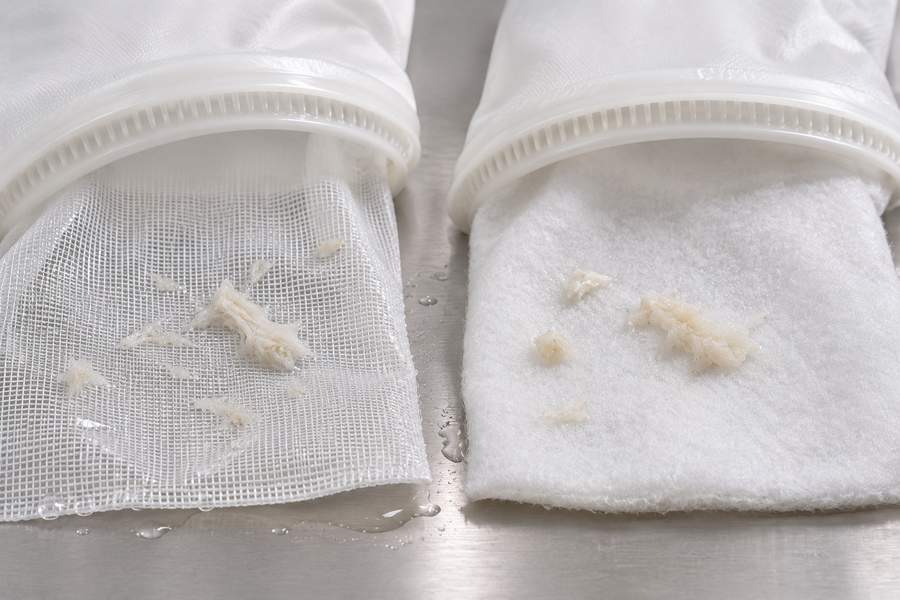
During operation, liquid passes through the openings while particles larger than the effective openings tend to accumulate on the upstream surface. This creates a relatively direct screening mechanism.
Surface accumulation can also become a limitation when contaminants are sticky or present in high concentrations. Deposits gradually cover available openings, increasing resistance to liquid flow and potentially causing premature blockage.
Felt filter bags typically use nonwoven fibers joined through a needle-punching process. This construction creates a porous three-dimensional structure rather than the more clearly defined openings found in woven mesh.
As liquid travels through the felt, particles can become trapped at different positions within the fiber structure. This depth-loading behavior provides multiple opportunities for contaminants to encounter and attach to fibers.
For certain deformable particles, the tortuous filtration path can improve retention compared with surface screening alone. However, actual performance depends on fiber arrangement, media density, particle characteristics, and operating pressure.
Depth filtration also introduces limitations. Contaminants accumulate inside the media, potentially reducing permeability throughout its thickness. Sticky substances may coat internal fibers and cause media blinding before the available filtration capacity is fully utilized.
| Comparison factor | Mesh filter bags | Felt filter bags |
| Construction | Woven fibers | Nonwoven fibers |
| Filtration tendency | Primarily surface screening | Primarily depth loading |
| Pore structure | Relatively defined openings | Complex porous structure |
| Particle retention | Mainly at the surface | Within the media depth |
| Soft particle behavior | Depends on opening size and deformation | Depends on fiber structure and particle properties |
| Solids accumulation | Surface deposits | Internal deposits |
| Cleaning potential | Depends on construction and contamination | Depends on material and loading conditions |
Mesh vs Felt Filter Bags for Different Soft Particle Applications
Gelatinous contaminants can change shape considerably when exposed to pressure. Their behavior makes conventional particle-size measurements less reliable when predicting whether they will pass through mesh openings.
For example, a gel particle may initially appear larger than a selected mesh opening but compress sufficiently to pass through. Increasing differential pressure can make this problem more noticeable.
Felt may provide better retention opportunities because particles encounter a complex fiber structure rather than a single surface opening. Nevertheless, very soft or highly deformable contaminants can still penetrate unsuitable felt media.
Sticky particles create different challenges because they tend to attach to the filtration surface. On mesh, accumulated deposits can progressively cover openings and reduce the effective area available for liquid passage.
Felt distributes contaminant capture through its thickness, potentially delaying surface coverage under suitable conditions. However, adhesive materials can penetrate the fiber structure and coat internal surfaces.
Once internal fibers become coated, liquid permeability may decline substantially. Replacing mesh with felt therefore does not automatically eliminate blockage problems, particularly when the process liquid contains highly adhesive substances.
Some industrial liquids contain loosely bonded particle clusters alongside individual contaminants. These agglomerates may break apart during pumping, circulation, or passage through filtration equipment.
Felt can provide multiple opportunities to capture particles of different sizes within its structure. However, smaller fragments may still pass through if the selected media cannot retain them effectively.
Where coarse contaminants accompany finer soft particles, staged filtration may be worth evaluating. An upstream mesh bag can remove larger debris, while a downstream felt bag handles the remaining particle load.
Key Factors When Selecting Mesh or Felt Filter Bags
Understanding the available mesh and felt filter bags helps engineers compare filtration structures and material options. Proper installation in compatible stainless steel bag housings also supports reliable operation.
Describe the unwanted solids separately from any ingredients that should remain in the finished liquid. Particle hardness, elasticity, compressibility, stickiness, shape, and size distribution all influence the appropriate filter media.
Determine whether particles retain their original dimensions during filtration or deform under normal operating pressure. This distinction is particularly important when evaluating mesh openings for gelatinous and elastic contaminants.
Also consider whether suspended particles have any useful function in the finished product. Removing valuable ingredients or functional solids may create unnecessary product losses, even when the filtrate appears cleaner.
Mesh opening size describes the dimensions of openings formed by its woven structure. Felt ratings describe particle-retention performance under a stated test, rather than one uniform opening size.
Compare the stated test methods before using those ratings to substitute one bag for another.
Two filter bags carrying the same nominal micron rating may produce different results because their filtration mechanisms and media constructions differ.
For mesh, evaluate opening dimensions and the possibility of soft particles deforming under pressure. For felt, examine the specified filtration rating and clarify whether it represents nominal or absolute retention.
Operating temperature can influence both liquid viscosity and contaminant behavior. Some soft particles become more deformable when heated, while changes in viscosity can affect flow resistance and differential pressure.
Flow rate and filtration area must also be considered together. Excessive flow demand through an undersized bag can increase pressure drop and alter how deformable contaminants interact with the media.
Finally, verify bag dimensions, collar configuration, sealing arrangements, and support basket compatibility. Incorrect installation can create bypass paths that allow unfiltered liquid to enter the downstream system.
Common Filtration Problems and Troubleshooting Methods
Particle breakthrough may result from unsuitable mesh openings, excessive differential pressure, damaged media, or poor sealing. Soft contaminants may also deform sufficiently to pass through an otherwise suitable opening.
Begin by checking the condition of the removed filter bag. Look for tears, damaged seams, distorted openings, incorrect installation, and signs of leakage around the sealing interface.
Compare the operating pressure with the recommended limits for the filter bag and housing. If the media remains intact, reconsider the retention rating and evaluate whether another construction provides better particle capture.
Rapid blockage can result from high solids loading, sticky contaminants, insufficient filtration area, or unsuitable media construction. Surface deposits and internal media blinding require different corrective approaches.
Inspect the removed bag to determine where contaminants accumulated. A heavily coated upstream surface suggests surface loading, while deposits distributed through the felt indicate internal depth loading.
Possible adjustments include changing the media structure, increasing available filtration area, or introducing upstream coarse filtration. Any change should preserve the required filtrate quality and remain compatible with the process.
Monitor pressure readings before and after the housing rather than judging filter condition through flow rate alone. Record pressure development alongside operating flow, temperature, and filter replacement intervals.
Do not respond automatically by increasing pump pressure. Higher pressure may deform soft contaminants, force particles through media openings, or exceed the permitted operating limits of the filtration assembly.
Practical Selection and Performance Validation Before Purchasing
| Application condition | Suggested starting point | Main consideration |
| Rigid particles with defined size requirements | Mesh | Opening dimensions and surface retention |
| Gelatinous and deformable particles | Felt | Depth capture and breakthrough resistance |
| Sticky contaminants | Mesh or felt after evaluation | Surface blockage versus internal blinding |
| Mixed particle sizes | Felt | Depth-loading behavior |
| Coarse preliminary filtration | Mesh | Defined openings and coarse particle removal |
| Coarse and fine contaminants together | Staged mesh and felt | Separate filtration duties |
Mesh is not automatically reusable. Confirm cleaning effectiveness, dimensional stability, and hygiene requirements for the actual bag before treating washability as a purchasing advantage.
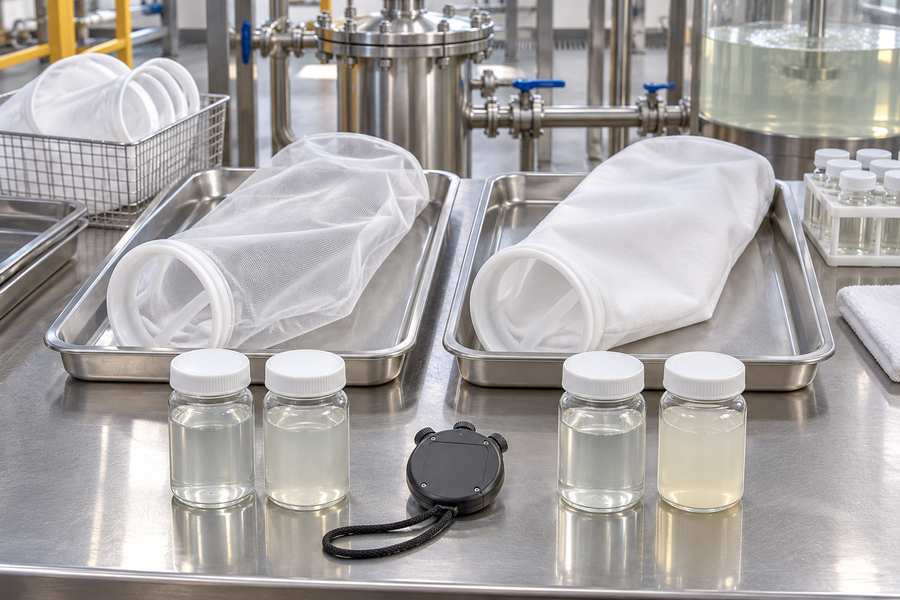
Before approving bulk purchases, arrange a representative filtration trial using the actual process liquid and contaminants. Laboratory particle measurements alone cannot establish how soft particles behave under operating pressure.
Compare candidate media under realistic viscosity, temperature, and flow conditions. Record differential pressure at startup and throughout operation, including the pressure level at which replacement becomes necessary.
Evaluate filtrate quality at both the beginning and end of the trial. Initial retention may appear satisfactory, but particle breakthrough can develop as differential pressure increases or the media becomes loaded.
Track product quality alongside contaminant removal. In processes containing valuable suspended ingredients, determine whether the selected medium unintentionally retains desirable material and creates unacceptable product losses.
Request application-specific media recommendations from Zonel Filtech using representative liquid samples, contaminant descriptions, operating temperature, flow rate, and expected pressure conditions. Agree on measurable acceptance criteria before moving from trial quantities to regular production purchases.