
Put bag filters in parallel when the main job is to share flow across more filtration area. Put them in series when the liquid needs successive treatment steps, such as removing coarse debris before a finer polishing stage. Those two arrangements solve different problems. Adding another vessel does not automatically give a line both greater capacity and finer separation.
The distinction becomes clear on a running plant. Two branches can reduce the load on each bag, provided the flow actually divides between them. Two successive vessels make every litre pass through both stages, so their pressure losses accumulate. In either layout, select the wetted components and service procedure for the actual formulation and its operating conditions.
Follow one litre through the proposed layout
Start with a simple piping sketch. Mark the inlet, every branch, each filter, the return connection, and the outlet. Then trace one litre of liquid from the feed tank to the receiving equipment. This catches surprisingly common misunderstandings before anyone specifies a second housing.
In a parallel system, the inlet header divides that litre between two or more paths. Each portion normally passes through one filter before the streams recombine. If every branch contains the same approved bag, the combined stream should meet the same separation requirement as an individual branch, assuming intact seals and comparable operating conditions.
In a series system, the whole litre passes through the first vessel and then the next. The second bag receives whatever the first bag allows through. The stages can have different jobs, but simply installing identical bags one after another does not guarantee a useful improvement in quality.
A third arrangement combines the two: parallel branches within a stage, followed by a second stage. That can address both hydraulic demand and staged removal, although it introduces more valves, seals, drains, and operating decisions. The extra equipment needs a defined purpose.
What parallel filters can improve
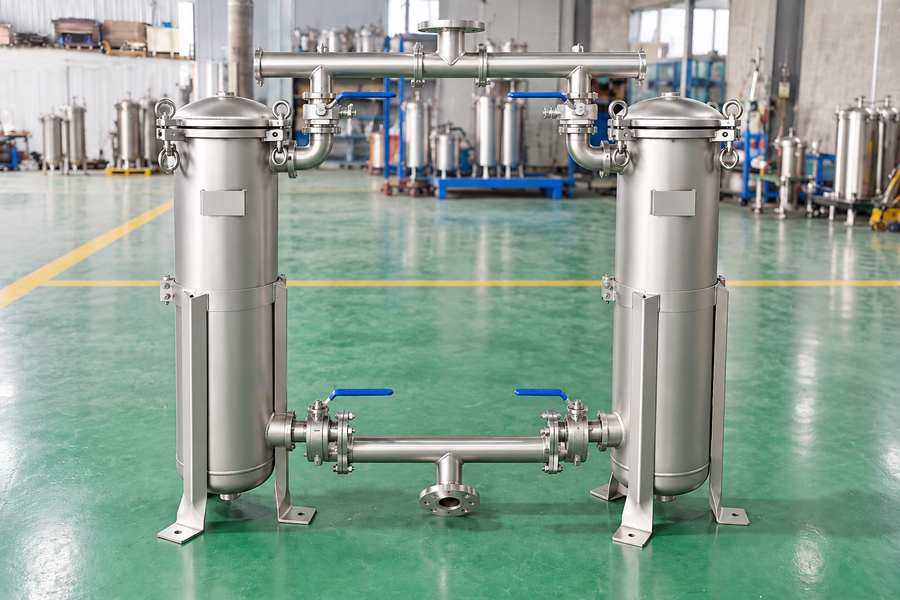
Parallel filtration is usually worth investigating when an otherwise suitable bag sees too much flow or contaminant loading. Sharing the duty can lower the superficial velocity through the media and reduce clean resistance. It may also give each bag more time before the plant reaches its changeout criterion.
Consider a purely illustrative line carrying 20 cubic metres per hour through one bag. Two equally loaded branches would each carry 10 cubic metres per hour. This arithmetic describes the intended split, not a guarantee of equal distribution or a prediction that pressure drop will halve. The actual result depends on the media resistance, liquid viscosity, branch piping, and how the bags load.
The upstream and downstream common pipes still carry the full 20 cubic metres per hour. If a restrictive header, control valve, or heat exchanger dominates the line loss, another filter branch may deliver little additional throughput. Separate the resistance of the filter assembly from the rest of the circuit before buying equipment.
Parallel capacity also depends on usable media area. A larger housing does not help if the fitted bag folds against its basket or part of the surface cannot receive flow. Check the supported bag dimensions and sealing arrangement when evaluating stainless steel bag filter housings.
Equal pipe sizes do not prove equal flow
Two branches can look symmetrical and still behave differently. One may contain more elbows, a partly closed valve, a longer flexible connection, or a bag from a different grade. The cleaner branch then takes more flow. As it loads, the distribution changes again.
Use the most comparable branch geometry practical, and provide a way to establish the actual split during commissioning. Depending on the installation, this may involve permanent flow measurement or a suitable temporary measurement method. Pressure readings alone do not always distinguish unequal flow from unequal element resistance.
Balance should be assessed under clean conditions and later in the run. A satisfactory startup reading does not establish that the branches remain well matched throughout a batch. Record bag identities and replacement times so that an unexpected shift has a traceable explanation.
What series filters can improve
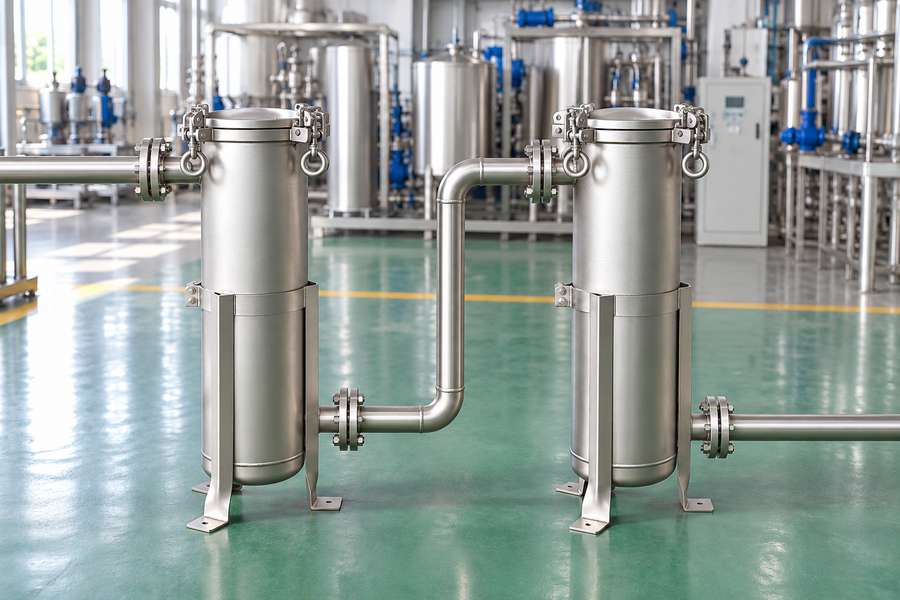
Series filtration makes sense when the feed contains different contaminant fractions that are better handled separately. A first bag can retain coarse fragments while the next stage controls smaller particles that affect the finished product or downstream equipment. The upstream stage is useful only if it removes enough relevant material to justify its own resistance and maintenance.
For example, a liquid may contain occasional large pieces of packaging debris together with a persistent fine particulate load. A coarse protective stage could intercept the large pieces, leaving the final stage to perform its specified duty. The example illustrates the purpose of staging; it does not specify the ratings to install.
Choose the grades from actual feed and filtrate results. The micron number printed on a bag does not describe the whole retention curve, especially when suppliers use different nominal efficiency definitions. Two numbers that appear neatly spaced in a catalogue can overlap substantially in service.
Series arrangements are less convincing when almost all the problematic material passes through the proposed first stage. In that case, the final bag still carries nearly the same burden while the plant gains another vessel to clean and drain. Test the first stage contribution before accepting a longer equipment list.
Account for the combined pressure requirement
At a given operating condition, the pressure loss through the first filter, connecting pipe, and second filter contributes to the total required pump head. Each stage also changes as it loads. A design based only on clean water measurements can run out of pressure margin during a cold or heavily contaminated batch.
Measure differential pressure across each filter separately, as well as the pressure available to the overall process where needed. One reading across both vessels can show that resistance has increased, but it cannot identify which bag requires attention. Changing both bags together may discard useful capacity and increase product loss.
Establish a stage-specific replacement criterion within the equipment and media limits. The final stage may need replacement because quality changes before the usual pressure limit is reached. The first stage may reach a hydraulic limit while the final bag remains serviceable. The operating procedure should allow for both cases.
Compare the arrangements against the actual problem
| Observed problem | Arrangement to investigate | Evidence needed |
| High clean resistance at the required flow | Parallel filters or more effective area | Viscosity, branch flow, clean differential pressure |
| Final bag rapidly fills with coarse debris | Coarse stage before the final stage | Contaminant distribution and loading at each stage |
| Production must continue during service | Duty and standby changeover arrangement | Full-duty capacity and validated valve sequence |
| Poor filtrate despite low differential pressure | Investigate media and sealing first | Outlet samples, bag fit, and retention performance |
| Both high flow and mixed contaminants | Parallel capacity within a staged process | Full operating envelope and stage-by-stage testing |
Parallel operation is not automatically duplex operation
Two vessels operating together to handle the full production rate are not necessarily a duty and standby system. If both are required to carry normal flow, taking one offline can double the demand on the remaining branch. Its clean pressure drop and loading rate may then be unacceptable.
A true uninterrupted-service strategy requires the available path to handle the intended flow while the other path is safely isolated. That could mean each vessel is sized for full duty, or that a larger bank retains sufficient capacity when one unit is removed. State the required operating condition explicitly.
The changeover sequence matters as much as installed area. The incoming path needs the correct bag, a sound seal, and the prescribed filling and venting procedure. Operators must establish a filtered flow path before isolating the other vessel without creating an uncontrolled pressure transient.
Never assume that a bypass around the entire filter bank is an acceptable production route. If unfiltered liquid would compromise the product or downstream equipment, the piping and controls should prevent an inadvertent bypass from being treated as normal operation.
Design for service, drainage, and sample access
The most elegant flow diagram can become awkward in a crowded plant. Allow room to open each lid, lift a wet bag and support basket, inspect sealing surfaces, and place used media in a suitable container. Adjacent vessels should not obstruct one another during routine service.
Provide isolation and a controlled means of verifying depressurization before opening equipment. A low reading on one gauge is not a substitute for the site’s isolation procedure. Trapped liquid, blocked instrument connections, and pressure from an adjacent operating branch all need consideration in the design review.
Drainage affects both housekeeping and yield. More vessels mean more liquid retained at the end of a batch. A series system may hold different quality fractions in its separate stages, so recovery streams cannot automatically be mixed with saleable product. Define where the drained liquid goes and how it is assessed.
Sampling points should make the trial interpretable. For series filters, samples before the first stage, between stages, and after the final stage show what each vessel contributes. For parallel filters, sampling individual branches helps identify a weak bag or seal that might be hidden after mixing.
Keep media selection separate from piping selection
Changing the arrangement does not correct chemical incompatibility or an unsuitable retention grade. The bag material must tolerate the process liquid, cleaning chemicals, temperature, and expected operating duration. The seal and basket need the same attention as the fabric.
Parallel branches usually need comparable media when their outlets recombine into one quality-controlled stream. Mixing a coarse bag in one branch with a fine bag in another does not create sequential treatment. Some of the liquid will take the coarse path and never encounter the fine media.
Series filters permit deliberately different media duties, but that choice still requires evidence. Review the available micron-rated liquid filter materials against the actual liquid and retention objective, then request the relevant efficiency and compatibility information for the proposed grade.
Select the downstream retention grade from the required filtrate quality and trial results, rather than assuming that finer media will improve the process. Unnecessary fineness may increase pressure demand, shorten runs, or remove material that belongs in the product. The target is a defined outlet condition, not the smallest number available.
Run a trial that can distinguish the options
Begin with a baseline using the current arrangement. Record flow, liquid temperature, inlet and outlet pressure, feed condition, accepted volume, and the reason the run ended. Keep sampling methods consistent. Otherwise, a warmer trial batch may make a new layout appear better than it is.
For a parallel trial, measure each branch and examine whether both bags use their available capacity. Compare the total acceptable volume before service, not simply the clock time. A slower line can appear to have a longer filter life while producing no more usable product.
For a series trial, inspect the loading of both stages and compare intermediate samples with the final outlet. A first bag that stays almost clean while the second blocks quickly deserves closer examination. It may be too open, poorly sealed, or simply unnecessary for that contaminant distribution.
Include startup, the heaviest expected feed, and the end of the batch. Then rehearse maintenance and restart under the approved procedure. Record off-spec liquid, drains, replacement media, and operator time. Those observations reveal whether the arrangement improves the complete production cycle.
Write the purchase specification around operating states
A useful specification states the normal production rate, maximum viscosity, expected solids variation, required filtrate quality, and allowable pressure loss. It also states what must happen when a bag is dirty, a branch is isolated, or the line restarts after cleaning.
Ask the supplier to identify the duty of every vessel and the expected flow through it in each state. Include instrument locations, isolation boundaries, bag access, drainage, and the spare media needed for routine service. This makes proposals easier to compare than a request for two filters of a certain connection size.
The final choice should follow the test results. Use parallel paths when distributing the duty solves the measured constraint. Use successive stages when separate removal steps demonstrably protect the final result. If both are needed, size and validate each function independently so the plant gains predictable operation rather than extra equipment with an uncertain role.