
Filter bags are at the heart of industrial dust collection systems, especially in baghouse filtration used across cement plants, power generation, metallurgy, chemical processing, and food industries.
Among the most widely used materials, polyester (PE), Nomex (aramid), and PTFE (polytetrafluoroethylene) dominate the market. Each has unique strengths and limitations, making them suitable for different environments.
Common Filter Bag Materials
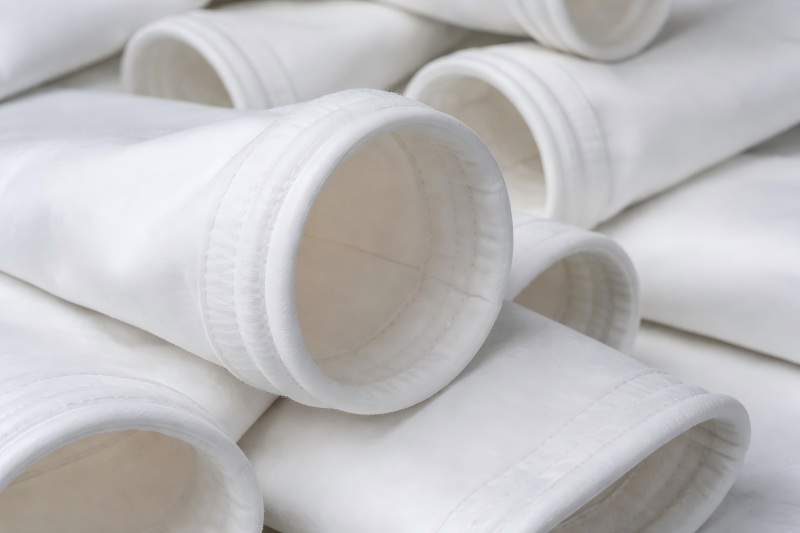
Polyester Filter Bags (PE)
Polyester is widely used for filter bags because it offers a cost-effective and versatile solution for various industrial applications.
- Strong mechanical strength
- Excellent abrasion resistance
- Good dimensional stability
- Cost-effective for general applications
| Pros | Cons |
| Low cost | Poor high-temperature resistance |
| Excellent abrasion resistance | Sensitive to moisture and hydrolysis |
| High airflow and permeability | Limited chemical resistance |
| Easy to manufacture and replace |
However, polyester has limited heat resistance (typically ≤150°C) and is sensitive to moisture and strong chemicals .
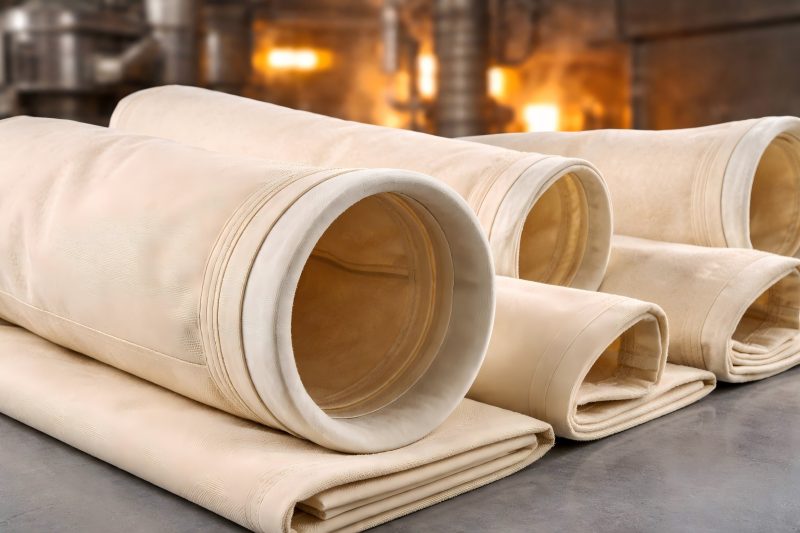
Nomex Filter Bags (Aramid)
Nomex is an advanced meta-aramid material valued for its superior heat resistance and inherent flame-retardant properties.
- Continuous temperature resistance up to ~200–260°C
- Excellent flame retardancy
- Strong mechanical and thermal stability
- Longer service life in hot conditions
| Pros | Cons |
| Excellent heat resistance | Higher cost than polyester |
| Flame retardant | Moderate chemical resistance |
| Strong and durable | Not ideal for extremely corrosive environments |
| Good performance under thermal cycling |
Nomex is widely used in high-temperature industrial processes, especially where temperature fluctuations occur.
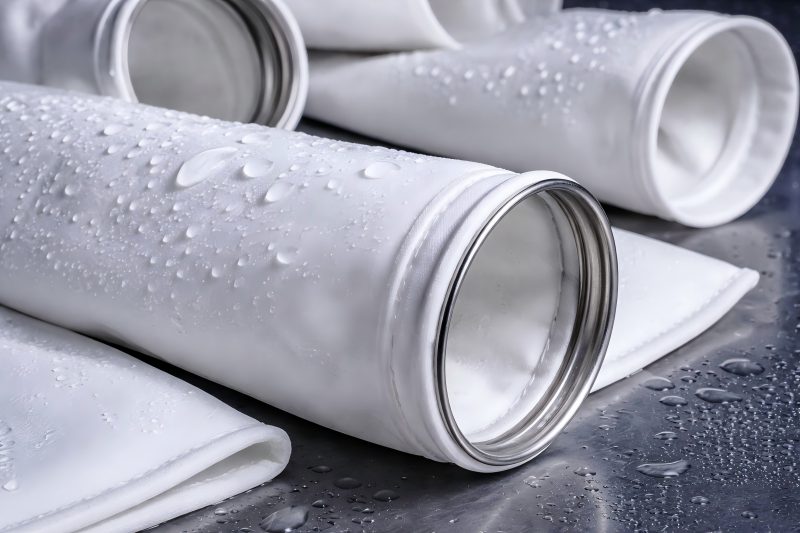
PTFE Filter Bags (Teflon)
PTFE is a premium material with exceptional chemical inertness and non-stick properties.
- Near-universal chemical resistance
- High temperature resistance (~260°C)
- Extremely high filtration efficiency (up to 99.99%)
- Hydrophobic and non-stick surface
| Pros | Cons |
| Outstanding chemical resistance | High initial cost |
| Highest filtration efficiency | Lower mechanical strength compared to polyester |
| Hydrophobic and non-stick | Overkill for simple applications |
| Longest lifespan |
PTFE is considered the top-tier solution for harsh environments, though it comes with a higher upfront cost.
Key Performance Comparison
| Property | Polyester (PE) | Nomex (Aramid) | PTFE |
| Max Continuous Temperature | ~130–150°C | ~200–260°C | ~240–260°C |
| Chemical Resistance | Moderate | Good | Excellent |
| Moisture Resistance | Poor–Moderate | Moderate | Excellent |
| Filtration Efficiency | High | High | Very High (up to 99.99%) |
| Abrasion Resistance | Excellent | Good | Moderate |
| Cost | Low | Medium | High |
| Lifespan | 2–4 years | 3–5+ years | 6–8+ years |
Temperature Resistance
Temperature is often the first deciding factor when selecting a filter bag.
- Polyester:Limited to low-to-medium temperatures (≤150°C)
- Nomex: Ideal for high temperatures (up to 260°C)
- PTFE: Matches Nomex in heat resistance but offers better stability under chemical stress
Filtration Efficiency
Filtration efficiency determines how well fine particles are captured.
- Polyester: ~98–99% efficiency
- Nomex: High efficiency for fine particles
- PTFE: Up to 99%, especially with membrane coatings
Chemical Resistance
Chemical exposure (acids, alkalis, solvents) significantly affects filter life.
- Polyester: Limited resistance; degrades in harsh environments
- Nomex: Better resistance but not universal
- PTFE: Nearly inert, resistant to almost all chemicals
Moisture and Hydrolysis Resistance
Moisture is often underestimated but can destroy filter bags.
- Polyester: Prone to hydrolysis (breakdown in humid conditions)
- Nomex: Moderate resistance
- PTFE: Completely hydrophobic and moisture-resistant
Dust Release & Cleaning Performance
Cleaning efficiency affects energy consumption and system performance.
- Polyester: Good dust release
- Nomex: Moderate
- PTFE: Excellent (non-stick surface)
PTFE’s non-stick surface reduces clogging and pressure drop, improving system efficiency.
Service Life & Maintenance
| Material | Typical Lifespan | Maintenance |
| Polyester | 2–4 years | Frequent replacement |
| Nomex | 3–5 years | Moderate |
| PTFE | 6–8 years | Low |
Although PTFE has a higher initial price, its extended lifespan and reduced maintenance needs often lead to lower overall ownership costs.
Application Scenarios
Polyester Applications
- Wood processing
- Food industry
- Pharmaceuticals
- Cement (low-temperature stages)
Nomex Applications
- Asphalt plants
- Cement kilns
- Steel and metallurgy
- Carbon black production
PTFE Applications
- Waste incineration
- Chemical processing plants
- Power plants with corrosive flue gas
- Pharmaceutical clean environments
Cost vs Performance Analysis
Initial Cost Comparison
| Material | Relative Cost |
| Polyester | $ (Lowest) |
| Nomex | $$ |
| PTFE | $$$ (Highest) |
Total Cost of Ownership
While polyester is cheaper initially, it may require frequent replacement. PTFE, although expensive, often:
- Lasts 2–3× longer
- Reduces downtime
- Lowers maintenance costs
- Improves energy efficiency
Choosing the Best Filter Bag
When selecting between polyester, Nomex, and PTFE, consider these key factors:
Operating Temperature
- <150°C → Polyester
- 150–240°C → Nomex
- Extreme/variable → PTFE
Gas Composition
- Mild → Polyester
- Moderate chemicals → Nomex
- Strong acids/alkalis → PTFE
Dust Characteristics
- Dry dust → Polyester
- High-temperature dust → Nomex
- Sticky/fine dust → PTFE
Moisture Levels
- Dry → Polyester
- Moderate → Nomex
- High humidity → PTFE
Budget Constraints
- Tight budget → Polyester
- Balanced → Nomex
- Performance-driven → PTFE
Which Is Best?
The best option varies based on your operating conditions.
✔ Choose Polyester if:
- You need a cost-effective solution
- Operating conditions are mild
- Temperature is low
✔ Choose Nomex if:
- You operate in high-temperature environments
- You need durability and flame resistance
- Conditions are moderately harsh
✔ Choose PTFE if:
- You face corrosive gases or high humidity
- You require maximum filtration efficiency
- You want the longest lifespan and lowest maintenance
Final Comparison Summary
| Criteria | Best Material |
| Cost Efficiency (Short-term) | Polyester |
| High Temperature | Nomex / PTFE |
| Chemical Resistance | PTFE |
| Filtration Efficiency | PTFE |
| Durability | PTFE |
| General Use | Polyester |
There is no one-size-fits-all answer to “which filter bag is best.” Each material serves a distinct purpose:
- Polyester dominates in affordability and general applications
- Nomex excels in high-temperature environments
- PTFE leads in extreme conditions and performance
In practice, the “best” filter bag is the one that balances performance, durability, and cost for your specific process conditions.