
An extra liquid filtration stage is worth considering when it performs a distinct job that the existing stage cannot handle efficiently on its own. It may remove a coarse contaminant fraction before a finer element, protect a sensitive downstream process, or provide a separately monitored polishing step. It is less useful when it repeats the same duty without improving accepted output or reducing the burden on the final filter.
The decision should begin with feed quality and the required filtrate, not with a standard sequence of micron ratings. Adding another vessel also adds resistance, retained liquid, maintenance, and another set of seals. A two-stage installation can be a sound choice, but only when its benefits survive a comparison of the complete production cycle.
Define what counts as a stage
In a series arrangement, the whole liquid stream passes through one filtration step and then another. Each step can have its own medium, retention performance, differential pressure measurement, and maintenance interval. That is the usual meaning of multi-stage filtration in this discussion.
Several bags inside one housing do not automatically constitute several stages. They commonly share the same filtration duty and provide more area within the same step. Likewise, two similar housings connected in parallel divide the flow; they do not necessarily produce progressively finer separation. Confusing area with staging can lead to the wrong equipment purchase.
A single stage can also use a medium with an internal density gradient. That construction may capture different particles through its depth, but operators still replace and monitor it as one element. Whether an additional external stage helps depends on how the feed loads that element, not on the number of layers described in its construction.
Draw the proposed flow path and assign a purpose to every vessel. If the explanation for the extra stage is simply more filtration, the specification is not ready. State what material it should remove, what it protects, and what measurement will demonstrate that it is doing so.
When a single stage is a sensible starting point
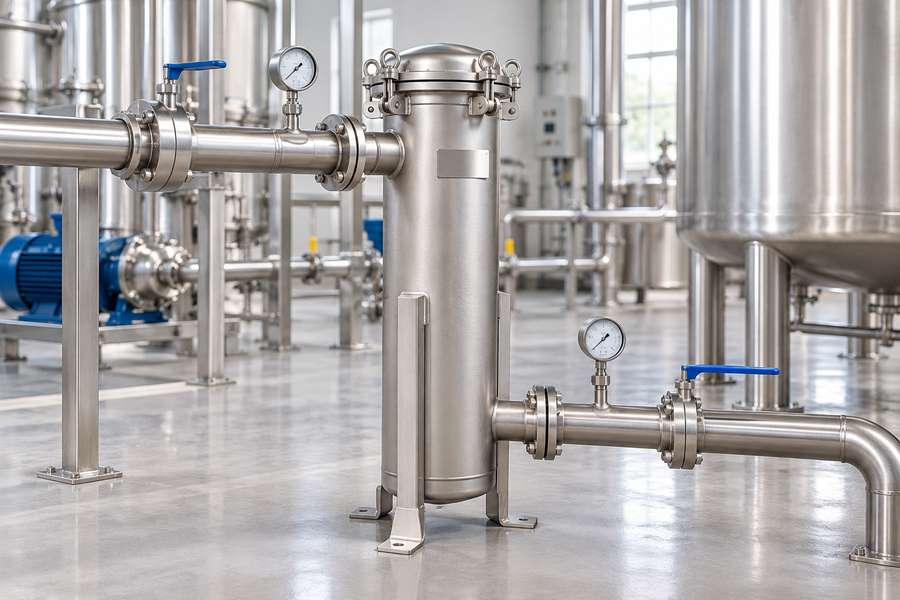
A stable, relatively light contaminant load and a clear final quality requirement can often be addressed by one suitably selected stage. The important condition is that the stage can meet the required flow and quality for a practical production interval. A single-stage design is not inherently basic or inadequate.
One stage offers fewer connections and less equipment to drain, clean, inspect, and recommission. This can be valuable for short batches, frequent product changes, or products for which retained inventory has a significant effect on yield. It also makes the relationship between feed quality and element performance easier to observe.
Before adding a prefilter, check whether the present stage has enough effective area. If a correctly selected clean element begins with excessive resistance at the required flow, increasing area may address the actual problem more directly. A new upstream stage cannot remove the clean resistance of the downstream one.
Also inspect installation and sealing. A final quality failure caused by bypass does not establish that a second stage is needed. Correct the failed barrier and verify the result. Additional equipment should not be used to hide an unresolved problem in an existing housing.
Judge the whole run, not the first sample
A single stage must perform at startup, during stable operation, and near the approved replacement point. A satisfactory sample taken immediately after installation says little about late-run performance. Conversely, a poor startup sample may reflect residual contamination or an incomplete commissioning sequence rather than insufficient stages.
Keep the quality requirement separate from the operating limit. An element can reach an unacceptable pressure drop while still producing acceptable filtrate, or it can lose acceptable retention without a dramatic pressure increase. The appropriate end of a run is determined by all relevant criteria.
What an extra stage can do well
A coarse upstream stage can be useful when a substantial coarse fraction consumes the capacity of a finer final element. In that situation, the first stage removes material that does not need to occupy the fine medium. The final stage can then concentrate on the particle range that determines the product requirement.
This approach needs evidence of a separable burden. Examine feed samples and spent elements, and compare upstream and downstream particle results where the method is appropriate. A stream containing mostly fine, deformable material may load both stages without delivering much protection to the final element.
An extra stage may also isolate an operational problem. For example, an upstream step that sees intermittent debris after tank transfers can be monitored and serviced independently of a downstream polishing step. That separation is useful when it makes maintenance more predictable, provided the additional resistance remains acceptable.
Some processes need different separation mechanisms or media properties at different points. A robust primary stage and a higher-efficiency final stage may be justified by those different requirements. Specify each stage from its actual duty rather than assuming that one supplier’s nominal rating is directly comparable with another supplier’s absolute rating.
The liquid filtration equipment range provides several possible equipment types, but the arrangement should follow the process. Bag, cartridge, and other pressure filtration systems serve different combinations of loading, quality, and maintenance needs. Selecting a familiar vessel is not a substitute for assigning its role.
A finer second rating is not a complete design
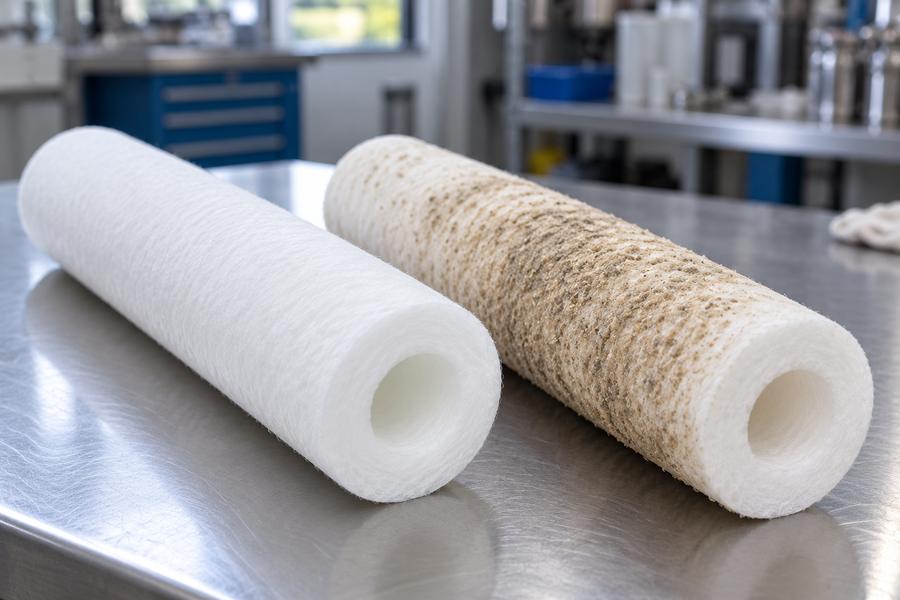
A sequence such as coarse then fine is only a starting description. The actual removal efficiency, contaminant shape, fluid properties, flow, and media construction determine what reaches the second stage. Two micron numbers alone do not show how much load the first stage will remove.
Ask how retention was measured and at what operating conditions. A nominal label does not by itself establish a fixed percentage removal, while an absolute designation still needs a defined test basis. Compare the information at the particle sizes relevant to the process, and retain the supporting data with the trial specification.
The upstream medium should intercept enough of the unwanted load to justify its presence without taking over the fine stage’s job inefficiently. If it is too open, it may provide little protection. If it is unnecessarily tight, it can become the new bottleneck and require frequent changes of its own.
There is no universal spacing between stage ratings that works for every liquid. A trial using representative feed is more useful than selecting a fixed ratio between labels. Where the feed changes by season or batch, include that variation in the evaluation instead of optimizing only for the easiest operating condition.
Account for the total pressure requirement
In a series system, the pressure losses of the stages and their connecting components add along the flow path. The pump and process must accommodate the required flow when the elements are loaded, not only when both are new. Confirm the pressure available at the downstream equipment as well as the differential across each filter.
Measure each stage separately. A single differential reading across the whole train may show that resistance is rising without identifying which stage is responsible. Separate measurements also help establish replacement criteria and reveal whether the prefilter is actually relieving the final stage.
Consider the combinations that can occur in normal operation: both elements clean, the first partly loaded and the second near its replacement point, or a fresh first element feeding an older final element. The arrangement must remain within its approved operating envelope through the intended sequence.
Before using a higher pump speed to recover throughput, confirm that the complete line can tolerate the resulting operating conditions. A higher pressure can affect equipment loads and process conditions. Housing pressure limits, element differential limits, temperature limits, and downstream requirements all remain relevant after an extra stage is installed.
Distinguish a pressure problem from a capacity problem
If the final stage starts with acceptable resistance but loads too quickly, upstream separation may help. If the final stage starts too high, examine area, viscosity, flow, and connections first. The same symptom of low output can therefore lead to different corrective actions.
Compare readings at matching flow and temperature. A trial that appears to lower final-stage pressure because total flow has fallen does not demonstrate better filtration capacity. Record accepted output along with each pressure measurement so that a hydraulic penalty is not mistaken for an improvement.
Include hold-up, cleaning, and changeover in the comparison
An extra vessel holds additional liquid and introduces more surfaces that may require cleaning. For high-value or frequently changed products, that inventory can matter even if element consumption falls. Measure the liquid recovered and discarded during each stage’s maintenance rather than assuming all of it returns to production.
Review the proposed filter housing arrangement for drain location, access, support, and the routes used for recovery and waste. Maintenance should be possible without exposing the clean side to dirty drainage or confusing the destinations of different streams.
Longer final-element life does not necessarily mean fewer production stops. If the upstream stage needs frequent attention and cannot be isolated without stopping the line, the number of interruptions may increase. Compare the whole train’s maintenance schedule, including the time required to drain, replace, refill, and release the system.
For products with residence-time or hygiene limits, the added inventory can also change the operating procedure. Consider what happens during a pause, an overnight shutdown, or a grade change. A system that performs well during a continuous trial may be awkward in the plant’s actual production schedule.
Run a comparison that can support the decision
Start with a documented single-stage baseline. Record element identity, feed source, flow, temperature, quality results, processed volume, and the reason the run ended. Use a representative production period rather than a convenient short interval with unusually clean feed.
Test the proposed additional stage while keeping the final requirement and comparison conditions consistent. If the final element is changed at the same time, record that as a separate variable. Otherwise, it may be impossible to tell whether the improvement came from staging or from the replacement medium.
- Quality: Compare the same downstream acceptance test at startup, during the run, and near the stopping point.
- Hydraulics: Record flow, temperature, and differential pressure across each stage.
- Capacity: Track the volume or mass of accepted liquid produced before each replacement.
- Maintenance: Count every element change and the resulting production interruption.
- Yield: Include retained product, recovery, cleaning discharge, and startup diversion.
Use paired samples with a clear sampling method. A sample taken from settled feed and another from a well-mixed outlet can produce a misleading comparison. Flush sample connections as required by the method and identify the sample time relative to transfers, starts, and stops.
Repeat the trial where feed variability is material to the decision. If the first stage helps only during a particular raw material condition, that may still justify it, but the operating strategy should reflect the evidence. A permanent extra stage is not the only possible response to an intermittent problem.
Choose from the result, including the inconvenient parts
| Trial observation | What it suggests |
| Final quality is met, runs are practical, and maintenance is manageable with one stage | Retain the simpler arrangement unless another requirement justifies expansion |
| The first stage removes a distinct load and materially extends useful final-stage operation | Staging may be justified if total pressure, yield, and maintenance remain acceptable |
| Both stages load rapidly with similar material | Revisit feed treatment or media selection rather than assuming another stage will help |
| Final-stage life improves but throughput falls or product loss rises | Evaluate the complete production tradeoff before adopting the arrangement |
| Clean resistance is excessive before meaningful loading occurs | Review area, fluid conditions, and the installed flow path |
Write the decision in terms of accepted production. The relevant result might be more batches completed without interruption, fewer final-element changes, or more stable downstream quality. State the conditions under which that result was demonstrated and the conditions still requiring validation.
Keep an extra stage when it earns its place through a defined separation task and a measured operating benefit. Keep a single stage when it already meets the duty reliably. The number of vessels is an outcome of the process requirements; it should never become the performance target itself.