
A filter cloth plant trial should track seven measurements: filtration cycle time, filtrate flow rate, filtrate quality, cake moisture, cake release, filtration resistance, and cloth condition.
Recording these indicators under comparable operating conditions helps engineers identify performance changes, investigate filtration problems, and determine whether a candidate cloth meets production and maintenance requirements.
1. Filtration Cycle Time
Recording only the total cycle duration can hide the stage responsible for delays. Divide the operating sequence into individual stages wherever the equipment configuration allows.
- Filling time: Record the duration required to introduce slurry into the filtration chambers.
- Filtration time: Measure the period during which liquid passes through the cloth and filter cake.
- Squeezing time: Record membrane squeezing or other mechanical dewatering stages when applicable.
- Air-blowing time: Track the duration of air displacement or cake drying where these operations are used.
- Discharge time: Measure how long cake removal and preparation for the next cycle require.
Use seconds or minutes consistently, and identify the beginning and ending points of every recorded stage. Keep the measurement method unchanged throughout the trial.
Compare several consecutive cycles rather than relying on one unusually fast or slow result. Longer filtration periods may indicate increased cake resistance, cloth blinding, or changing feed properties.
Longer discharge periods require a different investigation. Check whether cake adhesion, incomplete release, mechanical movement, or manual cleaning contributes to the delay.
2. Filtrate Flow Rate
Collect filtrate volume over a known time interval using a calibrated flowmeter or a suitable collection vessel.
Choose one flow unit for the trial record, such as L/min, and convert any readings from instruments that report a different unit.
Record measurements at consistent points during the filtration cycle. Initial flow, intermediate flow, and later-stage flow can differ substantially as the filter cake develops.
A declining flow rate can result from increasing cake resistance, cloth blinding, particle accumulation, or changes in slurry characteristics. Operating pressure and temperature may also influence the measured result.
Compare flow measurements with pressure readings and feed conditions before attributing a reduction to the cloth. A flow decline accompanied by changing feed solids may reflect process variation rather than cloth deterioration.
3. Filtrate Clarity and Suspended Solids
Visual inspection provides a quick indication of cloudy filtrate, discoloration, or visible particle leakage. However, appearance alone cannot establish whether the liquid meets the plant’s quality requirements.
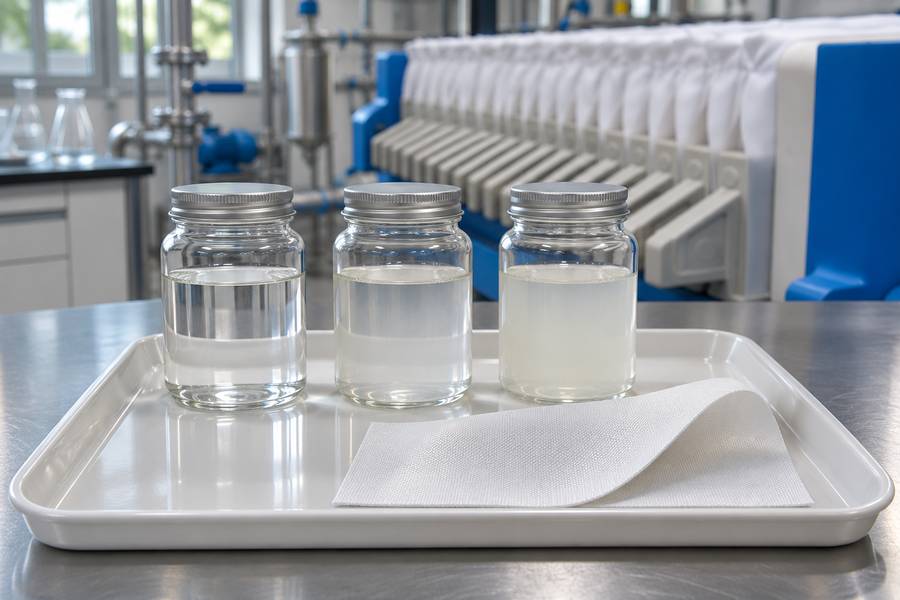
Measure suspended solids using an appropriate laboratory or plant method. Record each sample’s suspended-solids concentration alongside its collection time, retaining the laboratory unit, usually mg/L, so early and late filtrate can be compared.
Turbidity can provide an additional indicator of changes in liquid clarity. Report results in nephelometric turbidity units (NTU) when using a suitable calibrated instrument and consistent procedure.
Turbidity and suspended solids are different measurements. Do not convert NTU directly into mg/L without an application-specific, validated relationship established for the liquid being tested.
Collect samples at comparable cycle stages and use consistent sampling locations. Record whether a sample represents initial filtrate, steady operation, or the later portion of a cycle.
Unexpected increases in suspended solids may indicate particle breakthrough, damaged fabric, seam leakage, or incorrect installation. Check sealing areas and attachment points before changing the cloth specification.
4. Filter Cake Moisture Content
Collect representative cake samples using the same procedure throughout the trial. Sampling should account for differences between chamber positions and locations within individual cakes.
Record the sampling time, chamber position, and operating cycle. Avoid comparing a freshly discharged sample with material that has undergone additional drying or exposure.
Determine moisture content using an agreed laboratory or plant method. A common mass-based calculation is:
Moisture content (%) = (Initial sample mass − Dry sample mass) ÷ Initial sample mass × 100
Record both initial and dry masses in grams or kilograms. Use the same drying procedure and endpoint criteria for all samples being compared.
Filtration pressure, cycle duration, cake thickness, and optional squeezing or air-blowing stages also affect dewatering. Record these settings alongside moisture measurements to avoid misleading comparisons.
5. Filter Cake Release Performance
Observe cake removal after each selected filtration cycle. Record whether the cake falls away naturally, separates unevenly, or requires additional mechanical assistance or manual cleaning.
- Residual cake mass: Measure remaining material where practical, using a consistent collection and weighing procedure.
- Residual surface coverage: Estimate or document the proportion of cloth surface still covered after discharge.
- Discharge consistency: Record whether similar release behavior occurs across repeated cycles and different chamber positions.
- Cleaning requirements: Document additional washing, scraping, or operator intervention needed to restore the cloth surface.
Use kilograms for residual cake mass and a consistent percentage or documented inspection scale for surface coverage. Keep the inspection point and assessment method unchanged.
Check whether sticking occurs throughout the filter or only in particular chambers. Localized problems may indicate uneven operation, installation issues, or differences in cake formation.
6. Filter Cloth Permeability and Operating Pressure Differential
Record the pressure difference across agreed measurement points during operation. Use a separate permeability test to investigate whether the cleaned cloth itself has changed.
Air permeability characterizes how readily air passes through a dry filter medium under a defined test pressure difference. It is commonly expressed in L/(dm²·min) or another unit specified by the applicable test method.
Record the test standard, test pressure, specimen condition, and measurement location. Repeat the same specimen preparation for every fabric.
A damp sample and a dry sample do not provide a fair comparison under an otherwise identical test.
Air permeability is not the same as liquid flow through an operating filter. Wetting behavior, liquid properties, particle accumulation, and cake formation influence actual process performance.
Compare initial and post-trial air permeability when evaluating changes in the fabric. A reduction may indicate deposits, pore blockage, or incomplete cleaning, although the result requires supporting inspection.
Operating pressure differential measures the pressure difference between defined locations in the filtration system. Record both pressure readings, their measurement positions, and the corresponding filtration stage.
Depending on the equipment arrangement, pressure differential can include resistance from the filter cloth, accumulated cake, flow passages, and other system components.
Check the pressure-tap locations before assigning the entire reading to the fabric; a wider measurement boundary may also include losses in the vessel or piping.
Use consistent pressure units, such as kPa or bar, and compare readings at equivalent operating conditions. Record filtrate flow at the same time to help interpret changes.
An increasing pressure differential combined with declining flow may indicate rising filtration resistance. Inspect cake buildup, cloth condition, feed characteristics, and equipment passages before identifying the cause.
7. Filter Cloth Wear and Dimensional Changes
Inspect the cloth before installation and at scheduled points during the trial. Use consistent lighting and inspection positions to make visible changes easier to identify.
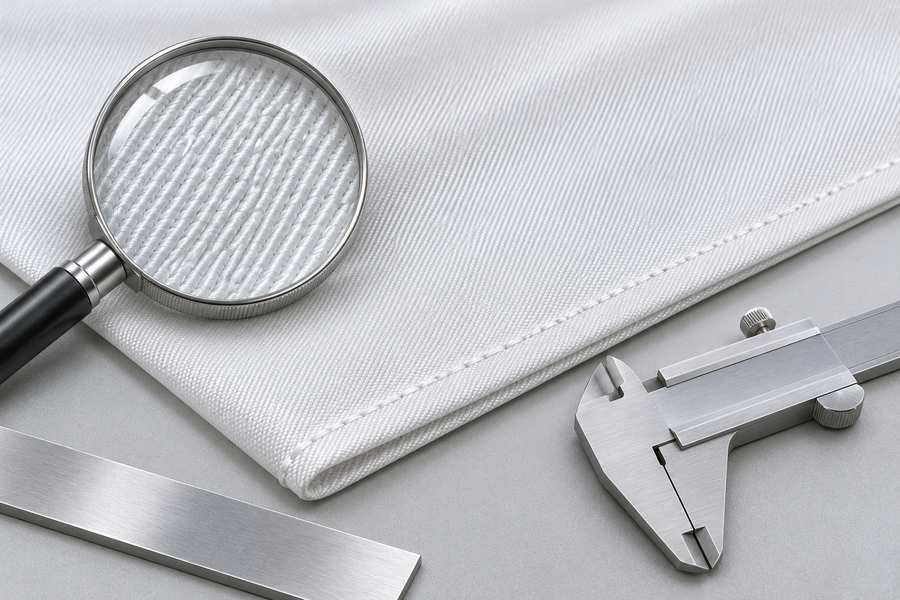
- Abrasion: Look for thinning, roughened surfaces, or localized material loss caused by contact with equipment or solids.
- Cuts and holes: Check for openings that could allow particles to pass into the filtrate.
- Fraying: Inspect fabric edges and exposed yarns for deterioration.
- Seam damage: Examine stitching and welded or otherwise joined areas for separation or weakness.
- Attachment damage: Check mounting and sealing areas for deformation, tearing, or movement.
Record the location, extent, and appearance of each defect. Photographs can supplement written inspection records when the same positions and viewing conditions are used.
Record relevant initial dimensions before installation, including cloth length and width. Repeat measurements after the trial using the same reference points and measurement conditions.
Express dimensions in millimeters and document whether the fabric is measured relaxed, installed, or under a specified tension. These conditions should not be mixed in one comparison.
Changes in dimensions may affect fitting, sealing, and alignment. Consider whether observed stretching, shrinkage, or deformation is associated with mechanical loading, temperature, chemical exposure, or cleaning.
How to Organize and Compare Plant Trial Results
When evaluating filter cloth specifications, engineers should compare the stated material characteristics with actual operating results. The trial should also account for the capabilities and operating conditions of the filter press equipment.
Before installing the trial cloth, document the existing filtration conditions wherever baseline comparison is possible. Record feed concentration, temperature, pH, and relevant particle characteristics.
Also document filtration pressure, cycle settings, cleaning procedures, and any chemical conditioning. These operating controls provide context for interpreting subsequent measurements.
Keep sampling locations, measurement intervals, instruments, and calculation methods consistent. If the plant changes a process setting, record the change and identify the affected trial period.
| Measurement | Observed change | Recommended investigation |
| Cycle time | Longer operating cycles | Review individual stages, feed conditions, and cake resistance. |
| Filtrate flow | Declining liquid throughput | Compare pressure, cake buildup, and cloth condition. |
| Filtrate quality | Higher suspended solids | Inspect fabric integrity, seams, and sealing areas. |
| Cake moisture | Higher residual moisture | Review feed properties, sampling, and dewatering settings. |
| Cake release | More residual material | Check cake adhesion and discharge conditions. |
| Permeability and pressure | Reduced permeability or rising pressure differential | Investigate deposits, cake resistance, and system losses. |
| Cloth condition | Visible damage or dimensional changes | Inspect mechanical loading, chemical exposure, and cleaning practices. |
Before approving a purchase, request a documented trial evaluation covering the candidate fabric construction, material, relevant specifications, and observed operating performance. Confirm that the tested cloth configuration matches the proposed production supply.
Agree on acceptance criteria with the supplier before the next trial or procurement stage. Specify the required measurement methods, operating conditions, sampling frequency, and acceptable performance ranges in the trial record.