
Audit compressed air at the baghouse point of use, under a representative cleaning sequence, rather than relying only on the compressor-room gauge. Check moisture control, contamination, pressure recovery, and the condition of the local treatment equipment. The purpose is to establish whether the cleaning system receives the air quality and dynamic supply its manufacturer requires, without compensating for supply problems by increasing pressure indiscriminately.
What Should the Audit Boundary Include?
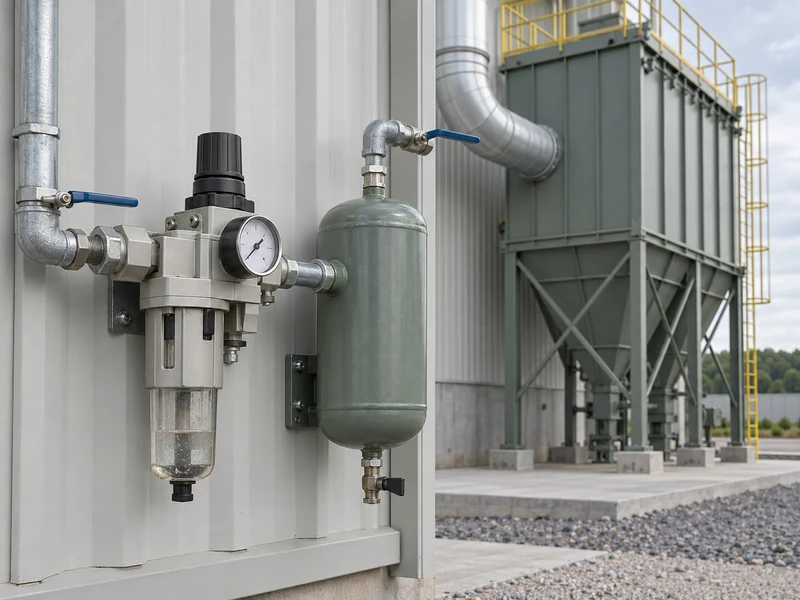
Include the compressed air route from the relevant supply header to the baghouse receiver and cleaning valves. Identify filters, dryers, regulators, drains, flexible connections, and isolation points within that route. Record which components are shared with other users.
A compressor may deliver acceptable air at one location while a remote branch experiences pressure loss or condensate accumulation. Long outdoor sections, low points, and changing demand can alter conditions at the collector. The audit boundary should capture those influences rather than treat the air network as one uniform source.
For a pulse-jet bag filter housing, ask for the manufacturer’s required supply conditions and the intended measurement location. A pressure value without its location and operating state is incomplete. Also confirm whether the requirement refers to static supply, receiver behavior, or another specified condition.
Which Air Quality Requirements Need Confirmation?
Obtain the applicable requirements for particles, water, and oil from the equipment and process stakeholders. Different duties can require different air quality, particularly when recovered dust returns to a product stream. Do not assign a universal cleanliness class to every baghouse.
The U.S. Department of Energy guidance on compressed air quality distinguishes the functions of filters and dryers and notes the pressure loss associated with filtration. It supports checking treatment performance against the actual application. It does not establish a baghouse-specific air quality class.
Record the basis of each requirement in the audit sheet. If the original specification is unavailable, identify that gap and obtain an engineering decision. A maintenance team should not have to infer an acceptable oil or moisture level from the appearance of a sight glass.
How Should Moisture Be Evaluated?
Evaluate moisture in relation to pressure dew point and the temperatures reached by the air system. A dry-looking compressor room does not establish conditions in a cold branch pipe. Condensation risk depends on whether the air cools below its relevant dew point at the operating pressure.
Review dryer performance, drain operation, low points, and seasonal temperature exposure. Use suitable measurements and record pressure with dew point data. Comparing values taken on different pressure bases without correction can lead to a false conclusion.
Avoid assuming that one drain discharge proves the entire branch is protected. A blocked drain, a damaged automatic drain, or an unrecognized low point can create a local problem. Inspection and sampling must follow the site’s safe compressed-air maintenance procedure.
How Can Oil and Particle Contamination Be Investigated?
Use an appropriate point-of-use test or laboratory method where contamination is suspected or controlled by specification. Visual inspection can identify gross contamination, but it cannot establish a numerical air quality class. Select a method that addresses the form of contamination of concern.
Review maintenance records for compressor lubricant carryover, treatment-element condition, and work performed on the distribution network. Contamination can originate downstream of the compressor. New pipework or disturbed deposits may change the local condition even when the compressor has not changed.
Record observations separately from conclusions. An oily deposit in a cleaning component is a useful finding, but its source should be investigated before a corrective action is chosen. Replacing filter bags alone does not resolve contamination entering through the cleaning air.
Why Must Pressure Be Recorded During Cleaning?
A static gauge reading describes the system when little or no air is being demanded. Pulse cleaning creates a changing demand, so the local receiver and supply branch must recover between events. Record the pressure behavior during the actual sequence to understand that dynamic condition.
Capture enough time resolution to see the relevant pressure changes using suitable instrumentation. A slowly updated display may hide a short drop. Synchronize the trace with cleaning commands so that a pressure event can be associated with the correct row or sequence.
Compare operation during low and high plant air demand where those conditions occur in normal service. If another machine’s cycle coincides with the problem, record that relationship. It may reveal a shared-supply limitation rather than a fault inside the collector.
| Audit Item | Evidence | Interpretation Boundary |
| Moisture control | Pressure dew point and branch temperature | Use a consistent pressure basis |
| Local treatment condition | Maintenance record and differential pressure | Do not infer contaminant class from appearance |
| Dynamic supply | Pressure trend during cleaning | Static readings alone are insufficient |
| Shared demand | Other equipment timing and branch behavior | Separate network effects from valve faults |
How Is This Different from a Blowpipe Inspection?
The air-quality audit examines what reaches the cleaning assembly. Blowpipe geometry, alignment, valve response, and nozzle relationships determine what happens after the supply arrives. Both matter, but they should be investigated as distinct parts of the system.
The site’s article on dust collector blowing pipe design addresses that downstream mechanical topic. If supply conditions are verified and cleaning remains uneven, the audit record helps the next investigation proceed without repeating assumptions. It does not prove that every valve or blowpipe is correct.
Similarly, a sound air supply does not establish that the installed dust filter bags match the process. Keep media suitability, installed condition, and cleaning supply evidence in separate fields. Combining them into a single “baghouse problem” label makes corrective action less precise.
Which Corrections Should Be Prioritized?
Prioritize confirmed faults that prevent the system from meeting its documented requirements. Examples may include an inoperative drain, an overloaded treatment element, or excessive local pressure loss. The correct remedy depends on the measured cause and the approved design.
Do not raise the supply pressure to conceal a restricted branch or failed component. Additional pressure can change consumption and equipment loading without correcting moisture or contamination. Any change to operating settings should remain within the manufacturer’s requirements and the site’s change procedure.
After a correction, repeat the relevant measurement under comparable conditions. A work order marked complete is not evidence that the point-of-use condition improved. Retain before-and-after records and note any difference in plant demand.
What Should Be Included in Routine Monitoring?
Select a small set of indicators that can detect the faults found during the audit. These may include receiver pressure behavior, treatment-element pressure loss, drain checks, and periodic moisture verification. The interval should reflect the service and the consequences of a deviation.
Use the site’s dust collector maintenance guidance for the wider maintenance context. The air-quality record should complement that routine rather than duplicate every inspection on the collector. Assign responsibility for each indicator so that a concerning trend has an owner.
Where conditions change seasonally, retain a baseline from the relevant season. A summer check cannot automatically establish winter condensation performance. Identify the next review date around the actual operating exposure.
What Makes the Instrument Record Useful?
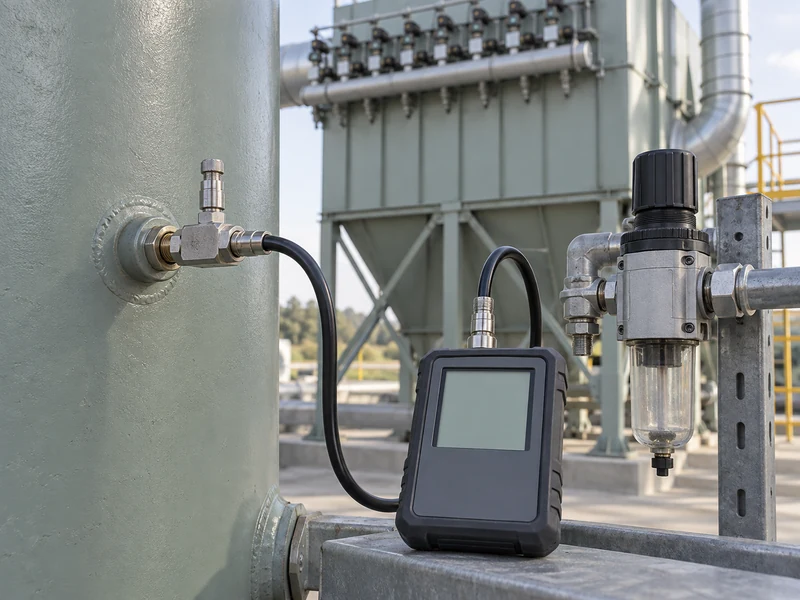
Identify each instrument, its measurement range, and the location where it was connected. Record the time basis of the pressure trend so that another reviewer can align it with cleaning events. A screenshot without those details may be impossible to interpret after the audit.
Use instruments appropriate to the pressure, medium, and required response time, installed by authorized personnel. A temporary connection must not defeat the equipment’s containment or protection arrangements. Where a measurement cannot be made safely with the existing provisions, record the limitation and obtain a suitable engineering solution.
Keep the raw data as well as the summary chart. A short disturbance may be lost in an averaged presentation, while a noisy trace may create a misleading impression of instability. Retaining both allows the team to revisit the conclusion without repeating the entire site visit.
What Does a Useful Audit Conclusion Look Like?
State the measured point-of-use conditions, the requirements used for comparison, and any remaining uncertainty. Identify whether each issue concerns treatment, distribution, dynamic demand, or the collector’s cleaning components. That structure makes the handover actionable.
Relate the findings to observed process symptoms without assuming a single cause. The site’s filter bag clogging discussion lists other conditions that can produce poor performance. An air audit resolves one part of that investigation with measurements.
When requesting support from Zonel Filtech, provide the supply diagram, pressure traces, cleaning sequence, and relevant moisture or contamination results. Include the collector and bag specifications as context. Those records allow a focused technical discussion instead of a recommendation based only on a remote gauge reading.