
Filter cloth permeability describes how easily fluid passes through the media, while filtration efficiency indicates how effectively the cloth retains particles. A flow measurement cannot establish a particle-retention percentage.
Buying decisions need both measurements. Their relationship changes with the slurry, fabric construction, and developing cake, so test conditions matter as much as the numbers on a specification sheet.
What Is Filter Cloth Permeability?
However, permeability is not a universal value independent of testing conditions. The measured result depends on the fluid, pressure difference, temperature, fabric structure, and measurement method.
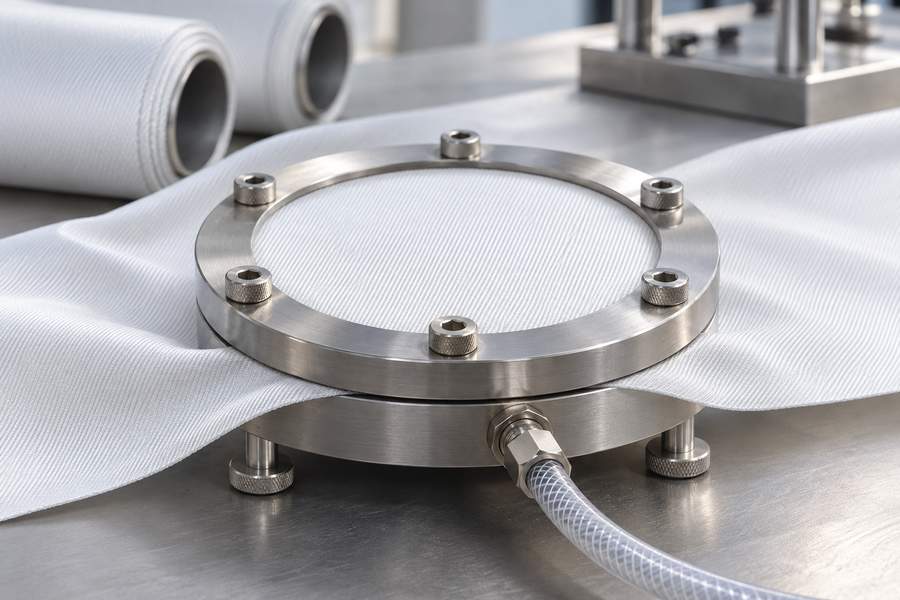
Fluid moves through openings between yarns and through the interconnected spaces within the fabric structure. The size, distribution, and continuity of these passages influence the resistance encountered during filtration.
- Weave structure: Different weave patterns create different arrangements of yarn intersections and openings.
- Yarn characteristics: Filament diameter, yarn type, and arrangement influence the available flow passages.
- Fabric thickness: The distance fluid travels through the media can influence its resistance.
- Finishing: Heat setting, surface treatments, and other finishing processes can change fabric dimensions and pore characteristics.
In an air test, the instrument holds a fabric specimen across its opening and records airflow at a controlled pressure difference. Results are commonly reported as airflow per unit area and time.
The stated test pressure is essential when interpreting the result. Values obtained under different pressure conditions or test methods should not automatically be compared as equivalent specifications.
Air permeability must also be distinguished from liquid permeability. Air and liquid interact differently with porous structures, particularly when wetting, surface tension, viscosity, and fluid properties affect passage through the fabric.
Therefore, an air permeability value at a stated pressure does not establish liquid permeability, filtration efficiency, or a specific micron cutoff. Buyers should request application-relevant information rather than infer these properties from one measurement.
Relatively high permeability generally indicates that fluid can pass through the clean fabric more readily under the specified test conditions. This characteristic may be useful when the process requires substantial fluid throughput.
Lower permeability indicates greater resistance to fluid passage under comparable conditions. It may be appropriate for certain filtration requirements, but it does not automatically guarantee better particle retention.
What Is Filtration Efficiency?
Filtration efficiency describes how effectively a filter medium removes or retains particles from a fluid stream. In liquid filtration, it is commonly evaluated by examining particle concentrations in the feed and filtrate.
Filter cloth captures particles through several mechanisms. Particles larger than available openings may be retained at the fabric surface, while smaller particles can interact with yarn surfaces and become trapped within the media structure.
Surface filtration occurs when particles accumulate primarily on the upstream face. Depth-related retention involves particles entering the fabric structure before becoming trapped within its interconnected passages.
- Particle characteristics: Particle size, shape, concentration, and distribution influence the likelihood of passage through the media.
- Fabric construction: Weave, yarn arrangement, and pore distribution affect particle interception and retention.
- Operating pressure: Pressure conditions influence fluid movement and may affect particle behavior during filtration.
- Media condition: Wear, tears, damaged seams, and installation problems can create unwanted particle passage.
- Filter cake development: Accumulated solids create an additional filtration layer that can change particle retention during operation.
Clean filter cloth and cloth covered by an established cake do not necessarily exhibit identical retention behavior. During startup, smaller particles may pass through before sufficient solids accumulate on the fabric.
As filtration continues, deposited particles form a cake that provides additional resistance and particle retention. This can improve filtrate clarity, although the developing layer also makes fluid passage more difficult.
Particle retention should therefore be evaluated at defined stages of the filtration cycle. A single sample may not represent startup behavior, established cake filtration, and the final filtrate condition.
Filter Cloth Permeability vs Filtration Efficiency: Key Differences
| Comparison factor | Permeability | Filtration efficiency |
| Main meaning | Ease of fluid passage through media | Effectiveness of particle retention |
| Main concern | Flow resistance | Particle breakthrough |
| Typical evaluation | Air or liquid permeability testing | Particle concentration or filtrate quality testing |
| Important influences | Weave, thickness, pore structure, and test pressure | Particle characteristics, media structure, and cake development |
| Purchasing relevance | Helps assess fluid passage requirements | Helps assess solids retention requirements |
A fabric with relatively open flow passages may allow fluid to pass easily, but some particles may also pass through those openings. This creates a potential conflict between throughput and particle retention.
However, permeability alone does not describe the complete pore structure. Two fabrics with similar air permeability may have different pore distributions, yarn arrangements, and particle-retention behavior.
Effective particle retention can contribute to clearer filtrate, but captured solids accumulate on the media and create additional resistance.
As the cake becomes thicker, maintaining the required flow may demand greater pressure or longer filtration time.
How Both Properties Affect Actual Filtration Performance
Fluid passage depends on resistance from both the filter cloth and the accumulated filter cake. Slurry viscosity, solids concentration, operating pressure, and cake properties also influence the overall filtration rate.
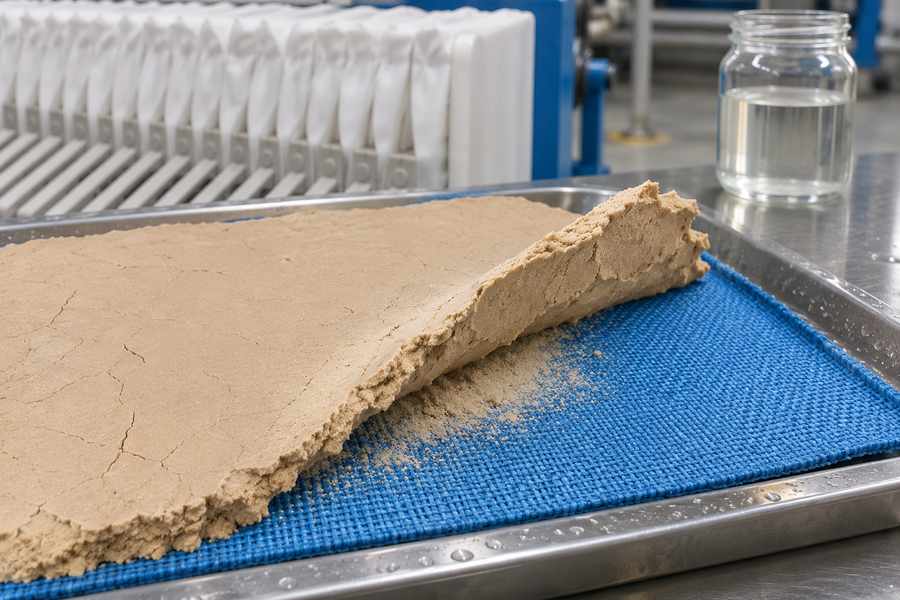
Higher clean-cloth permeability may reduce the initial resistance, but its advantage can become less significant after cake formation. A highly resistant cake can dominate the pressure loss during later filtration stages.
Cycle time also includes filling, filtration, cake discharge, and other operating steps. Consequently, changing cloth permeability alone may not substantially reduce the complete production cycle.
When evaluating particle-count concentration efficiency, inlet and outlet samples must represent comparable operating periods. Measurements should use consistent sample volumes, flow conditions, and particle-size bins.
Particle-count concentration efficiency should not be confused with solids mass recovery. The two calculations measure different outcomes, particularly when particle sizes and mass contributions vary significantly.
Deposited solids naturally increase filtration resistance as the cake develops. This is different from progressive blinding, where particles become lodged in the fabric openings and are not adequately removed during normal cleaning.
Fabric construction and surface characteristics influence how solids interact with the media and how readily the cake separates during discharge. Poor release can leave deposits that interfere with subsequent filtration cycles.
How to Select Filter Cloth Based on Permeability and Filtration Efficiency
When evaluating woven filter fabric options or specifying filter press systems, buyers should consider both properties alongside actual process requirements.
First, identify the acceptable solids content or particle concentration in the filtrate. Establish whether the application requires a particular particle-size retention level or a broader filtrate-quality target.
Evaluate the slurry before selecting the fabric construction. Particle size distribution, solids concentration, liquid viscosity, temperature, and chemical composition all influence media suitability.
Also consider operating pressure, expected cake thickness, filtration duration, and available cleaning methods. These factors determine whether the proposed cloth can maintain acceptable performance throughout repeated operating cycles.
When reviewing supplier data, request the permeability test method, pressure difference, measurement units, and reference conditions. Confirm whether the reported result represents air permeability or a relevant liquid-flow measurement.
For particle retention, request information about the tested particle characteristics, concentration, sampling interval, and cake stage. If particle-count efficiency is reported, verify that inlet and outlet measurements use comparable sampling conditions and size classifications.
Do not treat nominal micron ratings as guaranteed absolute retention unless the measurement method and acceptance criteria explicitly support that interpretation. A single rating cannot describe every particle-retention condition.
Troubleshooting Common Problems Related to Permeability and Filtration Efficiency
| Observed problem | Possible contributing factors | Recommended checks |
| Filtration rate is consistently low | Low media permeability, high cake resistance, or unsuitable operating conditions | Check cloth specifications, pressure, slurry viscosity, and cake thickness |
| Filtrate contains excessive particles | Unsuitable media structure, cloth damage, or startup breakthrough | Inspect cloth integrity and evaluate filtrate particle content |
| Flow decreases progressively | Cake buildup, pore blockage, or changing slurry properties | Compare initial and operating flow behavior; inspect cleaning effectiveness |
| Filtrate quality varies between cycles | Inconsistent cake formation, installation problems, or process fluctuations | Check startup filtrate, cloth positioning, and slurry consistency |
| Cloth becomes difficult to clean | Embedded particles, pore blockage, or unsuitable surface characteristics | Inspect media condition and review cleaning procedures |
Low permeability is an inherent characteristic of the selected media under defined test conditions. Blinding develops when accumulated particles obstruct flow passages and increase resistance beyond the expected operating behavior.
Check whether low flow appears immediately after installation or develops gradually during operation. Inspect the cloth for deposits, compare cleaning results, and examine whether the slurry has changed.
If cleaning restores the original flow behavior, accumulated contamination may be a major contributor. If resistance remains consistently high with clean cloth, review the media specification and application requirements.
Excessive particles in the filtrate do not always indicate that the cloth permeability is too high. Tears, damaged seams, incorrect installation, and gaps around sealing areas can create direct leakage paths.
Determine whether particle passage occurs during startup, throughout the filtration cycle, or only under particular operating conditions.
A cloudy first sample followed by clear filtrate points toward startup behavior; persistent carryover calls for closer examination of the fabric and its sealing surfaces.
Before approving a replacement fabric, conduct a controlled application trial using representative slurry and consistent operating conditions.
Record inlet and outlet particle concentrations by size range, sampling intervals, filtration time, filtrate volume, pressure, and cake condition.
Compare candidate fabrics against the same acceptance criteria, including filtrate quality, throughput, cake release, and cleaning performance.
Use the recorded results to confirm the selected permeability and particle-retention characteristics before specifying the cloth for routine production.