
Compare air slide fabric permeability results only when the pressure difference, test area, airflow direction, units, specimen preparation, and test method are compatible. A larger number does not automatically identify a better fabric. The useful result is one that can be traced to a defined test and interpreted against the requirements of the intended conveying system.
What Does an Air Permeability Number Describe?
An air permeability result describes airflow through a defined fabric area under stated test conditions. It is not a standalone prediction of conveying capacity. The installed system also depends on powder behavior, distribution, slope, venting, and other design features.
Begin by asking what was actually measured and how the value was calculated. Some reports state airflow per unit area, while others use a total airflow through the test head. Those numbers cannot be compared without knowing the area and units.
Zonel Filtech’s air slide fabric and system range provides context for the intended application. Request the specific fabric construction and its test report when evaluating an offer. A general product-family description is not a substitute for lot-linked data.
Which Conditions Must Match Between Reports?
Check the test pressure difference, effective test area, conditioning procedure, airflow direction, and reporting units. Also record the method revision and any departures from it. A report that omits these details may be useful for internal production control but insufficient for comparing suppliers.
The ASTM D737 overview identifies air permeability testing as applicable to textile fabrics and discusses acceptance testing. It also notes that construction, finishing, and airflow direction can influence results. The public overview is not the complete laboratory procedure, so the laboratory should use the applicable controlled method.
If suppliers used different methods, ask the testing laboratory whether a meaningful comparison is possible. A unit conversion alone cannot correct different test pressure or specimen conditions. A matched retest may be more reliable than a calculated adjustment.
How Should Units Be Normalized?
Write out the quantity represented by each unit before converting it. Determine whether the value is a volumetric flow, flow per area, or another reported property. Keep the test pressure difference beside the converted value.
For example, a value expressed in litres per square decimetre per minute can be converted to another flow-per-area unit through dimensional conversion. That operation preserves the original test condition. It does not predict what the same fabric would deliver at a different pressure difference.
Have one person perform the conversion and another review the unit chain when the result affects acceptance. A misplaced area factor can create a large apparent supplier difference. Retain the original report so that the converted table remains auditable.
Why Does Specimen Location Matter?
A specimen from one point in a roll may not describe variation across the width or along its length. The sampling plan should address the manufacturing form and the characteristic being accepted. Take specimens from planned positions across the supplied roll rather than relying on the easiest offcuts to obtain, because an edge-only selection leaves the interior material unexamined.
Record roll identity, specimen location, orientation, and the number of measurements. Keep individual results as well as the summary. An acceptable average can conceal a local region outside the agreed requirement.
Where destructive sampling is involved, agree on how samples are taken without compromising the usable material. The sampling arrangement should be understood before delivery. Otherwise, the buyer and supplier may disagree about whether a rejected specimen represents the supplied roll.
| Report Field | Why It Matters | Question When Missing |
| Pressure difference | Defines the driving condition | At what pressure was airflow measured? |
| Test area and units | Defines the reported quantity | Is the number total flow or flow per area? |
| Direction and conditioning | Supports like-for-like testing | Were specimens prepared and oriented consistently? |
| Sampling locations | Shows coverage of the roll | Does the sample represent the supplied material? |
| Individual readings | Reveals variation hidden by averages | Were any locations outside the requirement? |
What Should Be Specified for Incoming Acceptance?
Agree on the acceptable range, method, sampling plan, and disposition rule before the order is placed. Specify whether the requirement applies to individual readings, a lot average, or both. Those are different acceptance rules.
Include the product identity and construction revision in the specification. If a supplier changes the weave or finish, a similar average permeability may not establish complete equivalence. Other required properties still need their own evidence.
The site’s guide to choosing air slide belt fabric covers the wider selection decision. This report review addresses how one measured property is demonstrated. Passing it does not complete the whole application qualification.
How Should Differences Between Laboratories Be Handled?
First check whether the reported conditions and calculations match. Then review instrument status, sample handling, and specimen allocation. A supplier disagreement should not immediately be interpreted as poor material quality when the methods differ.
Where necessary, arrange a comparative test using suitably representative specimens from the disputed material. Agree on allocation, identification, method, and analysis before testing. The purpose is to distinguish material variation from a systematic measurement difference.
Avoid choosing whichever laboratory result supports a preferred commercial outcome. Keep both reports and document the resolution. If the cause remains uncertain, state that uncertainty and limit the acceptance decision accordingly.
Can Permeability Alone Predict Powder Movement?
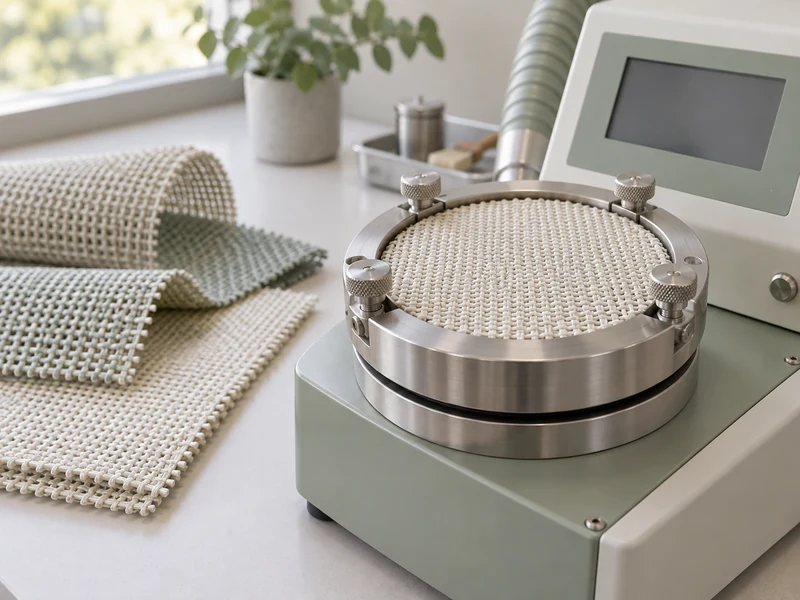
No, because the fabric is only one part of the conveying arrangement. The clamped textile sample characterizes the fabric under laboratory conditions; it leaves out the conveying channel, powder loading, incoming material condition, and exhaust arrangement that influence behavior after installation. The report helps control the fabric property but cannot replace system evaluation.
The site’s article on air slide system components explains those broader relationships. Use it to identify other information needed for an application review. Keep a clear separation between a textile acceptance test and a conveying trial.
For an air slide system, ask how the proposed fabric property range relates to the specific design. The answer should address the powder and operating requirements. “Higher permeability” is not a complete engineering objective.
What Does a Practical Comparison Look Like?
Suppose Supplier A and Supplier B report different numerical values, but one uses a different pressure difference. The first action is to align the test basis, not rank the offers. After matched testing, the difference may narrow, remain, or reveal variation within one lot.
In another illustrative case, both averages meet the specified range, but one roll includes isolated low readings. Review the acceptance rule and sampling evidence. An average-only decision and an individual-location decision can produce different outcomes, so the rule must not be invented after the results arrive.
These examples are decision frameworks rather than product data. The actual acceptable range must come from the application and agreed specification. A generic article cannot establish it for an unknown powder and conveying geometry.
Which Other Records Should Remain Linked to the Report?
Keep the report with the roll identification, purchase specification, inspection decision, and eventual installation location. This traceability allows a later operating issue to be connected to the supplied material. Without it, a valid report may become impossible to associate with the installed fabric.
Record relevant dimensional and visual checks separately. Permeability testing does not establish that the delivered fabric has the correct width, edge condition, or construction. Those requirements need their own acceptance evidence.
The site’s broader air slide fabric selection guide can support the remaining specification review. Keep the permeability report as one controlled record within that package. Do not let it become a proxy for every property of the fabric.
What Should Happen to a Disputed Roll?
Keep the material identifiable and separate from released stock while the discrepancy is reviewed. Record which specimens were removed and preserve the remaining evidence needed for a comparative test. Cutting or installing the roll before resolution can make the original disagreement harder to investigate.
Agree who authorizes release, retesting, replacement, or another disposition. The decision should reference the original acceptance rule and the resolved evidence. This creates a clear record for both the receiving team and the supplier instead of leaving an informal exception attached only to an email.
What Should a Buyer Ask Zonel Filtech to Provide?
Request the test method, conditions, units, specimen plan, individual results, summary, and lot identification. Include the application’s agreed acceptance range and the proposed resolution process for disputed results. This makes the quotation and receiving inspection use the same technical language.
If the existing specification is incomplete, identify the missing fields before ordering a large quantity. A small matched test can resolve uncertainty more efficiently than arguing over incompatible certificates after delivery. The outcome should be a reproducible comparison that both the plant and supplier can use for future lots.