
Filter presses remove water from sludge in batches by forcing liquid through cloth, while decanter centrifuges separate solids continuously using rotational force. The better choice depends on sludge behavior and the required operating pattern.
Evaluate cake solids, solids capture, filtrate or centrate quality, chemical use, capacity, and costs under representative conditions before specifying equipment.
How Do Filter Presses and Decanter Centrifuges Work?
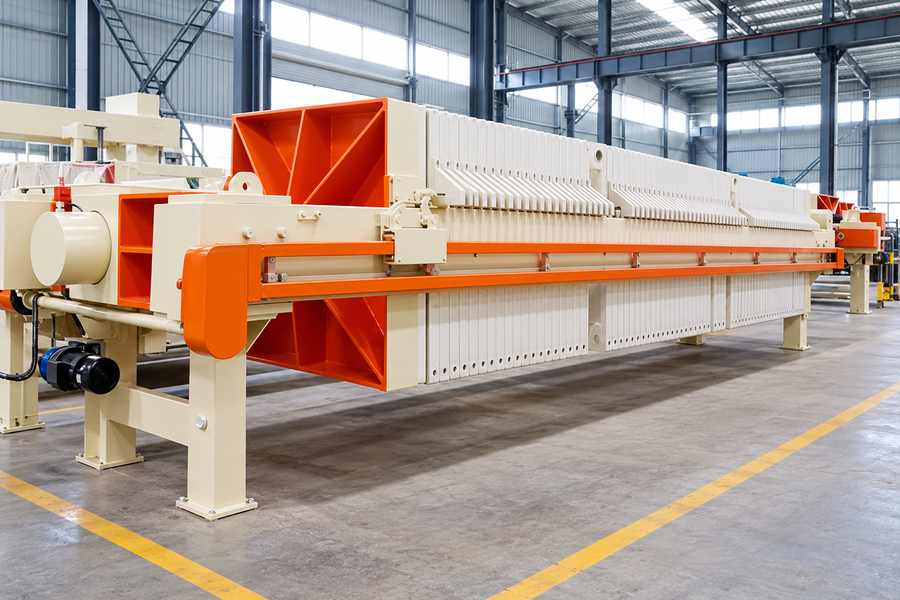
Batch Chamber and Membrane Filter Presses
A recessed-chamber filter press pumps sludge into cavities between closed plates. Liquid passes through filter cloth while retained solids gradually build a cake inside each chamber.
The operating sequence includes filling, pressure filtration, depressurization, plate opening, and cake discharge. Cloth cleaning or cake removal may extend the time before another batch begins.
A membrane press adds a squeezing stage after initial filtration, using flexible membranes to compress formed cakes. Sludge trials must establish how much extra water the squeeze stage removes under the intended operating conditions.
Plate-closing hydraulic pressure keeps the press sealed, whereas slurry feed pressure drives filtration. These must be specified, monitored, and assessed as separate operating variables.
The relevant capacity is dry solids processed over the complete cycle, including discharge and preparation, rather than the instantaneous flow rate during initial filling.
Continuous Decanter Centrifuges
A decanter feeds sludge into a rotating bowl, where centrifugal acceleration promotes separation. A scroll conveyor transports settled solids toward discharge while clarified liquid leaves separately.
Feed rate, bowl speed, differential speed, and conditioning influence solids retention, cake dryness, and centrate quality. Continuous discharge avoids batch opening but requires stable upstream and downstream handling.
Which Sludge Characteristics Affect Dewatering Performance?
Solids Concentration and Separation Behavior
Feed solids concentration determines how much liquid accompanies each unit of dry solids. Equipment comparisons should therefore use measured dry-solids loading, not volumetric feed rate alone.
Fine particles and compressible solids can form resistant filter cakes, slowing drainage through a press. Their behavior in a decanter also depends on particle separation and aggregation.
Filterability and centrifugal settling behavior are different characteristics. A successful filtration trial describes pressure-driven drainage; centrifugal separation still requires its own evaluation.
Composition and Chemical Conditioning
Biological, mineral, precipitated, and mixed sludges may require different conditioning. Polymer selection and dosage should be tested against cake properties, liquid quality, and solids recovery.
Oily material can complicate drainage or cake release; abrasive solids may accelerate equipment wear. Corrosive constituents require reviewing wetted materials and cleaning compatibility for either technology.
Feed Variability
Sampling should cover ordinary operation and difficult conditions, including shifts in solids concentration or composition. A favorable single sample may conceal throughput limitations or unstable separation.
Where feed changes are substantial, establish an expected operating envelope and identify which changes call for new conditioning trials rather than routine setpoint adjustments.
Filter Press vs Centrifuge: How Do Their Results Compare?
Use these criteria to structure the first equipment review. It is a screening guide, not a prediction of what either machine will achieve with a particular sludge.
| Evaluation factor | Chamber or membrane filter press | Decanter centrifuge |
| Separation | Pressure filtration through cloth | Centrifugal separation in a rotating bowl |
| Production mode | Batch, with intermittent cake discharge | Continuous feed and cake discharge |
| Cake dryness | Influenced by filterability, cycle endpoint, optional squeeze | Influenced by feed properties, speed, and conditioning |
| Sustainable capacity | Dry solids per complete cycle and available hours | Dry solids per hour at stable operating conditions |
| Liquid stream | Filtrate quality depends on cloth, cake formation, and operation | Centrate quality depends on separation settings and conditioning |
| Solids recovery | Measure solids retained in discharged cake | Measure solids retained in discharged cake |
| Key upkeep | Cloth, plates, hydraulics, cake release | Scroll, bearings, wear surfaces, vibration |
Which Produces Drier Cake?
For some sludges, pressure filtration can deliver a drier cake, especially when membrane squeezing is effective. Other feeds may not justify the added stage or longer cycle.
Dryness matters because retained water contributes to the wet mass transported or disposed of. Still, pursuing maximum dryness can reduce capacity or increase resource consumption.
Compare cake solids on a consistent dry-mass basis, and check whether the discharged material can be conveyed, stored, or loaded without unacceptable handling problems.
What About Solids Capture and Liquid Quality?
Cake dryness is not the same as solids capture. A relatively dry cake does not establish how much feed solids escaped into filtrate or centrate.
Measure suspended solids or another agreed liquid-quality indicator alongside recovered cake solids. Poor liquid quality can increase recycle loads or burden subsequent wastewater treatment.
Both systems involve trade-offs among dryness, capture, chemical use, and processing rate. Identify the acceptable combination instead of optimizing a single result in isolation.
What Are the Operational and Cost Differences?
Batch Scheduling and Continuous Flow
Presses may need feed holding capacity while plates open and cakes discharge. The whole process must coordinate pumping, cake conveying, container availability, and operator or automated interventions.
Decanters can support continuous sludge treatment, provided incoming feed and cake removal remain dependable. Continuity offers little benefit if storage or downstream handling becomes the bottleneck.
Installation and Maintenance
Press layout should allow plate travel, cloth access, safe cleaning, and unobstructed cake discharge. Automation can reduce routine intervention, but does not remove inspection and service needs.
Decanter installations require appropriate foundation support, vibration consideration, noise management, and access for rotating-component maintenance. Wear exposure depends strongly on the actual sludge and duty.
Inspection intervals should reflect abrasive exposure, cloth condition, and actual running hours; planned maintenance affects the number of operating hours available for sludge treatment.
Compare the Entire Operating Cost
Include feed pumping, bowl and scroll drives, optional membrane squeezing, chemical conditioning, cleaning, and standby consumption within a clearly defined energy boundary.
Also account for cloth or wear-part replacement, maintenance labor, operator coverage, cleaning downtime, and disposal charges. Equipment purchase cost alone cannot establish operating economy.
Where discharge charges depend on wet mass, cake dryness can materially affect cost. Evaluate that effect together with solids capture and achievable dry-solids throughput.
How Should You Test Sludge Before Selecting Equipment?
Establish a Comparable Test Basis
Start with required dry-solids throughput, available operating hours, acceptable cake solids, and liquid-quality limits. Document the sludge source, solids concentration, temperature, and expected variation.
Agree on sampling methods, conditioning boundaries, measurement instruments, and what constitutes stable operation. The comparison is unreliable when each technology is tested against a different objective.
A practical trial record should cover the following measurements for both options, with units and sampling times clearly stated.
| Measurement | Why it matters |
| Feed dry-solids concentration and flow | Defines actual solids loading |
| Cake dry-solids concentration | Indicates water remaining in discharged material |
| Feed, cake, and liquid solids mass balance | Supports measured solids capture |
| Filtrate or centrate suspended solids | Indicates return-load or treatment impact |
| Conditioning dose per dry-solids mass | Makes chemical demand comparable |
| Energy per dry-solids mass | Compares consumption under a common boundary |
| Complete press cycle or sustained decanter run | Establishes practical processing capacity |
Run Representative Trials
Test normal and challenging sludge samples, not only an easily dewatered batch. Vary conditioning deliberately, recording dosage, mixing method, and any changes in feed properties.
For presses, select appropriate cloth and chamber configuration, then record filling, filtration, optional squeeze, depressurization, plate opening, cake discharge, and necessary cleaning time.
For decanters, examine stable operation across reasonable feed and separation settings. Record differential speed, relevant process conditions, cake discharge consistency, and centrate quality during each run.
Avoid equating brief peak performance with sustained duty. If early trials are small-scale, plan pilot or full-scale confirmation before committing to final equipment sizing.
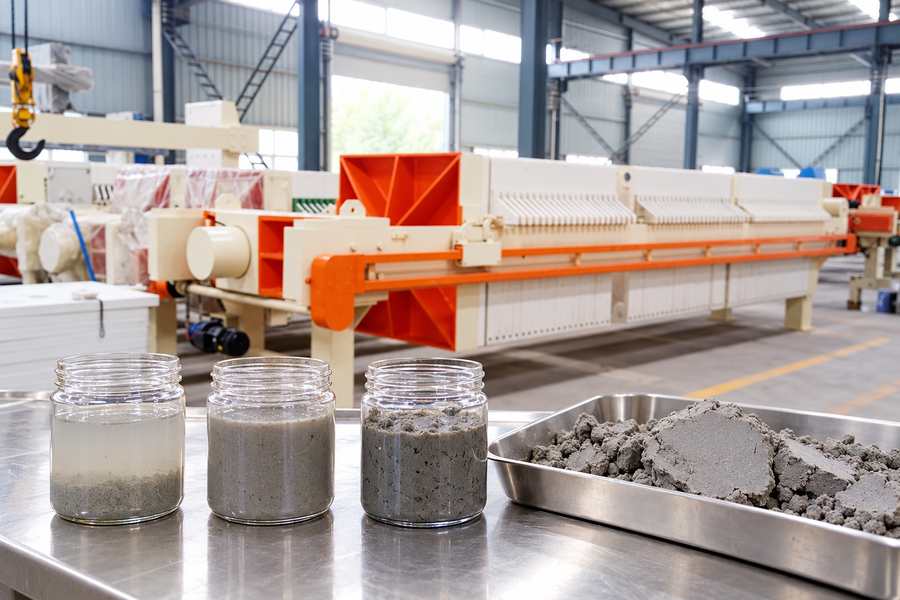
Compare Results on a Dry-Solids Basis
Express capacity as dry-solids mass processed per hour, incorporating every stage of a press cycle. For decanters, use representative sustained results rather than short-lived feed peaks.
Check solids balances and measurement uncertainty before ranking options. A lower liquid-solids reading is useful only when sampling, flow accounting, and laboratory methods are comparable.
Assess different sludge conditions against the plant’s operating window. The preferred machine should meet required performance repeatedly, not merely achieve one impressive laboratory result.
Which Sludge Dewatering Equipment Should You Choose?
When a Filter Press Fits
Choose pressure filtration for further evaluation when batch scheduling is workable and trials demonstrate the required cake condition, filtrate quality, and cycle-based dry-solids capacity.
Zonel Filtech supplies chamber and membrane filter presses with optional automation. Configuration should follow sludge testing, required plate access, cake discharge arrangements, and site constraints.
For certain sealing applications, its rubber edge-coated filter press cloth may merit review; suitability depends on plate design, slurry properties, and sealing requirements, not sludge category alone.
When a Decanter Fits
Consider a decanter when continuous operation is valuable and representative trials confirm acceptable cake dryness, centrate quality, solids capture, and sustained loading without excessive conditioning demands.
The plant must also support rotating-equipment maintenance and reliable continuous cake handling. These requirements belong in the same decision as dewatering results.
Information to Prepare for Equipment Selection
Provide sludge analyses, expected variability, dry-solids throughput, operating schedule, target cake solids, liquid discharge criteria, and chemical restrictions. Include available utilities and site access constraints.
Use the resulting trial records to define capacity, configuration, maintenance provisions, and measurable acceptance criteria before issuing the final equipment specification.