
Filter bag size #1 and #2 are both common industrial liquid filtration sizes, but they are designed for different operating needs. The main difference is length: #1 is shorter, while #2 is longer. Because of this, #2 filter bags usually provide more surface area, higher dirt-holding capacity, higher flow potential, lower pressure drop at the same flow rate, and longer service life.
For small or medium-flow systems, #1 filter bags may be enough. For higher-flow industrial systems, continuous operation, or applications with heavier particle loading, #2 filter bags are often the better choice.
What Is a Filter Bag?
A filter bag is a replaceable filtration element installed inside a bag filter housing. Liquid enters the housing, flows through the filter bag media, and particles are captured either inside the bag or on the bag surface. The cleaned liquid then exits the housing.
Industrial filter bags are usually made from materials such as:
- Polypropylene felt
- Polyester felt
- Nylon mesh
- Polypropylene mesh
- Polyester mesh
- Oil-absorbent media
- High-efficiency multi-layer media
They are available in different micron ratings, such as 1 micron, 5 micron, 10 micron, 25 micron, 50 micron, 100 micron, 200 micron, and higher. Pentair’s industrial liquid filter bag data shows available media ratings from 1 to 1500 microns, depending on the filter bag type and application.
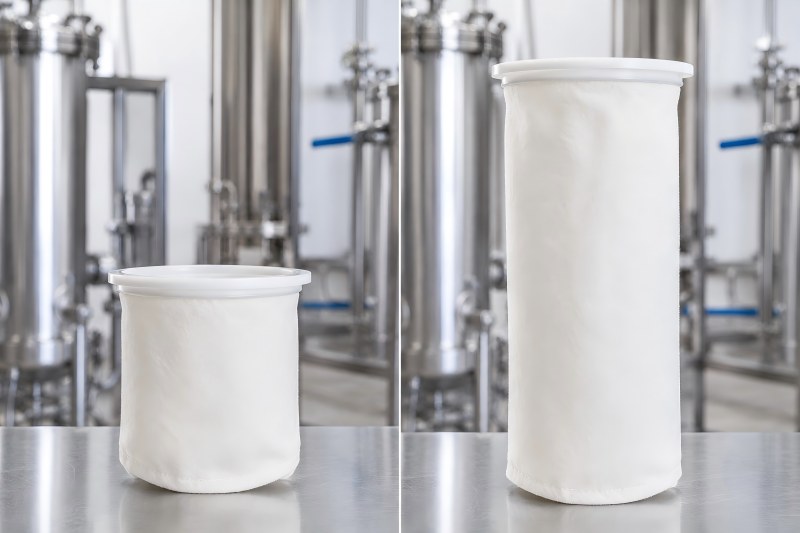
Basic Difference Between Filter Bag Size #1 and #2
The simplest difference is this:
Size #1 filter bag is shorter. Size #2 filter bag is longer.
In many industry-standard designs, both #1 and #2 bags have a diameter of about 7.06 inches, but #1 is about 16.5 inches long, while #2 is about 32 inches long. Critical Process lists size #1 as 7.06 in × 16.5 in and size #2 as 7.06 in × 32.0 in. Pentair also lists standard #1 as 7 1/16 in × 16 1/2 in and standard #2 as 7 1/16 in × 32 in.
Size #1 vs #2 Quick Comparison
| Item | Filter Bag Size #1 | Filter Bag Size #2 |
| Common diameter | 7.06 in / 179 mm | 7.06 in / 179 mm |
| Common length | 16.5 in / 419 mm | 32 in / 813 mm |
| Length type | Single length | Double length |
| Surface area | Smaller | Larger |
| Dirt-holding capacity | Lower | Higher |
| Flow capacity | Lower | Higher |
| Housing size | #1 housing | #2 housing |
| Change-out frequency | More frequent | Less frequent |
| Best for | Medium or lower flow | Higher flow and heavier loading |
Surface Area Difference
Surface area is one of the biggest performance differences between filter bag size #1 and #2. A larger surface area allows more liquid to pass through the media at a lower filtration velocity. This can reduce pressure drop and increase dirt-holding capacity.
Pentair lists a standard #1 filter bag with about 2.0 sq. ft. of surface area and a standard #2 filter bag with about 4.4 sq. ft. of surface area. This means a #2 filter bag can provide more than double the filtration area of a #1 bag in many standard designs.
Some high-performance filter bags may have different surface areas because of special media construction. For example, Eaton technical data for certain filter bag ranges lists size 01 with 2.6 sq. ft. and size 02 with 5.2 sq. ft. of filter area.
Why Surface Area Matters
A larger filtration area can help:
- Reduce clean pressure drop
- Improve flow stability
- Increase contaminant-holding capacity
- Extend filter bag service life
- Reduce change-out frequency
- Lower maintenance labor
- Reduce production downtime
If the process liquid contains a high amount of suspended solids, a #2 filter bag is often more suitable because it can hold more particles before reaching the pressure drop limit.
Flow Rate Difference
Because #2 filter bags are longer and have more surface area, they usually support higher flow rates than #1 filter bags. However, the actual flow rate depends on liquid viscosity, micron rating, filter media, particle loading, and pressure drop limit.
Eaton’s filter bag brochure shows that maximum flow rates vary by product range. For some filter bag types, size 01 is listed at 15 m³/h, while size 02 is listed at 30 m³/h. Other special bags have lower limits depending on design and media type. Critical Process also notes that the recommended flow rate for a single #2 bag should not exceed 110 GPM under its stated test conditions for certain CB bag filters.
General Flow Selection
| Application Condition | Better Choice |
| Low to medium flow | #1 filter bag |
| High flow | #2 filter bag |
| Limited installation space | #1 filter bag |
| Heavy solids loading | #2 filter bag |
| Frequent clogging problem | #2 filter bag |
| Compact filtration skid | #1 filter bag |
| Longer service interval needed | #2 filter bag |
A #1 filter bag can work well when the flow rate is moderate and the liquid is relatively clean. A #2 filter bag is usually better when the system needs higher flow, longer filter life, or fewer change-outs.
Housing Compatibility
Filter bag size must match the filter housing. A #1 filter bag is designed for a #1 bag filter housing, while a #2 filter bag is designed for a #2 bag filter housing.
Even though both sizes may have a similar diameter, the length is different. A #1 bag is too short for a #2 housing, and a #2 bag is too long for a #1 housing. Incorrect sizing may cause leaks, bypass, collapse, or filtration failure.
Before ordering replacement filter bags, always check:
- Housing model
- Bag size number
- Basket length
- Ring or flange type
- Seal material
- Micron rating
- Operating temperature
- Chemical compatibility
- Flow rate
- Pressure drop limit
The size number alone is not enough. Two filter bags may both be size #2, but one may have a polypropylene ring, another may have a steel ring, and another may have a special plastic flange. The ring design must match the housing sealing structure.
Dirt-Holding Capacity Difference
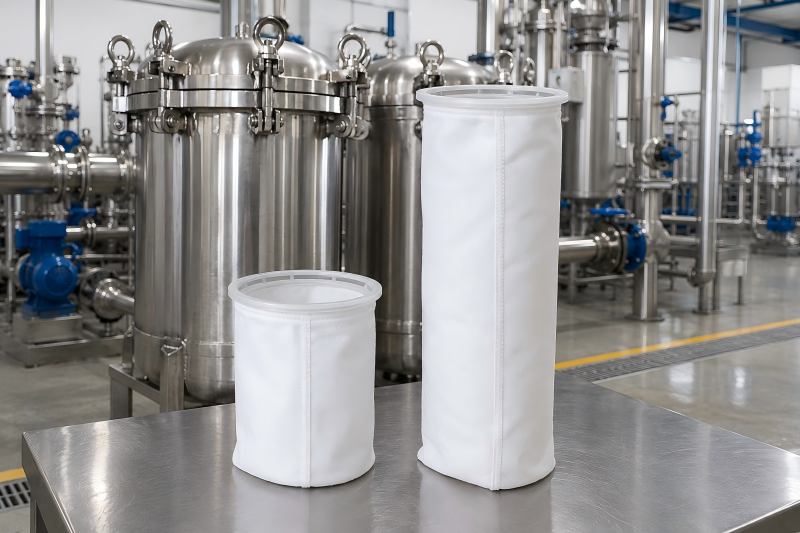
Dirt-holding capacity means how much contaminant the bag can collect before it needs to be replaced. Since #2 filter bags are longer and have more media area, they usually hold more dirt than #1 filter bags.
This is especially important in applications such as:
- Wastewater pre-filtration
- Paint and coating filtration
- Chemical batch processing
- Cooling water filtration
- Metalworking fluid filtration
- Oil and lubricant filtration
- Food processing liquid filtration
- Raw water filtration
If a #1 filter bag clogs quickly, switching to a #2 housing and #2 bag may reduce change-outs. This can save labor cost and reduce process interruptions.
However, if the system has very light solids loading, a #1 filter bag may be enough. In that case, using #2 may not be necessary unless the process requires longer service intervals.
Pressure Drop Difference
Pressure drop is the resistance created when liquid flows through the filter bag. A small filter area, fine micron rating, high viscosity, or high solids loading can increase pressure drop.
A #2 filter bag usually has a lower pressure drop at the same flow rate because it has a larger filtration area. This allows liquid to pass through the media more easily.
Common Pressure Drop Situations
| Problem | Possible Reason | Suggested Solution |
| Pressure rises too quickly | Bag area too small | Use larger bag size or lower micron rating carefully |
| Frequent bag replacement | High dirt loading | Use #2 bag or multi-bag housing |
| Low outlet flow | Bag clogged or undersized | Increase filter area |
| Bag rupture | Pressure drop too high | Replace bag earlier and check housing design |
| Poor filtration result | Wrong micron rating or bypass | Check seal, ring, and media |
A #2 filter bag is often chosen when the process needs more stable pressure drop and longer operating cycles.
Cost Difference
A #2 filter bag usually costs more than a #1 filter bag because it uses more material. However, the total filtration cost is not only the purchase price of one bag.
The real cost should include:
- Bag purchase cost
- Labor for replacement
- Downtime cost
- Waste disposal cost
- Product loss during change-out
- Frequency of filter replacement
- Risk of poor filtration
For example, if a #1 filter bag needs to be replaced twice as often as a #2 bag, the lower unit price may not mean lower total cost. In many industrial systems, #2 filter bags can be more economical because they reduce replacement frequency.
When Should You Choose Filter Bag Size #1?
Choose a #1 filter bag when:
- The flow rate is low to medium
- The filtration system is compact
- Installation space is limited
- The liquid has low solids content
- Batch volume is not very large
- A #1 housing is already installed
- Frequent replacement is acceptable
- Initial equipment cost needs to be lower
Size #1 is common in small and medium process systems. It is also useful for pilot systems, small batch filtration, compact skids, and applications where space is more important than maximum dirt-holding capacity.
When Should You Choose Filter Bag Size #2?
Choose a #2 filter bag when:
- The flow rate is higher
- The liquid contains more suspended solids
- Longer service life is required
- Fewer change-outs are preferred
- Pressure drop must stay stable
- The process runs continuously
- Maintenance downtime is expensive
- A #2 housing is already installed
Size #2 is one of the most widely used industrial liquid filter bag sizes because it offers a strong balance of flow capacity, dirt-holding capacity, availability, and cost efficiency.
#1 vs #2 Filter Bag: Which One Is Better?
There is no single answer. The better choice depends on your process.
If you need a compact, lower-flow filtration solution, size #1 may be the better choice. If you need higher flow, longer service life, and better dirt-holding capacity, size #2 is usually better.
In simple terms:
Choose #1 for compact systems and lower flow. Choose #2 for higher flow and longer service life.
Final Selection Checklist
Before choosing between filter bag size #1 and #2, confirm the following:
- What filter housing size do you have?
- What is the required flow rate?
- What is the liquid viscosity?
- What micron rating is required?
- What type of particles need to be removed?
- How much dirt is in the liquid?
- What is the allowed pressure drop?
- What is the operating temperature?
- Is the liquid chemically compatible with the bag material?
- How often can the system stop for bag replacement?
The best selection should not be based only on bag size. It should also consider housing compatibility, micron rating, media material, seal type, liquid properties, pressure drop, operating temperature, and maintenance goals. The right filter bag helps improve efficiency, reduce downtime, and ensure better filtration results.